
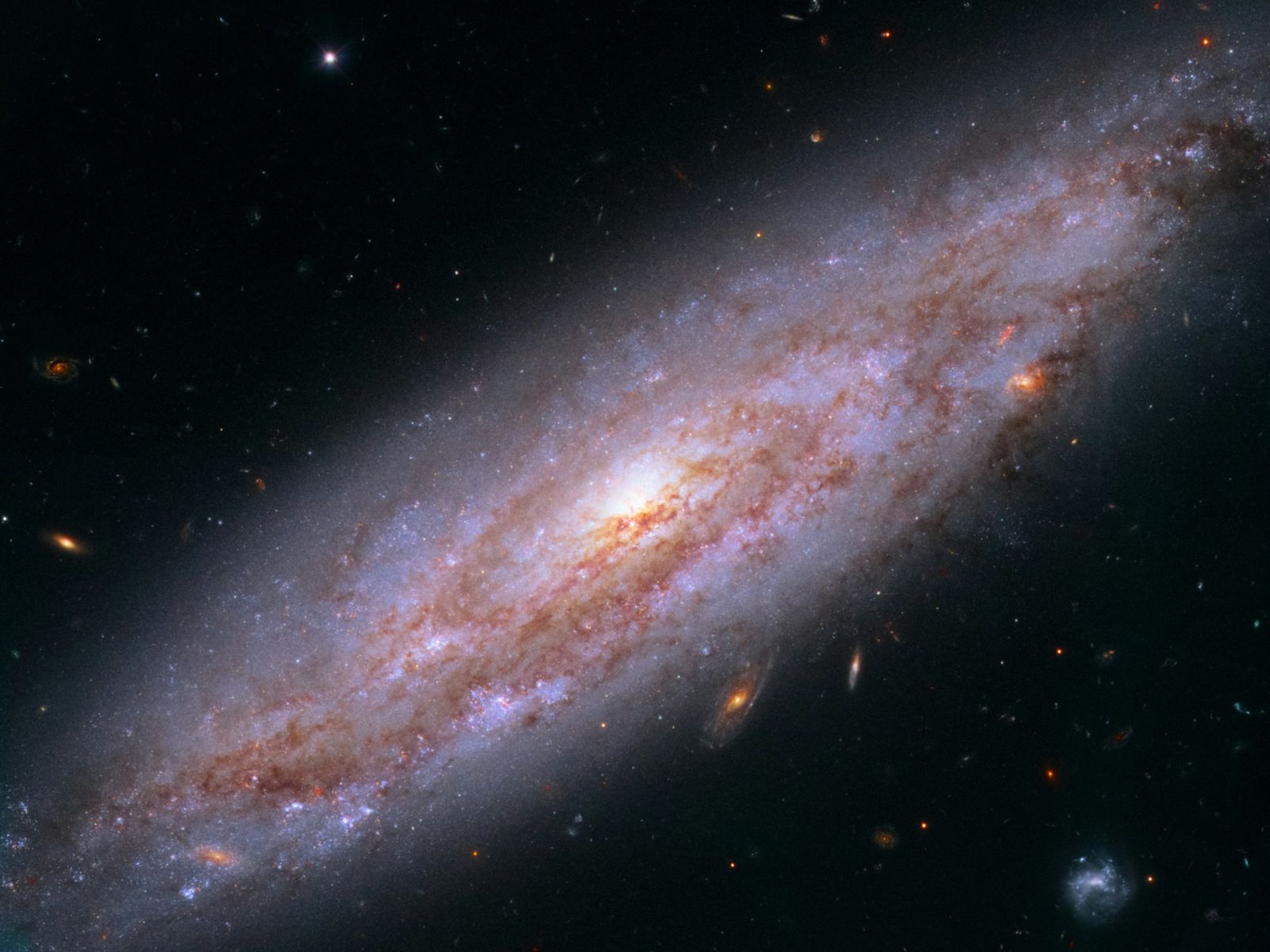
The spiral galaxy M88 may look calm in Hubble’s latest view, but that calm is only temporary. Behind its neat arms and bright core, astronomers see a system that is moving toward significant change.
NASA’s image shows M88 in striking detail, with a structure that appears orderly from a distance. Yet the galaxy sits in an environment where nearby interactions can reshape its future.
A bright core powered by a massive black hole
At the center of M88, the glow is intense. That brightness comes from a cluster of reddish stars surrounding a supermassive black hole with a mass of about 100 million times the Sun.
This crowded inner region makes the galaxy’s nucleus appear especially active. The mix of old stars, nearby material, and the black hole offers clues about the galaxy’s internal dynamics.
A spiral structure that still looks balanced
Hubble also captured M88’s outer arms with clear symmetry. Pink and blue star clusters stand out across the spiral pattern, while dust clouds add strong visual contrast.
That orderly appearance suggests the galaxy is still in a stable-looking phase. Even so, the stability is expected to be temporary because the surrounding cosmic environment continues to influence how M88 evolves.
Located deep inside the Virgo Cluster
M88 lies about 63 million light-years from Earth and spans roughly 121,000 light-years across. It is part of the Virgo Cluster, a vast region containing more than a thousand galaxies bound together by gravity.
Inside such a crowded setting, galaxies do not evolve in isolation. They move around the cluster’s center and can affect one another’s shape and development over time.
A future encounter that could change the galaxy
Within 200 to 300 million years, M88 is expected to come very close to M87. M87 is an elliptical galaxy that contains a supermassive black hole with a mass of about 6.5 billion times the Sun.
That approach is likely to trigger major changes in M88. The gas that serves as the raw material for new stars may be pulled out of the spiral galaxy, weakening its ability to keep forming stars.
If that gas loss continues, M88’s internal composition will shift as well. The galaxy would still exist, but its appearance and star-making capacity could change in ways that mark a very different stage in its evolution.
Source: www.notebookcheck.net-

-

-

-

