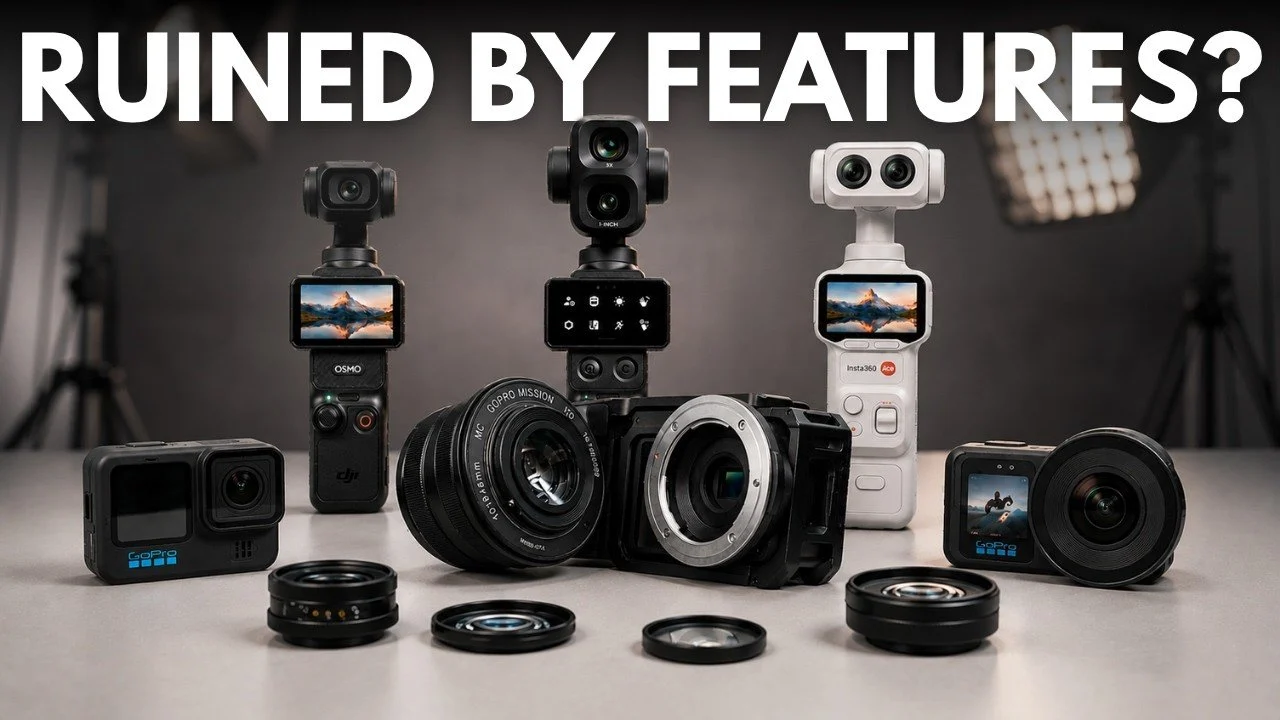
Creators are increasingly rethinking what they actually want from a camera. Instead of chasing the most feature-packed setup, many now prefer tools that get out of the way and let them shoot with less friction.
That shift is happening as the line between action cameras, smartphones, and mirrorless cameras continues to blur. Features that once defined a single category are now spreading across all of them, which gives creators more choice but also makes the buying decision more complicated.
More capability, more steps
Tech Court describes the creator camera market as moving toward hybrid devices. Action cameras are adding cinematic functions, smartphones are gaining advanced stabilization and high-quality audio, and mirrorless cameras are becoming more compact without losing flexibility.
On paper, that sounds like progress for everyone. In daily use, though, it often means more settings to adjust, more accessories to carry, and more technical decisions to make before recording even starts.
For creators who value speed, that extra preparation can become a problem. Time that should go into telling a story is instead spent managing gear, checking power, and making sure everything works together.
When compact gear starts acting like a studio
The rise of modular systems has made camera gear more versatile, but it has also made workflows heavier. Interchangeable lenses, professional audio setups, and additional modules can all improve creative control, yet each one adds a layer of setup and compatibility checking.
That is why modern cameras can feel less like simple tools and more like miniature production systems. They may offer more control than ever, but they also demand more attention before filming begins.
For spontaneous creators, that trade-off matters. A device that slows down the start of shooting can work against the very process it is supposed to support.
Examples of the shift
GoPro Mission 1 Series shows how far action cameras have moved beyond their original role. The product is described as bringing cinema-level capabilities, including interchangeable lenses and a professional audio workflow.
DJI Pocket 4P follows a similar direction. What was once known as a compact, stable camera for casual use has evolved into a filmmaking device with advanced controls, modular add-ons, and deeper cinematic capability.
Insta360 Luna Ultra pushes modularity even further. Creators can adapt the workflow through swappable components, but that flexibility also adds complexity to everyday use.
Category lines are getting harder to see
There was a time when buyers could separate camera types with relative ease. Action cameras were for mobility and durability, smartphones were for convenience, and mirrorless cameras were for image quality and creative control.
That clarity is fading. Smartphones now challenge dedicated cameras on image quality and features, while action cameras and compact cameras absorb capabilities that were once limited to professional systems.
As a result, each category is becoming less distinct. For creators, that overlap makes it harder to know which device truly fits the job, especially when many products now promise similar abilities.
Why simplicity is becoming a premium feature
Tech Court notes that many creators are now looking for tools that feel intuitive and easy to use. In a fast-moving creator culture, spontaneity and simplicity are increasingly seen as premium qualities.
The appeal is straightforward. When gear is easy to deploy, creators can focus on content instead of managing accessories, modules, and technical workflows.
That preference also reflects a wider change in buying behavior. Raw specifications still matter, but efficiency and ease of use are becoming just as important for people who need to work quickly and naturally.
What manufacturers need to balance next
The next challenge for camera makers is finding the right balance between innovation and usability. Advanced features still have value, but that value drops if the setup process becomes too demanding.
Devices that reduce friction and simplify the workflow are likely to fit creator needs more closely. In a crowded market full of feature-rich products, intuitive design may become the most important difference.
That is why the move away from complex camera setups is not simply about avoiding new technology. For many creators, it is about working faster, carrying less, and staying focused on the story instead of the gear.
Source: www.geeky-gadgets.com-
-
-
-