AMD’s latest move in gaming CPUs looks designed to give buyers more options across both old and new platforms, but the pricing may undercut the appeal before these chips even reach shelves. The renewed Ryzen 7 5800X3D and Ryzen 7 7700X3D Anniversary Editions bring familiar names back into focus, yet their official price tags make the story harder to defend than the specs alone suggest.
On paper, both processors still target the same audience that made AMD’s X3D lineup so popular: gamers looking for strong performance without jumping to the company’s very top-end chips. In practice, they enter a market where AMD already has faster gaming CPUs at the top and where Intel’s 270K Plus is described as the cheaper alternative.
A revived classic on AM4


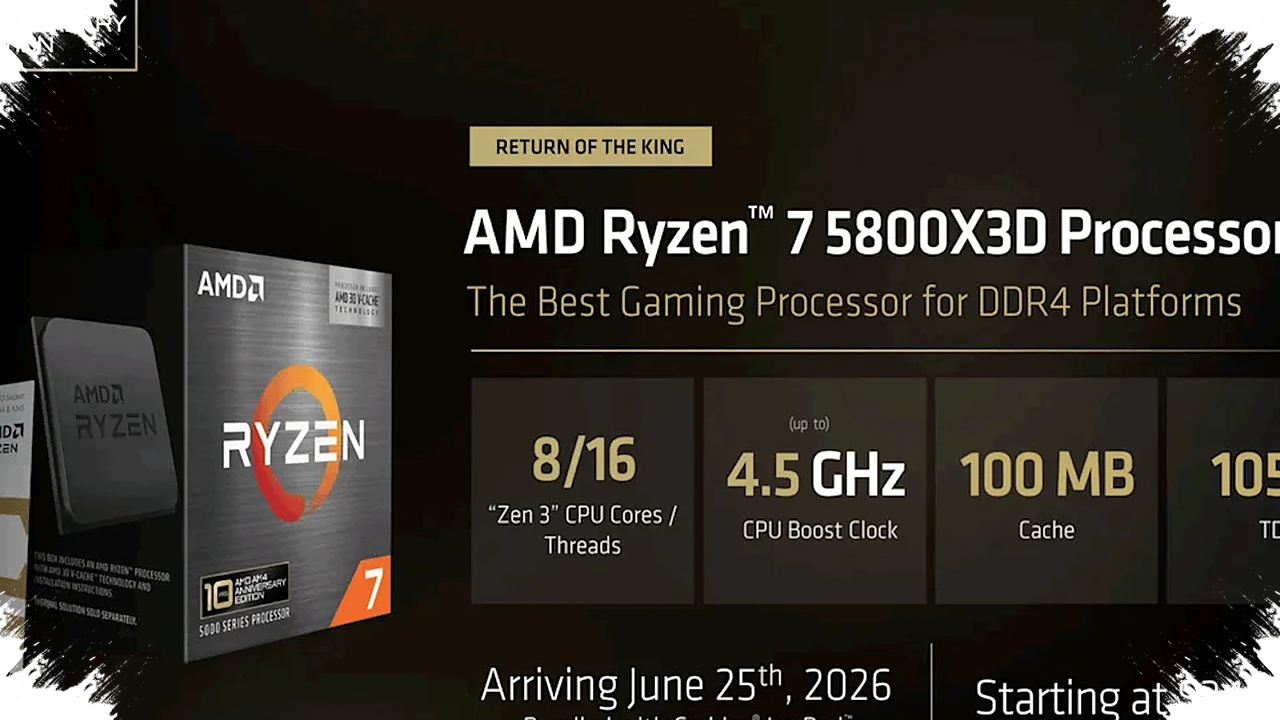
The Ryzen 7 5800X3D Anniversary Edition is essentially a return of one of AMD’s most recognizable CPUs from recent years. It was the first processor to feature 3D V-Cache and earned attention for its strong raw gaming performance.
Its hardware remains unchanged from the earlier version. AMD keeps the chip at eight cores and 16 threads, with boost clock speeds up to 4.5GHz and a 105W TDP.
The chip also continues to use the AM4 socket and DDR4 memory. That combination can still help keep total build costs lower for gamers who are not moving to AMD’s newer platform.
The price makes the value case difficult
The problem starts with the suggested $350 price. That figure is higher than the newer 7700X3D and also sits above Intel’s 270K Plus.
That makes the revived 5800X3D harder to recommend purely on value. Its platform may be cheaper to build around, but the CPU itself is priced in a way that weakens that advantage.
7700X3D brings newer platform support
The Ryzen 7 7700X3D follows a different strategy. It uses the AM5 socket and the Zen 4 architecture, which makes it the more modern option of the two.
It also carries eight cores and a 4.5GHz boost clock, so the basic headline specifications land very close to the 5800X3D. Its main appeal comes from the platform rather than a dramatic spec jump.
AM5 support gives it access to faster memory and newer motherboard features. That makes the chip more relevant for current-generation gaming systems.
Yet AMD’s suggested $330 price still leaves room for hesitation. It is cheaper than the 5800X3D, but it remains slightly above the 270K that is usually available at a lower price.
Internal competition does not help
Even before looking outside AMD’s lineup, the 7700X3D faces a familiar obstacle. The 7800X3D is technically discontinued, but it is still widely available at retail.
That matters because the older chip often sells at a price close to the 7700X3D. It also carries a 500MHz higher boost clock, which gives buyers who care mainly about gaming another reason to consider the older model instead.
This leaves the new Anniversary Editions in an awkward middle ground. They are not low-cost entry products, but they also do not clearly outclass the alternatives that remain on sale.
AMD appears to be trying to widen the X3D lineup for both AM4 and AM5 users, especially at a time when hardware prices still feel elevated. The two revived chips could fill useful gaps for budget-conscious gamers, but only if the pricing gives them enough room to stand out when they arrive on 25 June.