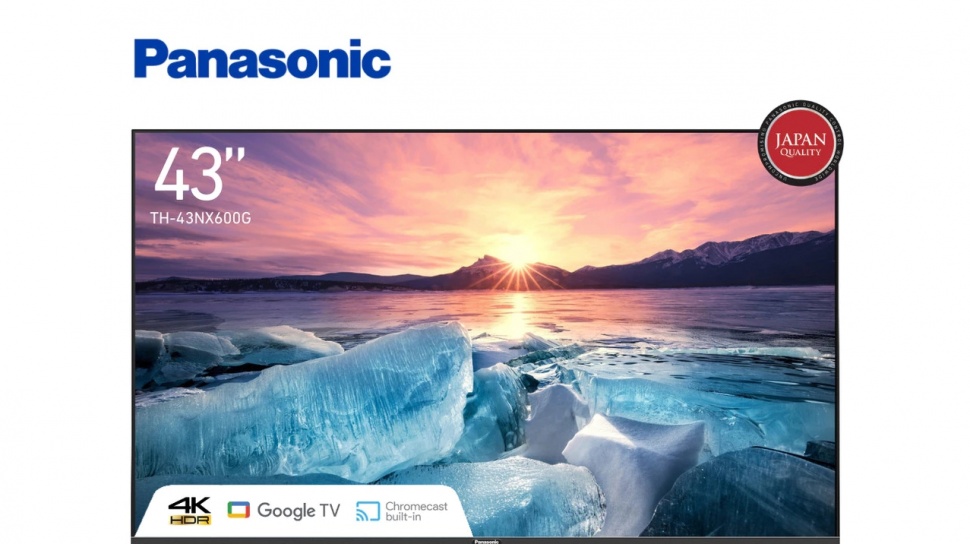
Panasonic’s TH-43NX600G is drawing attention not because of headline-grabbing size or aggressive pricing alone, but because of how it handles image depth on certain content. In 4K HDR YouTube viewing, the TV can automatically detect the HDR signal and adjust contrast in a way that makes the picture feel more layered and immersive.
That impression is supported by a combination of image processing, panel characteristics, and a practical smart-TV setup. With a listed price of Rp6.4 million on Panasonic’s official page, the TH-43NX600G sits in the midrange 4K segment while aiming to deliver a more refined viewing experience than its category might suggest.
A panel designed for wide-angle viewing

The TH-43NX600G uses an IPS panel, a choice that is known for broader viewing angles. That matters in a family room, where people often watch from different positions rather than directly in front of the screen.
Muhamad Sholekan, a senior technology reviewer at Candi Elektronik Solo, said the panel also offers a wide angle, anti-radiation characteristics, and deeper dark tones. He noted that dark scenes do not easily turn gray, which is important when watching films with heavy shadow detail.
Those traits help preserve atmosphere in darker sequences. They also make shadow areas look more defined, which can strengthen the drama in movies and other cinematic content.
Color treatment goes beyond standard RGB
Another point that stands out on this model is Panasonic’s Hexa Chroma Drive. The system uses six color reproductions instead of the more common RGB approach found in many TVs in the same class.
Sholekan explained that Panasonic adds colors such as magenta and purple to enrich the image. As a result, color transitions on water, fire, and skin tones can appear more natural and less flat.
That approach gives the TH-43NX600G a more vivid look when content contains complex gradients. In suitable scenes, the image can feel closer to real life rather than simply brighter or more saturated.
Google TV keeps the experience simple
The TH-43NX600G also runs on Google TV, which is meant to make content discovery easier. Instead of digging through layers of menus, users are presented with recommendations shaped by their viewing habits.
That setup helps the TV function as a more practical home entertainment hub. Access to streaming services is also more direct and organized.
Panasonic includes a compact remote control with shortcut buttons for Netflix, YouTube, and Prime Video. The remote also has a built-in microphone for voice commands through Google Assistant, making content search and certain functions more convenient.
A clean design with useful connectivity
Visually, the TV adopts a borderless design that gives it a more premium appearance. The thin frame makes the display look cleaner and helps it blend into a modern living room setup.
Connectivity is also fairly complete for a midrange model. Panasonic provides 3 HDMI ports, 2 USB Movie ports, Optical Audio, LAN, and AV In, giving users enough flexibility for external devices.
That arrangement makes it easier to connect a media player, console, or audio device without constantly swapping cables. For a household that uses multiple sources, the port selection adds practical value.
Why the picture can feel unusually immersive
The strongest impression comes from the way the IPS panel and Panasonic’s image processing work together. In one viewing description, Sholekan said the underwater visuals on the TV felt as if the viewer were “inside it,” and he added that no lines were visible on the fish.
That comment captures the sense of depth the TH-43NX600G can produce on certain content. When the material is suitable, the result is a viewing experience that feels fuller and more immersive than expected from a TV in this price range.
Source: www.suara.com