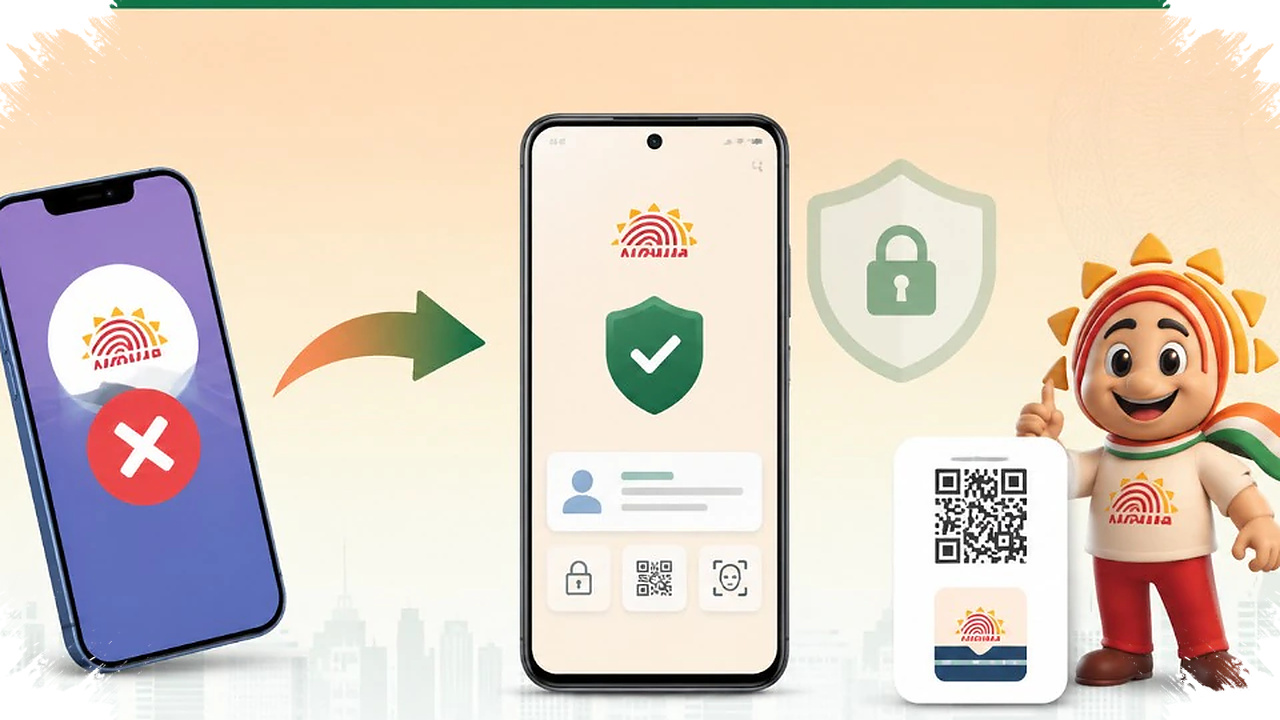
A new Aadhaar app is beginning to take over from mAadhaar, and the shift is changing more than just the interface. The new platform is designed to make identity verification stricter, more private, and more tightly controlled.
UIDAI introduced the new Aadhaar app in January 2026 with a framework aligned to the Digital Personal Data Protection Act. Its guiding principle is data minimisation, which means only the information needed for a specific verification should be shared.
Verification is moving toward less data exposure


The biggest change for users is how identity details are handled during verification. Instead of repeatedly handing over a physical Aadhaar copy or photocopy, the new system pushes verification toward QR-based digital checks and face authentication.
That approach limits how much of a person’s Aadhaar profile must be opened each time. In everyday situations such as hotel check-ins, hospital visits, age verification, or checks by service partners, the process can now rely on more limited data.
UIDAI is also encouraging faster adoption so that identity checks no longer depend on sharing the full Aadhaar profile every time it is needed. The older mAadhaar app can still be used for now, but the direction of service is clearly shifting to the new platform.
How the new app is set up
The latest Aadhaar app is available on both Android and Apple iOS. Users can download it from Google Play Store or Apple App Store.
Activation involves a more layered security process than the older mAadhaar setup. Users first open the app, choose a language, and enter the mobile number linked to their Aadhaar account.
The system then sends an OTP to the registered number. After that OTP is verified, the user must complete Face Authentication as a key part of the initial setup.
The next step is creating a six-digit security PIN. The app also offers biometric access for extra protection, and users then add the Aadhaar details requested by the app.
A final OTP round completes the process before the account becomes fully active.
Features that separate it from mAadhaar
One of the main additions is selective sharing. This allows users to share only the specific details required for verification, such as name, age, address, or photo.
The app also supports Aadhaar verification through QR, allowing digital identity checks without exposing unrelated information. Face Authentication is built directly into the verification flow to add another security layer.
Users can lock and unlock Aadhaar biometrics directly from their phone. That control covers fingerprints, iris data, and face authentication.
The app also includes Aadhaar usage tracking, letting users check when and where authentication has been used. This makes suspicious activity easier to monitor from a personal device.
Another practical feature is support for up to five Aadhaar profiles on one device. That can help families managing Aadhaar for children or elderly members who share the same mobile number.
Updates that no longer need a trip to a service center
The new app is also meant to make some data updates easier. Users are said to be able to update their mobile number and address directly from the phone instead of always visiting an Aadhaar service center.
UIDAI has also indicated that additional update services may arrive in later versions. That positions the app as more than a replacement for mAadhaar, turning it into a broader digital identity management hub.
For users who still rely on mAadhaar, the transition period is a practical time to move over. The earlier the new app is activated, the sooner its more private and secure verification flow can be used for daily needs.
Source: www.indiatoday.in