For many borrowers, the main question is not whether BRI has financing, but which product best fits the size and purpose of the funding need. When the ceiling of KUR is no longer enough, BRI’s non-KUR loan options become the more relevant comparison point because they offer broader purposes, higher ceilings, and more room to adjust the tenor.
That flexibility matters for people who are planning a home purchase, a vehicle purchase, consumer spending, or business expansion. It also makes the loan simulation and installment table an early filter before any application is submitted, since the monthly payment must still fit the borrower’s cash flow.
A wider lending menu beyond KUR
BRI’s non-KUR financing is designed for several customer segments, including individuals, MSME actors, and corporates. This makes the product line broader than micro-business lending alone and gives borrowers access to credit for assets as well as personal needs.
The main appeal lies in the larger loan ceilings compared with KUR. For borrowers who need more financing and want payment terms that can match their repayment capacity, this line of credit offers more room to choose.
Property financing comes with the highest ceiling
For housing needs, BRI offers Kredit Pemilikan Rumah, or KPR. The product is intended for people who want to buy a house, apartment, shop house, or office-house unit through a flexible financing scheme.
The KPR lineup includes BRI KPR Primary, BRI KPR Secondary, BRI KPR Top Up, BRI KPR Sejahtera FLPP, KPR Green Financing, and BRI KPR Solusi. In this segment, the loan ceiling can reach Rp10 miliar with a tenor of up to 20 years.
Vehicle financing is handled through KKB
For transportation needs, BRI provides Kredit Kendaraan Bermotor, or KKB. This facility covers four-wheeled and two-wheeled vehicles, including new cars, used cars, vehicle refinancing, Car Ownership Program (COP), and Motorcycle Ownership Program (MOP).
This product gives borrowers a way to match vehicle financing with a specific use case rather than relying on a generic loan structure. The result is a more targeted financing option for people who need a car or motorcycle with a repayment plan that fits the selected tenor.
Payroll-based multiguna credit serves consumer needs
BRI also has a Multiguna product for customers with fixed income. This credit is specifically intended for borrowers who have a payroll or salary account with BRI, and repayment comes directly from their monthly salary.
Because it is aimed at consumer use, this option fits borrowers who need funding for personal purposes and already have a salary flow through BRI. That structure makes the payment source clear from the start and helps keep the installment arrangement more orderly.
Kupedes remains part of the non-KUR set
Outside property, vehicle, and payroll-linked consumer credit, BRI also provides Kupedes BRI as one of its non-KUR lending choices. The product sits within the list of financing services that borrowers can consider according to their needs.
That broader lineup shows that BRI’s lending options are not limited to one type of customer or one type of use. The available products can be matched to property purchases, mobility needs, consumer spending, or business requirements depending on the borrower profile.
Why the installment simulation matters first
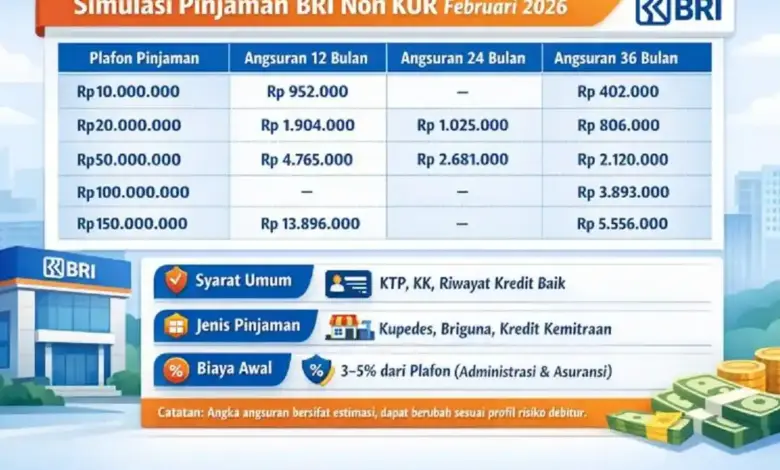
Even with many options available, borrowers still need to check the installment simulation before deciding. The size of the monthly payment has a direct effect on household finances, so the loan amount and tenor should be tested in advance.
The simulation helps borrowers align the loan value with the chosen repayment period. This lowers the risk of installments exceeding payment capacity and helps reduce the chance of late payments.
Long tenors can make monthly payments feel lighter, especially in large-ceiling products such as KPR. Still, the final decision should always reflect real needs and stable financial ability rather than the longest available repayment period.
The same logic applies to KKB and Multiguna. Borrowers are better served when the loan type matches the intended use of funds, since that makes the financing structure more precise and the repayment plan more manageable.
Who is most likely to benefit
BRI’s non-KUR loans are most relevant for people buying a home or vehicle through credit. They are also useful for salaried workers who want consumer financing through payroll-linked arrangements.
For business owners, non-KUR credit can be an alternative when funding needs move beyond KUR limits. With higher ceilings and more flexible tenor choices, the financing room becomes wider for business or investment needs.
Still, the key consideration is not only the loan size but also whether the product fits the purpose and the ability to pay regularly. KPR is more suitable for property, KKB for vehicles, Multiguna for consumer needs tied to payroll customers, while other products can be adjusted to the borrower’s profile and financing objective.