


For decades, astronomers have struggled to detect the magnetic fields of exoplanets by listening for radio signals. A new approach now looks at something more visible in comparison: the speed of atmospheric winds on ultra-hot gas giants.
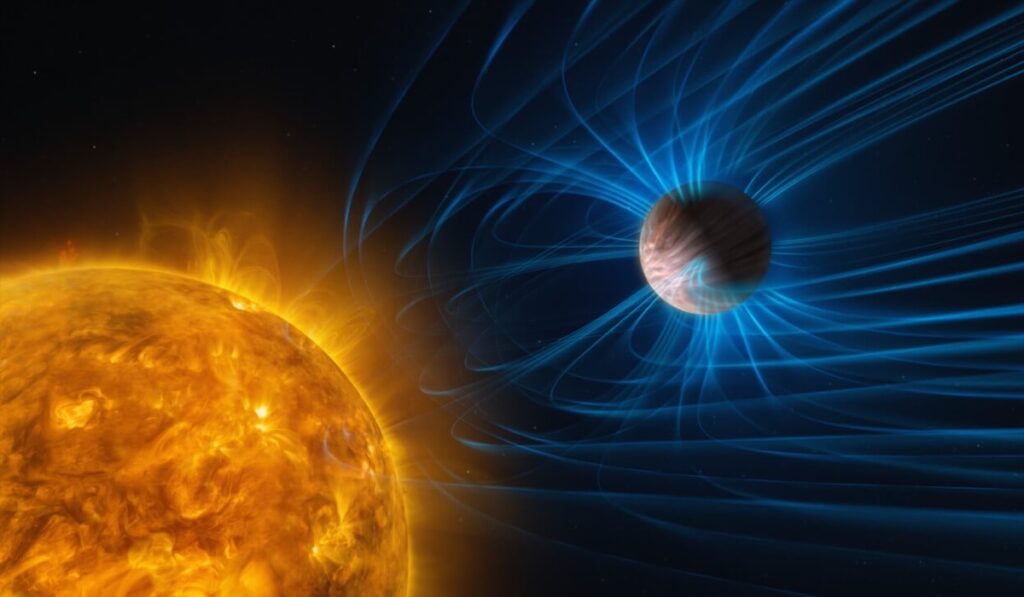
This shift matters because the winds themselves appear to reveal how strong a planet’s magnetic field may be. On some extremely hot worlds, the slowing of atmospheric flow points to a magnetic field acting like a brake on charged gas high in the atmosphere.
Reading Magnetism Through the Atmosphere
The study, published in Nature Astronomy, used observations from the Very Large Telescope in Chile and the Gemini North Telescope in Hawaii. Instead of chasing radio emission directly, the team tracked iron in the atmospheres of seven ultra-hot gas planets.
Iron absorbs starlight, which allowed the researchers to measure wind speeds across those distant worlds. The result was unexpected: as planetary temperature rose, the winds did not speed up as simple theory might suggest.
That pattern gave the researchers a new clue. Rather than seeing hotter planets with stronger and faster-moving air, they found evidence that something was limiting the flow.
A Magnetic Brake at Extreme Temperatures
On planets reaching temperatures of 1,650 degrees Celsius, measured wind speeds ranged from 4,500 to 15,500 miles per hour. Those numbers became a key part of the analysis, because they offered a way to infer how the atmosphere behaves under magnetic influence.
The interpretation points to magnetism slowing the motion of ionized gas. In that framework, the magnetic field works as a drag force, reducing wind speed even when the atmosphere is intensely heated.
That indirect method is important because a magnetic field cannot be seen directly. Its effect, however, can leave a measurable signature in the atmosphere through changes in wind behavior.
Why the Radio Silence May Not Mean Weak Science
The estimates from the study suggest that the magnetic fields of these planets are comparable to those of gas giants in the Solar System, including Jupiter and Saturn. That is far below the much stronger values predicted by older models.
This also helps explain why radio signals from hot exoplanets have remained so difficult to detect from Earth. The lack of radio evidence does not necessarily mean the planets lack magnetic fields.
Instead, the fields may simply not be strong enough to produce signals that current instruments can easily pick up. For years, astronomers have searched for those signatures using assumptions that placed hot-planet magnetic fields at hundreds of times Jupiter’s strength.
A New Route for Exoplanet Studies
The broader significance is that atmosphere itself can now serve as a tool for studying distant planets. That gives astronomers another path for understanding the physical properties of ultra-hot gas giants without waiting for direct radio detection.
It also gives new weight to the relationship between temperature, wind speed, and atmospheric slowdown. By combining those clues, researchers gain a more practical way to estimate magnetic strength in worlds beyond the Solar System.
The findings suggest that some of these distant planets may be more similar to familiar gas giants than earlier models implied. For astronomers, that opens the door to revisiting long-standing assumptions about magnetism in hot exoplanets and to reading what their winds have been hiding.
Source: mediaindonesia.com