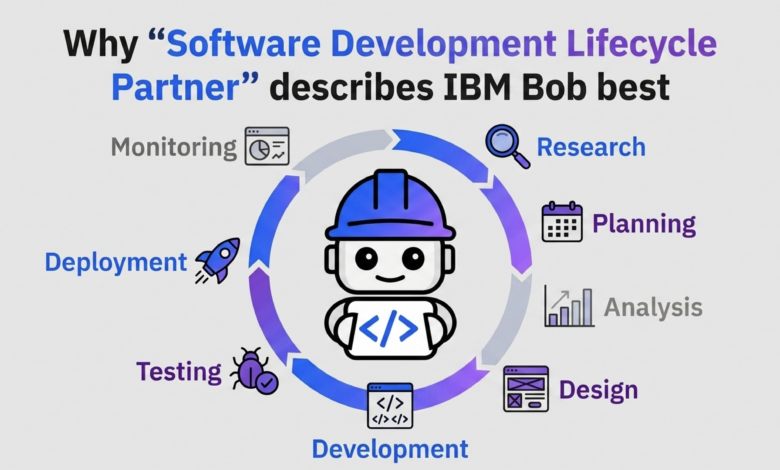
IBM is pushing Bob beyond the role of a simple coding assistant and into the center of enterprise software work. The platform is designed to support development teams across the full software lifecycle, from planning and testing to deployment and legacy system updates.
That broader scope matters because companies are under pressure to ship software faster while still meeting security and compliance demands. IBM positions Bob as a tool that can reduce repetitive work without removing control from enterprise teams.
AI Across the Full Development Cycle
Bob is built on agentic AI technology, which allows multiple AI agents to handle different tasks inside the Software Development Lifecycle, or SDLC. IBM says this approach helps reduce repetitive jobs that usually consume developer time.
The platform is not limited to writing code. It also supports application planning, testing, launching, and modernization work, which makes it more than a coding companion.
A Push to Modernize Older Systems
One of IBM Bob’s key targets is legacy system modernization. Many companies still rely on older systems that are expensive and slow to update, and IBM sees AI as a way to speed that process up without reducing quality.
The need is especially clear in digital transformation programs, where system upgrades often become one of the biggest bottlenecks. IBM says Bob is meant to help companies move through that stage faster.
Blue Pearl, a cloud solutions company, is cited as an example of the platform’s impact. It reportedly completed a Java version upgrade in three days, a task that would normally take around 30 days.
Security and Compliance Remain Built In
IBM has also placed enterprise security features at the center of Bob. The platform includes sensitive data scanning, real-time policy enforcement, and audit capabilities so AI activity can be traced.
That focus is important because enterprise AI tools often raise concerns about data handling and regulation. IBM’s approach tries to combine faster development with a controlled governance model.
Model Choice Helps Balance Cost and Performance
Bob also uses a multi-model AI setup. The system can choose the most suitable model for each task based on accuracy, speed, and cost efficiency.
IBM combines several models, including Anthropic Claude, open-source models from Mistral, and IBM Granite. Lighter tasks can be handled by more resource-efficient models, while more complex work is assigned to models with stronger analytical ability.
Internal Use Showed Early Results
IBM says Bob was first used internally in mid-2025. More than 80,000 IBM employees across different countries are now using it.
According to internal surveys, users reported an average productivity increase of up to 45 percent in software development and modernization activities. Some teams saw stronger results, including IBM Instana, which reported up to a 70 percent reduction in time for certain tasks.
IBM Maximo also reportedly cut code update work from days to just a few hours. Bob is now available globally as a Software as a Service platform for coding, testing, application modernization, and security management.