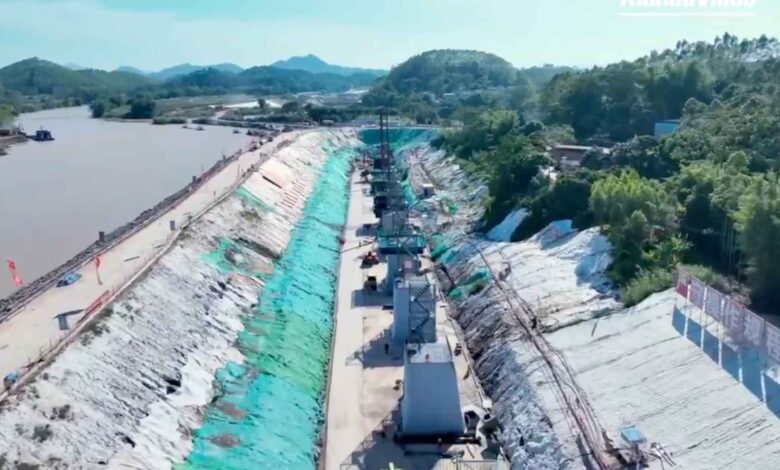
The Pinglu Canal is entering a decisive phase as water begins filling the full route, bringing a new China-ASEAN trade corridor closer to reality. The project is expected to open in September and is already being framed as a major shift in logistics for southwest China and Southeast Asia.
The canal is designed to shorten the journey from China’s inland southwest to the sea, reducing dependence on longer routes through established coastal hubs. By linking inland river systems more directly to Beibu Gulf, it could lower transport costs and strengthen regional trade flows.
A route built to change old logistics patterns
The Pinglu Canal stretches 134.2 kilometers in Guangxi Zhuang Autonomous Region in southern China. It begins on the Pingtang River in Hengzhou, passes through Luwu in Lingshan and Qinzhou, and follows the Qinjiang River until it reaches Beibu Gulf.
China has designed the waterway to accommodate ships of up to 5,000 tons. That makes it one of the country’s highest-capacity inland waterways and gives it a key role in future freight movement.
For decades, Beibu Gulf has served as the nearest maritime gateway for many areas in southwest China. Yet the region lacked a direct north-south inland waterway linking its river network to the sea, which pushed cargo from Yunnan, Guizhou, and Chongqing eastward through the Xijiang River system before reaching ports in the Pearl River Delta.
The new canal is meant to break that pattern. By creating a direct connection between the Xijiang River system and Beibu Gulf, it offers a shorter and more efficient path to international shipping lanes.
Compared with routes that rely on ports around Guangzhou, the canal is said to cut sailing distance by about 560 kilometers. That reduction is expected to improve transport efficiency and ease logistics costs for cargo moving through the region.
Why the project matters beyond inland shipping
The canal is also expected to support the New International Land-Sea Trade Corridor, a logistics network that links western China with global markets. Its role may become especially important as ASEAN remains China’s largest trading partner for several consecutive years.
Lei Xiaohua, deputy director of the Southeast Asian Studies Institute at the Guangxi Academy of Social Sciences, said the canal will increase freight capacity and improve operational efficiency along the corridor. He said that would create greater convenience for economic and trade exchange between western China and ASEAN economies.
Beibu Gulf ports are already serving as a key gateway between southwest China and ASEAN markets under the corridor. Since the implementation of the Regional Comprehensive Economic Partnership, their role as a gateway to Southeast Asia has continued to expand.
Today, Beibu Gulf Port operates shipping routes to major destinations in Southeast Asia and has expanded container services linking China with Vietnam, Thailand, Japan, and several other countries and regions.
From national planning to practical operation
Construction of the Pinglu Canal began in August 2022, and the project has drawn attention from the start because of its potential to reshape cargo distribution between southwest China and overseas markets. It is also regarded as the first canal since the founding of the People’s Republic of China to be planned and coordinated at the national level for a direct inland-water-to-sea connection.
Academic observers say its significance goes beyond transport alone. They view it as part of a broader effort to improve connectivity through infrastructure that fits local geographic conditions.
Ni Yuping, vice dean of the Faculty of Humanities and professor of history at Tsinghua University, said the canal serves both domestic navigation and international trade. He said it will bring Yunnan, Guizhou, and Chongqing closer to ASEAN markets, while lower water transport costs will make China-ASEAN cargo circulation far more efficient.
The water-filled trial along the full route shows the project moving from construction toward live operations. For southwest China, that means a shorter path to the sea, and for China and ASEAN, it points to smoother logistics, stronger trade links, and deeper regional connectivity.