The debate over artificial intelligence is shifting from what today’s models can do to who will build the next generation. Recent remarks from SoftBank CEO Masayoshi Son suggest that OpenAI has already reached a point where AI is helping design future AI models, intensifying concerns about how quickly the technology should advance.
That warning lands at a moment when Anthropic is pressing for a different priority: a possible slowdown mechanism if AI development begins to outpace society’s ability to manage it safely. The split is now as much about governance as it is about capability.
OpenAI’s reported shift in model building
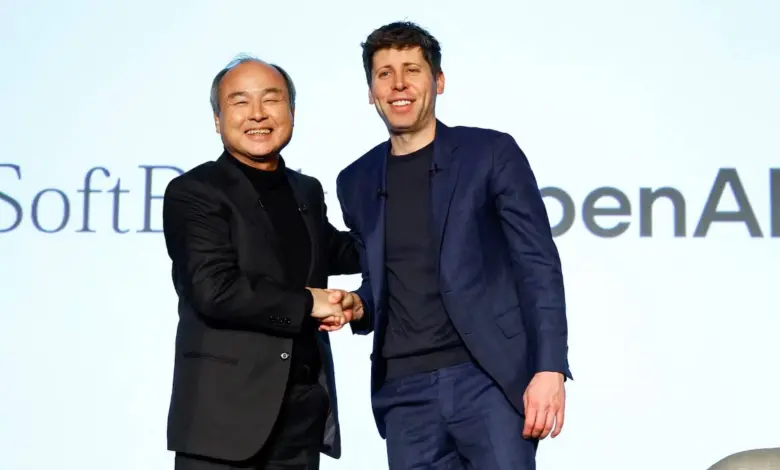
Son said OpenAI CEO Sam Altman and the company’s engineers told him that one AI model has helped design the next AI model. He framed that development as an early sign of superintelligence, a stage in which AI systems play a larger role in creating their successors.
He also argued that this change will not be limited to one company. In his view, the same dynamic will eventually reach other large model developers, because engineers may no longer be able to design the next generation without help from systems that are already more capable.
OpenAI did not comment on any unreleased model, but the company has acknowledged that AI is already involved in parts of model development. In February, OpenAI said GPT-5.3-Codex was the “first model” to play an important role in creating itself.
According to that explanation, an early version of the model was used to debug training processes, manage deployment, and help diagnose test and evaluation results. That does not mean AI is independently building its own successors, but it does show that AI is increasingly being used to speed up the technical work behind model development.
Anthropic wants a way to slow things down
Anthropic’s position is the opposite of acceleration for its own sake. The company says governments and leading AI firms should prepare a coordination mechanism to temporarily slow development if the technology starts advancing faster than society can safely handle it.
Jack Clark, one of Anthropic’s co-founders, recently reinforced that concern by saying the industry has a gas pedal but no brake pedal. The message is that guardrails need to exist before the most advanced systems arrive, not after.
The company’s fear centers on a future where AI could design, build, and train new models with little or no human involvement. Even if that scenario is not fully realized yet, Anthropic says regulators should start preparing for it now.
Son’s superintelligence timeline is getting shorter
Son’s comments also revived discussion around artificial superintelligence, or ASI, the idea of AI systems that exceed human intelligence across nearly every field. That includes scientific research, reasoning, creativity, and problem-solving.
Last year, Son described ASI as 10,000 times smarter than humans and said it could appear within a decade. Now he says the timeline may be much shorter.
Speaking to CNBC, Son said he had been conservative when he first mentioned 10 years because people would be shocked. He now believes ASI could arrive in four years, and perhaps in just two years.
He also said he uses ChatGPT for two to three hours every day and considers it more knowledgeable than he is in most areas. Looking ahead, he expects AI systems to surpass human intelligence in 70% to 80% of school subjects within a few years, and to be 10 times smarter than the average human in those areas.
None of that proves AI has fully taken over the design of new models without human input. But the combination of OpenAI’s acknowledgment, Son’s comments, and Anthropic’s push for a slowdown mechanism makes one thing clear: AI is moving closer to a phase where it does not just produce tools, but also helps shape the systems that come next.