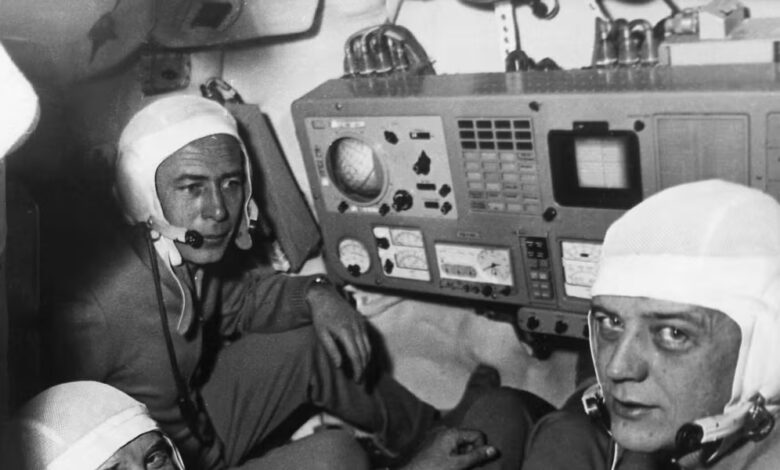
The Soyuz 11 capsule returned to Earth looking like a flawless landing. Inside, Georgi Dobrovolsky, Vladislav Volkov, and Viktor Patsayev were already dead after a failure during reentry turned a routine homecoming into a fatal disaster.
The mission became one of the darkest chapters in spaceflight history, but it also helped shift the Space Race away from pure competition. The tragedy later fed the cooperation that led to the Apollo-Soyuz Test Project, where American and Soviet crews met in orbit and shook hands.
How Soyuz 11 Began as a Breakthrough Mission
The Soviet Union launched Salyut 1, the world’s first space station, as an ambitious new step in orbital exploration. Soyuz 10 had already tried and failed to board it, leaving the historic firsts that Salyut promised to the crew of Soyuz 11.
That crew was not the original team assigned to fly. Valeri Kubasov was removed after a pre-mission medical exam found a spot on his lung that doctors feared could be tuberculosis, and the backup team of Dobrovolsky, Volkov, and Patsayev replaced them.
Leonov later said the crew was unhappy with the decision, especially once the lung issue turned out to be an allergic reaction to chemical insecticide used to spray trees. The mistaken diagnosis meant the original crew stayed on the ground, and that change saved their lives.
A Mission That Set Records Before Turning Tragic
The replacement crew spent 23 days aboard Salyut 1, where they conducted experiments, grew plants, battled fire and exhaustion, and pushed human endurance with treadmill exercise. Patsayev also became the first man to have a birthday in space, turning 38 while in orbit.
By the time the crew left the station, the mission had already become a success. Volkov’s comment about getting cognac ready for the return captured that confidence, but the reentry sequence would soon destroy it.
The Valve Failure That Killed the Crew
Between the orbital module and the descent capsule sat a pressure equalization valve meant to admit outside air after landing. During separation, the explosive bolts fired simultaneously instead of sequentially, the jolt loosened a seal, and the valve opened while the capsule was still in space.
Air rushed out of the cabin, and the cosmonauts had no pressurized suits to protect them during reentry. Flight recorder data later showed they were dead within 40 seconds, and the valve could not be found and blocked in time.
Grief That Changed the Politics of Space
For a time, even the exact cause of the deaths was unclear to the public outside the Soviet Union. NASA’s 1978 book Partnership: A History of the Apollo-Soyuz Test Project said confusion came from several factors, including mistranslations and inaccurate remarks reaching the Western press.
The grief that followed was real on both sides. President Richard Nixon sent NASA Chief Astronaut Tom Stafford to the funeral, and the Soviets asked him to serve as one of the pallbearers.
Nixon said in an official statement that “The whole world followed the exploits of these courageous explorers of the unknown, and shares the anguish of their tragedy.” That response helped move the Space Race toward cooperation instead of rivalry.
When Apollo and Soyuz docked in July 1975, Stafford was there again, this time as commander of the U.S. side, and Valeri Kubasov was there as well after being removed from Soyuz 11 days before launch. The meeting in orbit became the symbolic end of the Space Race, not through victory, but through shared loss and diplomacy.