


ChatGPT is starting to feel less like a one-off assistant and more like a persistent work partner. With its upgraded memory system, the platform can now retain user preferences, repeated instructions, and earlier conversations, making ongoing tasks noticeably easier to manage.
That change matters most in workflows that stretch across multiple sessions. Instead of re-explaining the same background every time, users can return to a project and pick up with more context already in place.
Memory that follows the work
OpenAI has positioned the improved memory feature at the center of this new personalization push. The system is designed to store user-specific context so later interactions become more efficient and better aligned with individual needs.
In practice, ChatGPT can remember working style, preferences, and recurring instructions. For users who repeatedly rely on the platform for project management, the responses can become more targeted over time.
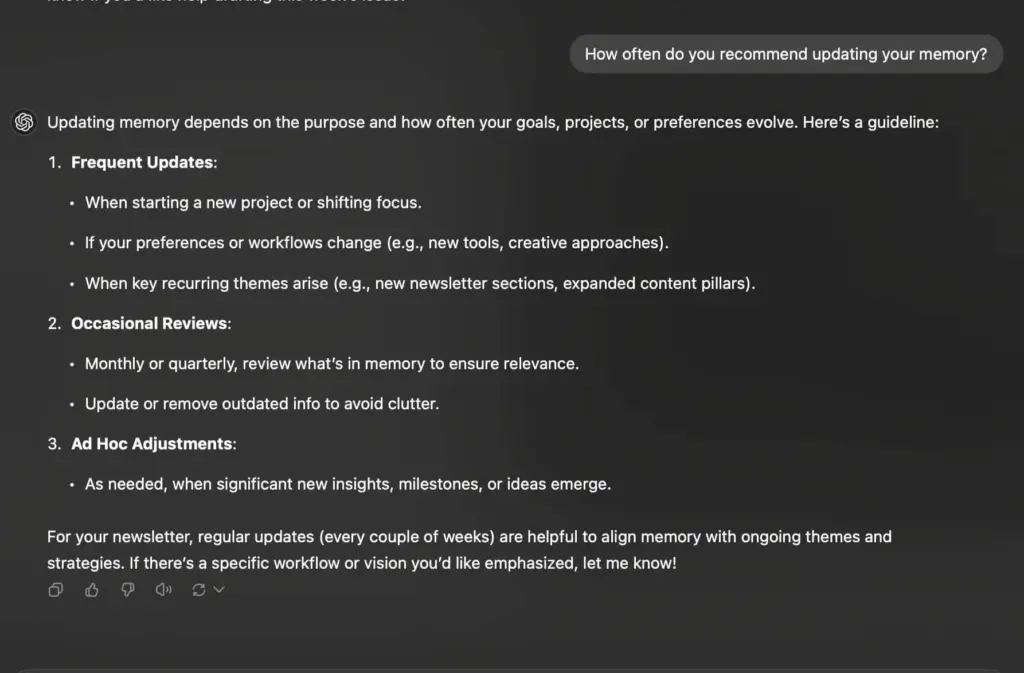
There is also a control layer built into the feature. According to The AI Advantage, users can view, edit, or delete saved memory summaries to keep the stored information accurate and relevant.
That balance between personalization and oversight is important. OpenAI also updates memory periodically, which helps keep the system useful without removing user control over what is retained.
Where the time savings show up
The biggest practical benefit is reduced repetition. Tasks that are split across several work sessions, such as planning, writing, or refining ideas, no longer require the same level of re-briefing every time a chat is reopened.
Creative work stands to gain as well. Memory can preserve direction and preference across successive conversations, which is useful for visual concepts, scripts, and brand assets that need consistency.
Operational work gets a different kind of lift. Repeated instructions do not always need to be typed again, so replies can come back faster and with more relevant context.
The result is efficiency rather than novelty. Once the basic context is recognized, users can move more quickly into execution instead of starting from zero each time.
More than a chatbot
The memory update arrives alongside the integration of Codex and Atlas into ChatGPT. Together, they push the platform further toward becoming a digital work hub rather than only a conversational tool.
Codex is described as capable of creating files, automating tasks, and running plugins. Inside ChatGPT, that means users can carry out more complex operations, including detailed reporting and repetitive process automation.
Atlas extends that direction into browser-based automation. It is meant to support web workflows such as extracting data from sites or managing online accounts more efficiently.
When combined with memory, those tools make the workflow smoother. ChatGPT can retain the context of a user’s habits and then help execute the next step in a connected digital task.
OpenAI has also added creative plugins tied to platforms such as Canva and Figma. These integrations allow visual creation and editing directly from the ChatGPT interface, shortening design workflows.
For designers and other creative professionals, that reduces the need to bounce between separate apps. Marketing materials, prototypes, and visual assets can be developed and refined with fewer interruptions.
The plugin expansion is not limited to visual design. OpenAI has also widened support into data analysis and product concept development, reinforcing ChatGPT’s role as a versatile tool for individuals and business teams.
Part of a broader AI direction
This shift reflects a wider pattern in the AI industry. YouTube, for example, uses AI to create a more personalized homepage and search responses that can build answers from video transcripts.
On the hardware side, Nvidia is preparing a dedicated AI chip for PCs in the fall. The chip is intended to optimize AI performance and is expected to help with video editing, 3D rendering, and complex simulation work.
Adobe is also adapting its software to take advantage of Nvidia’s AI hardware. That effort is visible in the restructuring of tools such as Photoshop and Premiere to create a smoother experience for creative professionals.
For enterprise users, OpenAI has introduced the “Sites” plugin. It is aimed at helping businesses design and launch websites directly from ChatGPT without requiring deep technical expertise.
All of these updates point in the same direction. ChatGPT is being shaped not just as a system that answers questions, but as one that remembers context, supports execution, and fits into repeating professional workflows.