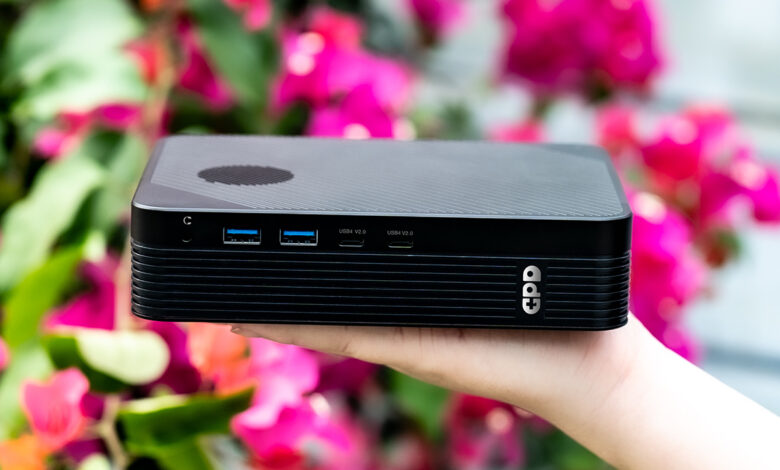
GPD is entering the mini PC market with a device that refuses to follow the usual formula. The GPD BOX combines a compact chassis, an Intel Core Ultra X7 358H processor, Intel Arc B390 graphics, and a built-in 160W GaN power supply.
That approach sets it apart from most mini PCs, which still rely on bulky external adapters. For many users, the appeal is not only cleaner cable management but also a more efficient use of desk space.
Performance first in a small body
Inside the small enclosure, GPD BOX uses Intel Core Ultra X7 358H from the Panther Lake 18A family. The chip brings 16 cores and 16 threads, positioning the device for productivity workloads, multitasking, and entertainment.
The processor is paired with Intel Arc B390 integrated graphics, which features 12 XE3 cores and clock speeds of up to 2500 MHz. That gives the machine a stronger graphics foundation than many compact systems in its class.
Memory and storage are also aimed at serious use. The device includes 32GB of LPDDR5X RAM running at 8,533 MT/s, while storage support covers M.2 2280 drives and the unit discussed already comes with a 1TB SSD.
Windows 11 is preinstalled, so the GPD BOX is ready for work and general use immediately. The overall package makes it clear that GPD is not treating this as a simple living-room PC or a basic office box.
Ports and connectivity carry real weight
Connectivity is one of the strongest parts of the design. On the front, GPD places two USB4 V2 ports with transfer speeds of up to 80 Gbps, two USB 3.2 ports, a 3.5mm audio jack, and a power button with an integrated fingerprint sensor.
The rear panel adds two more USB 3.2 ports for additional peripherals. GPD also includes full-size HDMI and DisplayPort connections, making dual-monitor setups straightforward for productivity users.
For wired networking, the device offers two 2.5Gb Ethernet ports. Wireless support includes Wi-Fi 7 and Bluetooth 5.2, giving the machine a broad set of options for both fast internet access and accessory pairing.
This mix makes the GPD BOX suitable for several use cases at once. Home users, professionals, and casual gamers all get a well-rounded connectivity setup without needing immediate add-ons.
Benchmark results show the hardware has substance
Performance figures shared for the device suggest it is far more than a novelty. In Geekbench 6, the GPD BOX reportedly scored 2,873 in single-core testing and 16,709 in multi-core testing.
In Cinebench R24, the single-core result is described as very strong, while the multi-core score remains competitive for creative and professional workloads. The Intel Arc B390 iGPU also reportedly outperforms many rivals in 3DMark Time Spy.
Gaming performance is another major talking point. The machine is said to handle 1440p gaming with XeSS frame generation, and titles such as Cyberpunk 2077, Red Dead Redemption 2, and God of War Ragnarök were reported to run smoothly, although real-world results will still depend on settings and optimization.
It is not positioned as a replacement for a high-end gaming desktop. Even so, for buyers who want a compact system with credible mid-range gaming ability, the GPD BOX makes a strong case.
Cooling and efficiency are part of the plan
GPD has also focused on power use instead of chasing peak performance alone. The device is said to draw only 8W at idle and average around 72W during gaming.
Thermal management appears well considered for a mini PC with this level of hardware. Average gaming temperature is reported at 67 degrees Celsius, with peaks reaching 82 degrees Celsius under heavy load.
Those figures suggest the system can sustain longer sessions without immediate thermal concerns. That matters in a compact device, where internal airflow space is naturally limited.
Customization and expansion add flexibility
Users can also tune the machine through GPD Tool, which allows adjustments to TDP, fan mode, and iGPU clock settings. That gives buyers room to choose between quieter, more efficient operation and a more aggressive performance profile.
Expansion support is another practical advantage. The GPD BOX supports an external GPU through USB4 V2 and the MCIO port, opening the door to setups such as the G2 dock for users who need extra graphics power.
In a crowded mini PC category, this is the kind of feature mix that can change buying decisions. The GPD BOX does not rely on size alone; it pairs compact design with desktop-grade ambition, broad connectivity, and enough performance to serve both work and entertainment needs.