


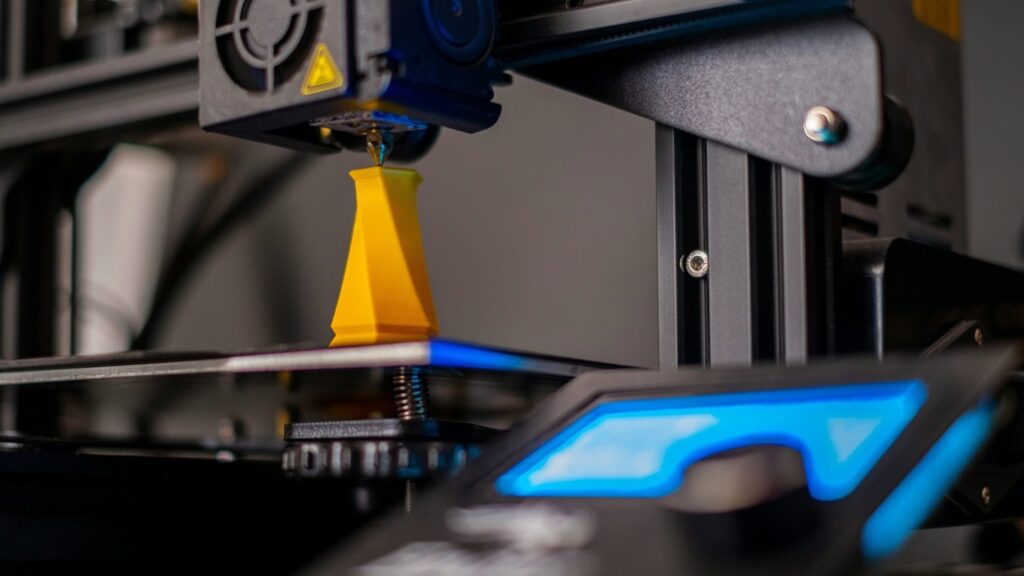
The biggest surprise for many first-time 3D printer buyers is not the machine itself, but the electricity bill they fear will follow. In practice, that concern is usually far smaller than expected.
For a typical home 3D printer, electricity costs often fall in the range of one to 10 cents per hour. That makes power consumption a minor expense compared with the printer, filament, and routine maintenance.
What the hourly cost looks like
The calculation is straightforward: divide the printer’s average wattage by 1,000, then multiply it by the local electricity rate per kWh.
Most FDM printers use around 60 to 150 watts. At the upper end of 150 watts and an average U.S. electricity rate of about 18 cents per kWh, the hourly cost comes out to roughly $0.027.
A 10-hour print on a machine averaging 120 watts would use about 22 cents, or $0.216. Repeating that every day for a full month would add up to $6.48.
Why some printers use more power
Printer size is one of the main drivers of energy use. Larger machines have bigger heated beds, and keeping those surfaces stable requires more electricity.
The two most power-hungry parts are the heated bed and the hot end. The bed keeps the model from warping, while the hot end melts the filament for extrusion.
Material choice also matters. PLA is typically printed at a nozzle temperature of 190 to 220 degrees Celsius, while ABS usually needs 220 to 250 degrees Celsius.
That difference affects power demand. PLA also does not always require a heated bed, and when it does, the recommended range is around 50 to 60 degrees Celsius.
ABS, by contrast, needs a bed temperature of 80 to 110 degrees Celsius. Holding that higher heat level naturally pushes electricity use upward.
Ways to keep usage lower
Lowering the hot end and heated bed temperatures, as long as they remain safe for the filament in use, can help reduce energy consumption.
PLA is already the easier option for efficiency because it prints at lower temperatures. An enclosure can also help by trapping heat around the printer and reducing the effort needed to keep the bed warm.
Print planning matters as well. Combining several small jobs into one session reduces heating cycles, which can save power over time.
Infill settings also play a role. Lower infill usually means a shorter print time, and that translates into less electricity used overall.
Printer placement and regular maintenance should not be overlooked either. Both help the machine run more efficiently over the long term.
Should electricity be a reason to hesitate?
In most cases, no. 3D printers are already relatively efficient, and their power draw is far below devices such as microwaves or space heaters, which typically operate at around 1,200 to 1,500 watts.
When all printing costs are considered together, electricity usually ranks behind the printer itself, filament, routine upkeep, and even nozzle replacement. For many users, that makes power consumption a much smaller concern than it first appears.