


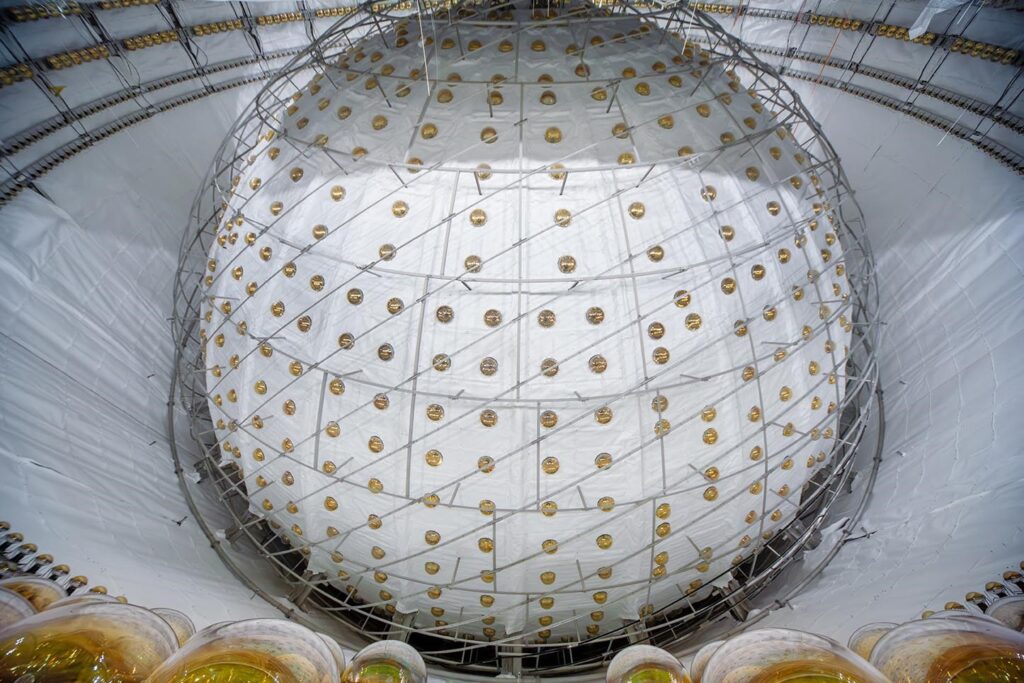
China’s Jiangmen Underground Neutrino Observatory, or JUNO, has released its first physics results in Nature, and the early performance is already drawing attention across particle physics. In only 59 days of valid data, the giant detector produced a high-precision measurement that reduced uncertainty by 1.6 times compared with combined results from previous experiments over decades.
That rapid progress matters because neutrinos remain among the least understood elementary particles. They carry no electric charge, have an extremely small mass, and interact so weakly with matter that they can pass through ordinary material with almost no resistance.
A major early validation
The published analysis used valid data collected between 26 August and 2 November 2025. From that relatively short window, JUNO was able to measure two key neutrino oscillation parameters with a level of precision that exceeded the uncertainty accumulated by earlier experiments.
According to Nature reviewers, the result shows more than just that the instrument is working as intended. It also validates the analysis method the team used to read neutrino signals, a critical step in a field where the signals are extremely weak and detector accuracy is everything.
Why the result matters
Neutrino oscillation is one of the central phenomena in the study of these particles. Measuring oscillation parameters helps scientists understand how neutrinos change between different types as they travel, while also opening a path toward answering deeper questions about their mass.
JUNO is designed to support that wider effort, not just one narrow measurement. The observatory’s team says the facility can also measure three of the six neutrino mixing parameters with better than 1 percent precision.
That level of accuracy could make JUNO an important reference point in global neutrino research. As more precise data accumulates, the experiment may help refine models built from many different experiments around the world.
A large detector with broad ambitions
Located in Guangdong Province in southern China, JUNO uses the world’s largest transparent spherical neutrino detector. The facility began collecting data in August 2025 with one of its main physics goals set on determining the neutrino mass ordering.
The observatory’s scientific program goes beyond oscillation studies. It can also be used to study supernova neutrinos, geoneutrinos, solar neutrinos, and atmospheric neutrinos.
That range of targets gives JUNO significance well beyond particle physics alone. The data it produces may help improve understanding of processes inside stars, activity deep within the Earth, and particles arriving from the atmosphere.
A new player in precision neutrino physics
Nature reviewers said JUNO now positions itself as a key player in the emerging era of precision neutrino oscillation research. The implications include testing the three-flavor neutrino framework, refining global oscillation fits, and eventually determining the neutrino mass ordering.
For China, the result underscores its capacity to deliver large-scale basic science projects with immediate scientific impact. For the wider physics community, the arrival of a new instrument with a giant detector and strong early precision creates fresh momentum around long-standing neutrino questions.
The JUNO team says more results will follow as data continues to accumulate at the observatory. With a growing dataset, the experiment is expected to reveal more about neutrinos and strengthen its role in precision studies of elementary particles.