Asus NUC 15 shows how far compact computers have evolved. Built around Intel Arrow Lake and designed with local AI workloads in mind, this mini PC is aimed at users who want near-desktop performance without giving up desk space.
The model reviewed as NUC 15 CRK is positioned for professional environments that value speed, flexibility, and easier upgrades. It combines a compact footprint with broad connectivity, business-friendly features, and enough headroom for lightweight to moderate local AI tasks.
Compact hardware with a rugged finish
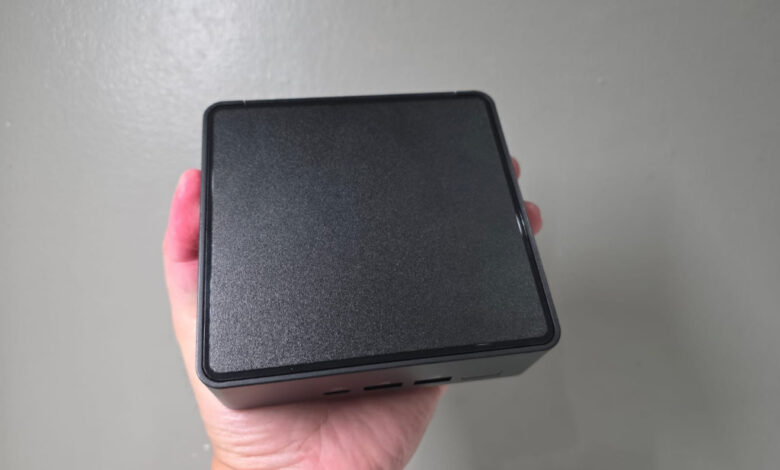
Asus uses the classic 4×4-inch footprint, with dimensions of 117 mm x 112 mm x 37 mm and a weight of around 500 grams. That makes the system easy to place in offices, labs, or commercial display setups.
The exterior comes in a scratch-resistant black finish that gives the device a restrained, professional look. Durability is reinforced by MIL-STD-810H certification, covering physical shock, vibration, high humidity, and extreme operating temperatures.
Upgrade access is intentionally simple
One of the strongest practical advantages is Tool-less Design 2.0. Asus uses a spring-latch mechanism on the underside, allowing the cover to be opened with a manual tab instead of a screwdriver.
Once inside, users can swap or install DDR5 SO-DIMM memory and M.2 SSD storage through a snap-and-slide layout. For controlled environments, the bottom latch can also be locked permanently with a hidden screw.
Business-focused port selection
The front panel includes one USB 3.2 Gen 2×2 Type-C port rated at up to 20 Gbps and two USB 3.2 Gen 2 Type-A ports rated at 10 Gbps. A Kensington lock slot is also available on the chassis to reduce theft risk in open work areas.
At the rear, the machine offers two HDMI 2.1 ports, two Thunderbolt 4 ports, one USB 3.2 Gen 2 port, one USB 2.0 Type-A port, and one RJ45 2.5 Gigabit Ethernet port. It does not include a 3.5 mm analog audio jack or an SD card reader.
That omission means users must rely on digital audio through USB-C, an external DAC, HDMI audio through a monitor, or Bluetooth 5.4 headphones. Wireless connectivity is handled by Intel Wi-Fi 7 (BE201) and Bluetooth 5.4.
Four 4K displays are supported
The combination of two HDMI 2.1 ports and two Thunderbolt 4 ports allows Asus NUC 15 to drive up to four independent 4K monitors. This makes the system suitable for multitasking, monitoring panels, and commercial signage environments.
Asus also includes Power Sync through HDMI CEC. With a compatible Asus monitor, the mini PC can power on or off in sync with the display, which simplifies operation in business setups.
Arrow Lake performance is close to desktop territory
Inside, the NUC 15 CRK uses Intel Core Ultra generation 2 hardware. The tested unit carried an Intel Core Ultra 5 255H, paired with 16GB of dual-channel DDR5-6400 memory and Intel Arc 130T integrated graphics.
Benchmark results point to strong productivity performance, with Cinebench 2026 scores of 3,830 in multi-core and 453 in single-core. In PCMark 10 Office, the device scored 8,835, indicating steady behavior in everyday business workloads.
Local AI is part of the pitch
Asus bundles the system with AI SuperBuild software, which helps users build local large language models with Retrieval-Augmented Generation support. In local testing through LM Studio using Google Gemma 3 7B, the NUC 15 CRK processed text at about 15 to 20 tokens per second.
Initial response latency was also relatively short at around 2 to 3 seconds. That places the mini PC in a practical range for light to moderate local AI use, in addition to standard productivity work.
Cooling keeps the compact chassis in check
Fitting this level of performance into a 37 mm-thick chassis requires careful thermal design. Even so, the processor remains efficient enough that heat does not become disruptive during heavy use.
CPU temperature can rise to around 80°C, but the cooling system continues to manage heat effectively. Dual heat pipes and active cooling work together to maintain stability under sustained load.
Asus NUC 15 CRK makes a clear case for the modern mini PC: small enough for tight spaces, fast enough for serious work, and flexible enough for AI tasks that are increasingly relevant in office and commercial settings.