


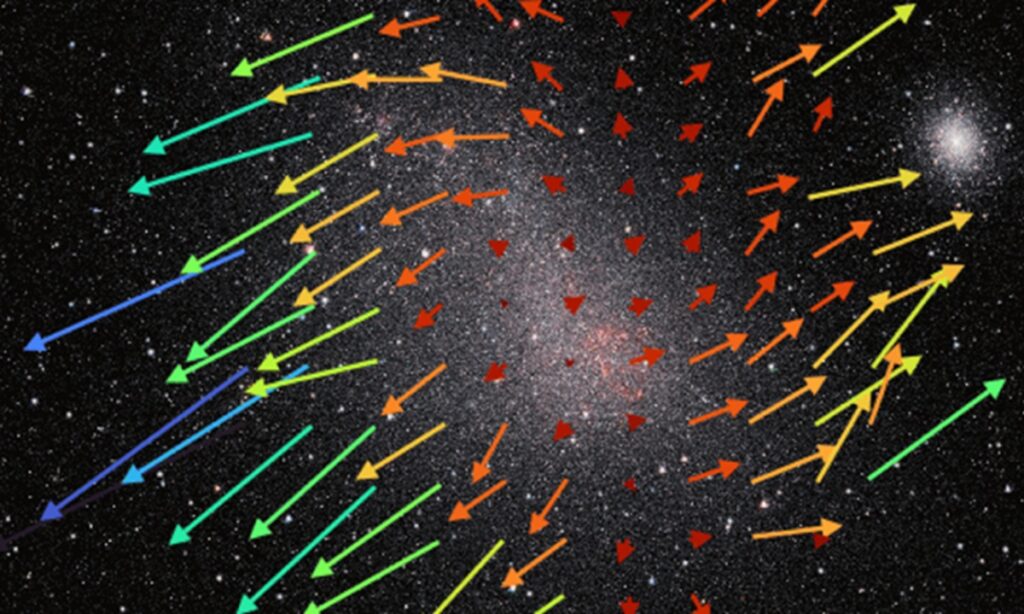
Astronomers have captured a rare close-up of a dwarf galaxy on the edge of the Milky Way that is no longer holding together as a single system. Sextans, one of the nearest satellite galaxies to the Milky Way, is now appearing to split into two parts under gravitational stress.
The finding offers a direct look at how small galaxies can be destroyed in a nearby cosmic environment. Stellar mapping shows that Sextans has lost its intact structure and is being pulled in opposite directions by strong gravitational interaction.
A galaxy that is coming apart
Sextans lies about 280,000 light-years from Earth and is classified as a dwarf spheroidal galaxy. Its small size makes it highly vulnerable to tidal forces from massive objects nearby.
Researchers identified evidence that the galaxy’s stars are being drawn toward two different directions. That process is pulling the core itself apart and leaving Sextans in a state described by one lead researcher as total disintegration.
Signs of a gravitational collision
The extreme pull from its companion, Sextans B, has shaped a bridge of stars and gas between the two systems. That bridge is a sign that the material inside Sextans is no longer stable and is beginning to shift from one system to another.
If the process continues, Sextans will keep weakening and may eventually cease to exist as an independent galaxy. Its remaining material could later merge into a larger system nearby.
Why astronomers care
Dwarf galaxies such as Sextans are often treated as living fossils from the early universe. They are dominated by dark matter and old, metal-poor stars, which makes them valuable clues to galactic history.
When a dwarf galaxy starts to break apart and merge with another system, astronomers can study how larger galaxies grow over billions of years. Such small mergers help explain the formation and evolution of the Milky Way.
The Sextans discovery has been published in a leading astrophysics journal, showing that even in a quiet-looking sky, galaxy interactions remain active and capable of reshaping stellar systems dramatically.