


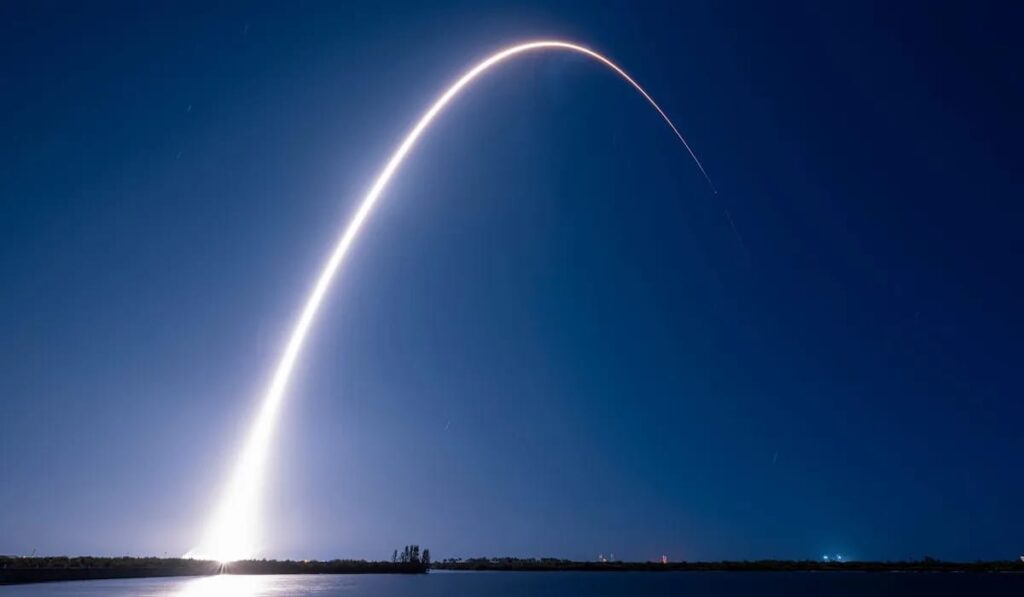
A Falcon 9 upper stage from SpaceX is now expected to hit the Moon on 5 August 2026, setting up an unusual impact event just days before a total solar eclipse on 12 August 2026. The predicted collision has drawn attention because it involves a piece of hardware that has been drifting in space long after its original mission ended.
Independent astronomer and software developer Bill Gray, who tracks celestial objects through Project Pluto, said updated orbit calculations point to a lunar impact at 13:44 WIB near Einstein Crater. The forecast highlights how long-lasting space debris can eventually return to interact with another body in the solar system.
Why this Falcon 9 stage is still in space
The object being tracked is tied to the 2025-010D mission launched in January 2025. That Falcon 9 flight carried Firefly Aerospace’s Blue Ghost Mission 1 and ispace’s Hakuto-R Mission 2, both of which were part of separate lunar efforts.
Unlike the rocket’s first stage, which is designed to return to Earth for reuse, the upper stage is not built for recovery. Once it completed its job, it continued moving through space and gradually shifted onto a path that now intersects the Moon’s orbit.
Gray said the Moon and the object are essentially on crossing trajectories, making a meeting on 5 August increasingly likely. The prediction is based on the latest orbital calculations rather than a visual observation of the impact itself.
What the impact could look like
The likely strike zone is close to Einstein Crater, an area near the boundary between the Moon’s near side and far side. The collision speed is expected to reach about seven times the speed of sound.
Experts say the event poses no threat to Earth. The main result would be a new crater on the lunar surface, created by the impact of the spent rocket stage.
If the collision happens as predicted, NASA’s Lunar Reconnaissance Orbiter may be able to document the fresh scar. Such imagery would add useful data for studying both the lunar surface and human-made objects that remain in orbit around it.
A reminder of growing lunar debris
The forecast has also renewed attention on space junk in the Moon’s environment. As exploration accelerates, more hardware is lingering in lunar space and increasing the number of man-made objects that may one day interact with the Moon.
NASA’s Artemis program is targeting a return of astronauts to the Moon in 2028, while China also plans to send humans there in 2030. In that context, an impact like this shows how long spacecraft components can remain active in orbit long after their missions are finished.
The timing is especially notable because August 2026 is already shaping up to be an important month for astronomy. A total solar eclipse on 12 August will pass over Greenland, Iceland, Spain, and Portugal, adding a major sky event to the same period as the predicted lunar impact.
With both events arriving within a week of each other, public attention on the Moon and the wider space environment is likely to rise. The sequence offers a rare chance to watch one of the clearest examples of how human-made hardware can still leave a mark far beyond Earth.