


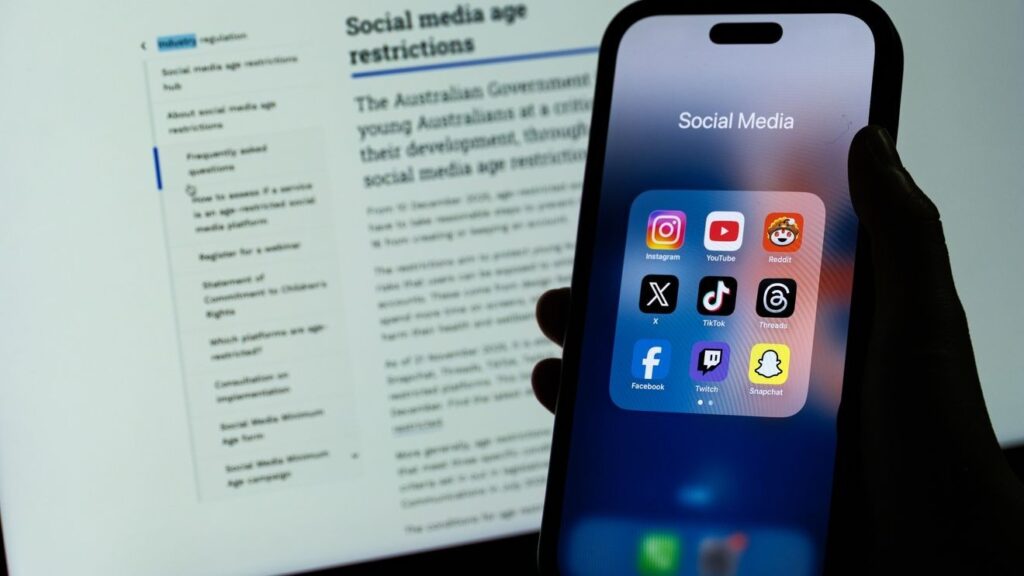
Britain’s plan to block social media access for children under 16 has quickly become more than a child-safety debate. It is now a wider argument over how far governments should go to police life online.
The sharpest criticism came from Elon Musk, who said the move was part of “a government surveillance state.” His reaction added a political edge to a proposal already drawing attention across Europe and the tech industry.
What the proposed ban would cover
If adopted, the rule would bar under-16 users from major platforms including Instagram, Facebook, TikTok, Snapchat, YouTube, and X. The proposal is not limited to conventional social feeds and also extends to other forms of digital interaction.
British officials say the plan would add restrictions on some online products, including limits on communication with strangers through gaming apps. It would also prevent users under 18 from using AI chatbot companions designed to simulate romantic relationships.
Starmer says child protection comes first
Prime Minister Keir Starmer announced the proposal in London and said social media can intensify bullying, abuse, and pressure on mental health. He acknowledged that the policy would not be without flaws, but argued that the benefits of stronger protection outweigh the costs.
Starmer also said support for innovation and child safety do not have to conflict. In his view, both goals can still coexist under a stricter regulatory framework.
Tech companies warn of unintended consequences
Major technology firms have pushed back against the idea of a broad ban. Meta, the parent company of Facebook and Instagram, pointed to Australia as an example of how such restrictions could isolate young people from online communities and trusted information.
YouTube offered a similar warning, saying children could be pushed away from supervised, moderated spaces and toward anonymous services with weaker protections. Snapchat also argued that cutting off communication features could damage ties with friends and family without necessarily making young users safer.
Age checks will decide how far the policy reaches
Enforcement would depend heavily on age-verification systems. Britain already uses several methods under the Online Safety Act, including facial age estimation, bank information checks, email-based verification, and digital ID tools.
Regulators are expected to examine whether additional steps are needed to stop underage users from bypassing the new restrictions. That is where concerns about surveillance become more politically sensitive, since tighter age rules often require deeper identity checks.
Public support is being used to justify the push
The government says consultation responses showed strong backing for stricter rules, with nine in 10 parents supporting a minimum age of 16 for social media access. Officials also said many young people support limits on at least some social platforms.
If approved, the proposal backed by Starmer is expected to take effect next year. The next phase of debate is likely to focus on whether child protection can be strengthened without expanding the digital verification systems critics see as a form of online surveillance.