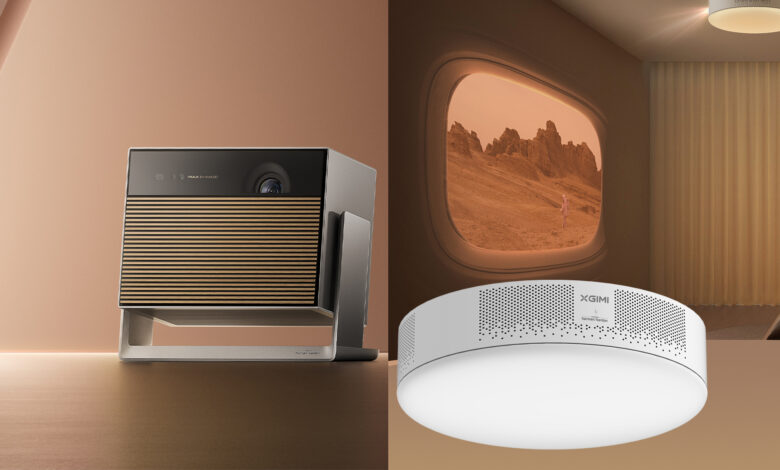
XGIMI is preparing three new projectors for global markets, and the lineup is built around one clear idea: making home entertainment more flexible. Two portable models in the Elfin Flip series are joined by MIRA, an ultra-short-throw projector aimed at big-screen living room setups.
The most interesting part is not just the mix of 4K, laser, and smart features. It is the way XGIMI is trying to cover two very different home-use cases at once, from a projector that can be angled toward the ceiling to a fixed unit designed to sit close to a wall.
Portable flexibility with a premium hinge design
The two portable models are the Elfin Flip 4K and the Elfin Flip Laser. Both use a premium design with a folding stand that also acts as the projector’s tilt pivot, making it easier to aim the image at a wall or even the ceiling.
When the projector is not in use, the stand folds back in for a cleaner, more compact shape. That makes the pair feel more practical for people who want flexible placement without giving up a tidy look.
Physically, the two Elfin Flip models appear identical. The real difference comes from the light source and the image capabilities each model offers.
| Model | Main Display Features |
|---|---|
| Elfin Flip 4K | 4K at 60Hz, 1080p at 120Hz, variable refresh rate |
| Elfin Flip Laser | 1080p 60Hz, triple-laser light source, variable refresh rate |
XGIMI positions the Elfin Flip 4K as the more affordable option, and teaser material suggests it may use a traditional projection lamp, although the company has not said so directly. The Elfin Flip Laser is the brighter-sounding pitch on paper, with XGIMI saying the triple-laser light source is meant to deliver sharper image quality.
Both models support variable refresh rate, which should help with gaming performance. One limitation remains the same across the pair: neither unit includes a built-in battery, so they are not fully untethered portable projectors.
MIRA is built for a fixed living-room role
While the Elfin Flip models focus on placement freedom, MIRA is aimed at a more permanent spot in the home. It is an ultra-short-throw projector, so it can sit very close to the wall while still producing a large image.
On the version already sold in regional markets such as China, MIRA delivers 4K video and is rated at 2,000 ISO lumens. XGIMI also includes HDR10+ support, which should help with contrast handling in supported content.
Audio is another major part of the package. MIRA uses a 2.1-channel system tuned by Harman Kardon with 360-degree output, making it look like a more complete all-in-one living room device.
Google TV could be the common thread
One of the biggest questions around the global launch is whether all three models will ship with Google TV. That is not fully confirmed yet, but the signs are encouraging.
In Japan, both Elfin Flip models already run Google TV, although it is still unclear whether the global versions will keep the same software setup. The global MIRA is also said to have the potential to use Google TV, even though the Chinese model ships with a custom interface.
The appeal is easy to understand. A projector with Google TV can act more like a complete smart entertainment hub, reducing the need for external streaming devices.
Price clues and launch timing
XGIMI has not announced official global pricing, but existing market figures give a rough sense of positioning. In Japan, the Elfin Flip 4K is priced at 206,800 yen, while the Elfin Flip Laser sells for 139,800 yen.
MIRA 4K is listed at 6,499 yuan in China. Based on XGIMI’s past launches, U.S. pricing could end up higher, but no official number has been shared.
The pre-order window is already set for 25 June to 14 July. Early buyers will get different bonuses depending on the model: the Elfin Flip 4K and Elfin Flip Laser come with a portable screen, while MIRA 4K includes two sets of 3D glasses.
XGIMI says priority shipping starts on 7 July, and wider sales for all three projectors are scheduled to begin on 15 July. With a mix of tilt-friendly portables, a laser option, and an ultra-short-throw model, the company is clearly trying to give home users more than one way to build a projector-based living room.