Beijing’s emerging embodied-intelligence industrial cluster is becoming notable for a reason that goes beyond scale: proximity is speeding up collaboration. In Zhongguancun, Haidian District, companies across the chain can now find partners so close by that cooperation may happen simply by moving up or down the stairs in the same office building.
That closeness matters in a field where progress depends on hardware, software, data, and real-world testing working together. For companies developing robots and related technologies, the cluster offers a practical advantage that is difficult to replicate in a more scattered industrial layout.
A cluster built for faster cooperation
The Beijing area has become a strong meeting point for firms involved in embodied intelligence, which refers to intelligent systems that interact with the physical world through robots or other machines. Its value lies not only in the number of companies present, but in how quickly those companies can connect and exchange resources.
When developers, system providers, and supporting businesses operate within a very small radius, partner searches become far more efficient. The result is an ecosystem where communication, coordination, and technical adjustments can move at a much quicker pace.
This setup gives companies a direct benefit in a sector that often requires rapid iteration. Instead of spending time reaching across a wide city network, firms can seek data support, integration help, or testing assistance from nearby players in the same building or neighborhood.
Robots, teleoperation, and data collection at work
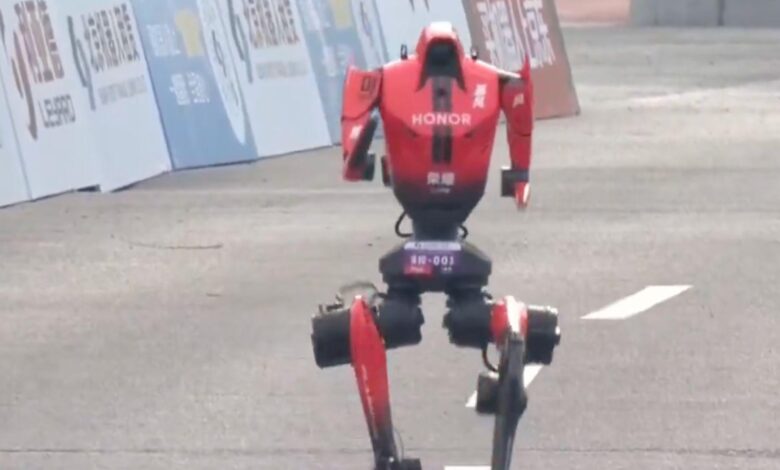
Activity in the cluster shows that embodied intelligence is being developed through practical use, not just theory. Robots are used for demonstrations, staff members handle teleoperation, and high-precision human behavior data collection supports system training.
One of the most eye-catching examples is a robot playing football, a demonstration that highlights movement, coordination, and responsiveness in a real environment. Such scenes reflect the effort to push intelligent systems beyond digital models and into physical interaction.
Teleoperation is another important part of the workflow. Through this approach, operators can control robots to support testing, refine functions, and gather operational experience that can later improve development.
Precise human behavior data collection is equally important because these systems need detailed information on movement, action, and interaction patterns. That data helps training models learn how people behave with greater accuracy in real settings.
Why Zhongguancun matters
Haidian District’s Zhongguancun has long been recognized as one of Beijing’s key technology innovation centers. The presence of an embodied-intelligence cluster there strengthens the area’s identity as a base for advanced technology experimentation.
For companies in the district, being embedded in such a dense innovation environment improves access to industrial networks. It is not only about business meetings, but also about how quickly a project can secure support from another company in the chain when a technical need appears.
That speed can be a decisive advantage in a fast-moving industry. When firms are concentrated in the same area, they can often solve communication and coordination issues much faster than they could if they were spread across multiple locations.
Beyond the business value, the cluster also shows how an industrial ecosystem can be built through everyday proximity. Regular interaction among participants creates more spontaneous opportunities for collaboration across research, development, testing, and integration.
The Beijing example suggests that the future of embodied intelligence may depend as much on geography as on technology. In this case, the ability to reach a partner with a short walk between offices may be one of the most practical advantages of all.