


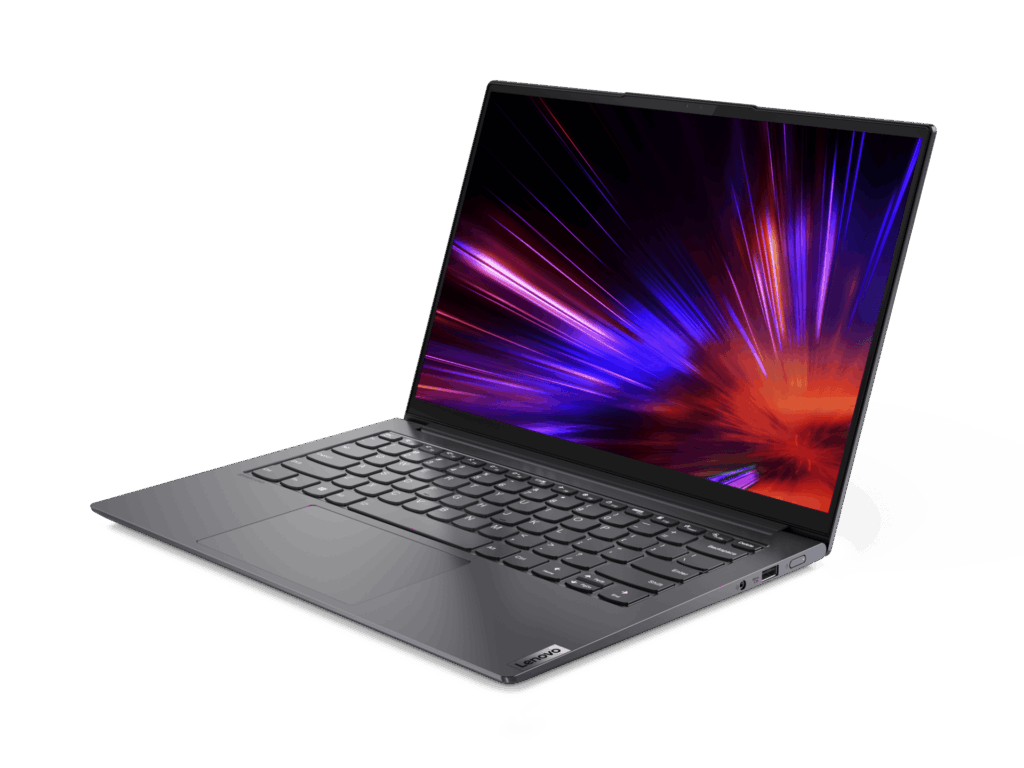
Lenovo is pushing its Yoga Pro 7 further into premium territory with a global 15-inch version that combines a 1,100-nit OLED display with unusually large VRAM allocation on the AMD variant. The result is a laptop lineup aimed at users who want both strong visual quality and serious graphics flexibility in a slim-format device.
The new models arrive as the Yoga Pro 7 15IPH11 and Yoga Pro 7 15ASH11. Both use a 15-inch OLED panel with a 2,560 x 1,600 resolution and a 165 Hz refresh rate, giving the series a common display foundation across the lineup.
Two platforms, two different priorities
Lenovo separates the two models by processor platform and graphics hardware. The Yoga Pro 7 15IPH11 pairs Intel Panther Lake with an Nvidia GeForce RTX 5060, while the Yoga Pro 7 15ASH11 uses a Ryzen AI Max+ 388 and Radeon 8060S.
That split gives each version a distinct appeal. The Intel and Nvidia configuration is positioned for users who want a discrete GPU setup, while the AMD model focuses on memory flexibility and integrated graphics capacity.
The display is built for demanding visual work
The OLED panel reaches a peak brightness of 1,100 nits in HDR mode. That level should help the laptop remain practical for users working with bright content, color-sensitive material, or visually dense interfaces.
A 165 Hz refresh rate adds another layer of responsiveness, especially when scrolling through content or using applications that benefit from smoother motion. The 2,560 x 1,600 resolution also provides enough workspace for everyday productivity.
The AMD version stands out for VRAM allocation
The biggest headline is reserved for the 15ASH11. Lenovo equips it with two SSD slots and support for up to 128 GB of LPDDR5X-8000 RAM.
That configuration allows the laptop to allocate as much as 96 GB of VRAM to the Radeon 8060S. Notebookcheck notes that this capability also appears on the ROG Flow Z13, placing Lenovo’s machine in the same conversation when it comes to memory flexibility for graphics use.
For users handling heavy graphics workloads, that amount of VRAM could be a notable advantage. Real-world value will still depend on the workload and software support, but the specification alone is enough to set the model apart.
Pricing and availability are still unknown
Lenovo has not announced pricing or a release schedule for the global 15-inch Yoga Pro 7 yet. The company’s site includes more details on the Yoga Pro 7 Gen 11 line for those looking for additional specifications.
With its 1,100-nit HDR OLED screen, 165 Hz refresh rate, and up to 96 GB of VRAM on the AMD version, the Yoga Pro 7 is clearly being positioned as a premium 15-inch laptop with an unusually aggressive feature set. It shows that Lenovo still sees room for high-end performance and display quality in a portable form factor.