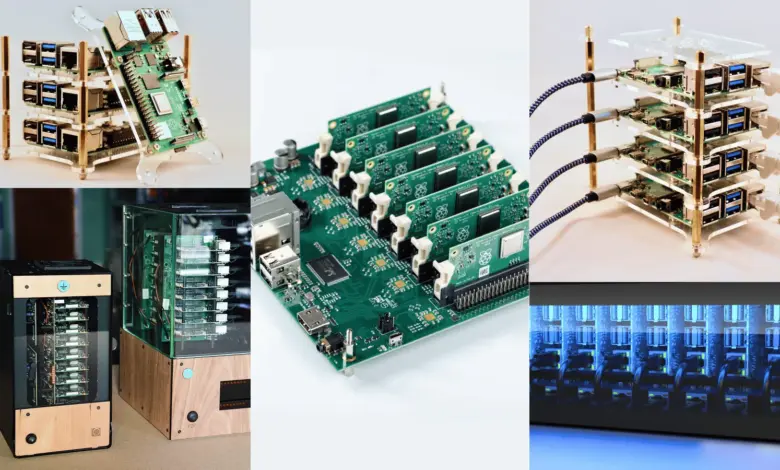
A four-node Raspberry Pi cluster has drawn attention for a simple reason: it looks less like a hobby build and more like a compact piece of finished hardware. The whole unit can be lifted with one hand, yet it combines compute, networking, monitoring, and shared power in a single enclosure.
That combination gives the project unusual appeal for a home lab. Instead of exposing a tangle of boards and cables, the build presents itself as a clean mini server with a deliberately polished finish.
A compact cluster with real utility
Michael Klements showed the project on the Raspberry Pi subreddit, where the design quickly stood out. His setup uses two Raspberry Pi 5 boards, two Raspberry Pi 4 boards, a dedicated network switch, a touchscreen for monitoring, and one power system for the full unit.
The result is a small multi-node cluster that is ready for networking and visual monitoring from the start. Users do not need separate displays or a separate power supply for each board, which keeps the setup simpler and easier to manage.
Built for maintenance, not just appearance
One of the most practical details is the sled-style mounting system used for each node. It allows a Raspberry Pi to be upgraded or serviced without taking apart the entire enclosure.
That approach matters in a cluster project, where accessibility can disappear once everything is packed tightly into a case. Here, the hardware remains serviceable even after the system is fully assembled.
The design is the real showpiece
Visually, the cluster goes beyond the usual DIY look. Dark acrylic panels keep the internal hardware visible while making the overall build feel cleaner and more refined.
Klements also used a CNC-machined chassis to shape the main body. That choice helps explain why the system looks closer to a commercial product than a standard maker project.
The touchscreen runs a custom dashboard that displays live system statistics. In practice, that means the status of each node can be checked directly from the device itself.
More than a display piece
Even with its strong visual appeal, the cluster is still intended to function as a working computing platform. With four active nodes and a dedicated network switch, it can support a range of distributed-computing experiments.
Klements said Kubernetes is the most obvious use case for a system like this. He also asked the community for other ideas on how the full hardware stack could be used.
The response focused heavily on the execution of the build. Many commenters were less interested in workloads and more interested in seeing the files released so they could build their own versions at home.
That reaction makes sense, because the project brings several needs together in one package. It combines multi-node computing, internal networking, visual monitoring, and integrated power in an enclosure that stays compact enough to carry with one hand.
Plans for a wider release
Klements said he plans to launch the project on Makerables, although the CNC-built chassis means the release will take a little more time. Until then, the build remains a strong example of how far the Raspberry Pi community continues to push small SBC projects.
Michael Klements is already known for unusual Raspberry Pi experiments, including a previous build that used a water block cooler on a Pi. This four-node cluster follows the same pattern of technical experimentation paired with careful presentation.
For Raspberry Pi enthusiasts, that mix of style and engineering is part of the appeal. The project shows that a mini server can look neat and serious, even when it houses four nodes, a network switch, a touchscreen, and a shared power system inside one compact frame.