


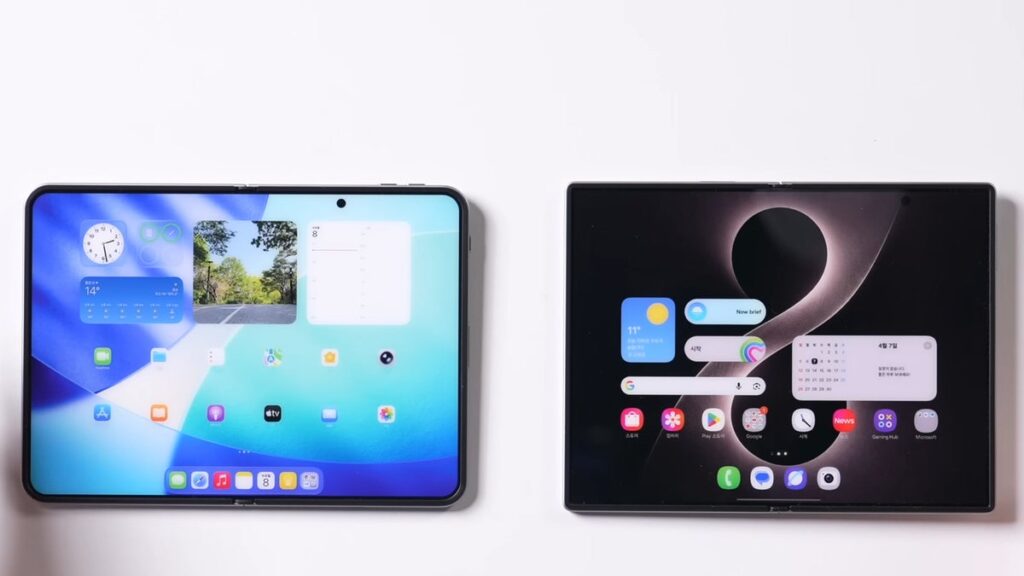
The next battle in foldable phones is starting to look less like a simple hardware race and more like a test of strategy. Fresh details around Galaxy Z Fold 8 and the rumored iPhone Fold Ultra point to a shared move toward wider folding designs, a shift that could make these devices feel more like compact tablets than experimental phones.
That matters because the foldable segment is no longer being shaped by one dominant player alone. Samsung has led the category for years, but Apple’s expected entry is already changing the pressure points, especially around durability, thickness, camera hardware, battery life, and software behavior.
Two different interpretations of the same idea
The rumored iPhone Fold Ultra is said to use a wide-folding design instead of the book-style format associated with Samsung’s Fold line. When closed, it is expected to work like a compact smartphone, then expand into a small tablet when opened.
Samsung is taking a more iterative route with Galaxy Z Fold 8, building on several generations of foldable experience. That maturity gives the company an advantage in refining hinge design, screen protection, and software integration.
There is also an unusual overlap between the two rivals. Samsung is reportedly supplying the foldable display for Apple’s first foldable device, which means the companies are competing in finished products while still connected through the component supply chain.
What the leaks suggest about the displays
The clearest differences appear in screen sizing. Galaxy Z Fold 8 is reportedly being tested in a standard or Ultra version with an internal 8.0-inch LTPO OLED panel and a 6.5-inch LTPO OLED cover screen.
A second, wider Fold 8 variant is also said to exist, with a 7.6-inch LTPO OLED main display in a 4:3 ratio and a 5.4-inch LTPO OLED cover display in a 4.7:3 ratio. That would suggest Samsung is exploring multiple layouts within the same family.
For Apple, the iPhone Fold Ultra is rumored to carry a 7.7- to 7.8-inch OLED inner screen in a 4:3 ratio, paired with a 5.3- to 5.5-inch OLED outer display. The dimensions point to a similar philosophy: a phone that stays practical when folded and feels expansive when opened.
| Model | Rumored Main Display | Rumored Cover Display |
|---|---|---|
| Galaxy Z Fold 8 standard or Ultra | 8.0-inch LTPO OLED | 6.5-inch LTPO OLED |
| Galaxy Z Fold 8 wider variant | 7.6-inch LTPO OLED, 4:3 ratio | 5.4-inch LTPO OLED, 4.7:3 ratio |
| iPhone Fold Ultra | 7.7- to 7.8-inch OLED, 4:3 ratio | 5.3- to 5.5-inch OLED |
Performance, cameras, and body design
Under the hood, Galaxy Z Fold 8 is said to use the Snapdragon 8 Elite Gen 5 for Galaxy, while Apple is expected to pair the iPhone Fold Ultra with an A20 chip built on a 2nm process. Both choices place performance at the center of the product pitch.
Memory and storage are also positioned at the premium end. Galaxy Z Fold 8 is rumored to come with 12GB or 16GB of RAM and storage options from 256GB up to 1TB on certain models, while the iPhone Fold Ultra is said to feature 12GB of RAM and up to 1TB of storage.
Camera systems appear to follow different priorities. The standard or Ultra Galaxy Z Fold 8 is said to include three rear cameras: a 200MP main sensor, a 50MP ultrawide, and a 10MP telephoto with 3x zoom.
The wider Fold 8 variant is reportedly simpler, with two rear cameras: a 50MP main camera and a 50MP ultrawide camera, leaving out telephoto hardware entirely. The iPhone Fold Ultra is also said to use two rear cameras without telephoto support, with a 48MP main camera and a 48MP ultrawide camera.
Thickness, weight, and biometric choices
Physical design remains one of the most important areas to watch. The standard or Ultra Galaxy Z Fold 8 is projected to measure about 9.0 mm when folded and 4.5 mm when open, while the wider variant is said to be 9.8 mm folded and 4.3 mm unfolded.
The iPhone Fold Ultra is rumored to sit between 9.5 mm and 11 mm when folded, with an unfolded thickness of around 4.5 mm. That keeps it in the same general range, even if Apple’s design appears less fixed in the current leaks.
Weight estimates are similarly close. Galaxy Z Fold 8 standard or Ultra is said to weigh around 215 grams, the wider variant around 201 grams, and the iPhone Fold Ultra between 200 and 215 grams.
On biometrics, Samsung is expected to continue using a side-mounted fingerprint sensor. Apple is also reportedly choosing Touch ID in the side button instead of Face ID, likely because the thin body leaves too little room for the full facial recognition system.
Battery, pricing, and launch window
Battery capacity remains another major competitive point. Galaxy Z Fold 8 standard or Ultra is said to carry a 5,000 mAh battery with 45W wired charging, while the wider variant is rumored to use a 4,800 mAh battery with the same 45W wired charging support.
The iPhone Fold Ultra is expected to land somewhere around 5,000 to 5,500 mAh, with support for wired charging and MagSafe, although the charging speed has not appeared in the leaked details.
Pricing suggests both companies are targeting the ultra-premium end of the market. Galaxy Z Fold 8 standard or Ultra is expected to start at $1,999, the wider variant at $1,799, and the iPhone Fold Ultra at $2,000+ (£1,700+).
The current timeline places Galaxy Z Fold 8 and the wider variant in July or August 2026, while the iPhone Fold Ultra is expected in September or the fall of 2026.
Even with all the attention on hardware, the same two issues still define foldables: durability and software. Foldable screens are still seen as more fragile than standard smartphone panels, and long-term reliability will remain central to adoption.
Software behavior may matter just as much, because these devices have to move smoothly between phone and tablet modes. Multitasking, display scaling, and daily usability will ultimately determine whether a price above $2,000 feels justified to buyers.
The arrival of Apple is also expected to push the wider industry forward, with companies such as Huawei and Xiaomi reportedly exploring new concepts as well. In that sense, the leaked details around Galaxy Z Fold 8 and iPhone Fold Ultra point to more than two products; they hint at the next phase of the foldable market.