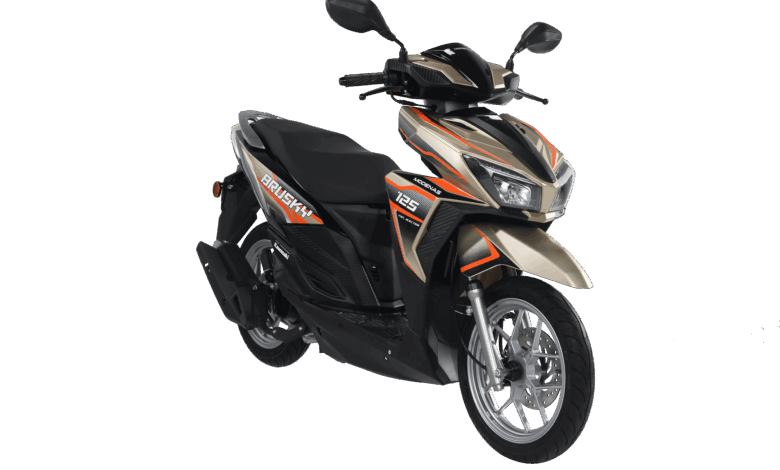
Kawasaki has taken a more serious step into Indonesia’s daily scooter market with the introduction of the Brusky 125. The move stands out because the brand long associated with sport, trail, and adventure motorcycles is now entering one of the country’s busiest two-wheeler segments.
Unveiled at Pekan Raya Jakarta 2026, the Brusky 125 signals a shift in Kawasaki’s strategy. It is a direct attempt to reach everyday riders in a class that has long been dominated by Honda and Yamaha.
Sporty styling aimed at commuters
The Brusky 125 uses a sharp body design with a slim silhouette that gives it a more aggressive look than many mainstream commuter scooters. Kawasaki appears to be targeting buyers who want a practical scooter without giving up a strong sporty identity.
Lighting is handled by LED headlamps, which add a modern touch while improving visibility. The instrument panel combines analog and digital elements, keeping the display easy to read without looking overly complicated.
Kawasaki also includes a USB port, a useful feature for urban riders who depend heavily on mobile devices throughout the day.
Built to feel approachable
The scooter is designed to be accessible to a wide range of riders. Its seat height is around 760 mm, which should make it friendlier for different body types and easier to handle in daily use.
At 108 kg, the Brusky 125 is also relatively light. That weight should help when maneuvering in traffic or parking in tight spaces, two situations that define city commuting.
125 cc engine focused on efficiency
Power comes from a 125 cc single-cylinder SOHC air-cooled engine with electronic fuel injection. The setup is aimed more at efficiency and ease of use than outright performance.
Output is listed at around 9.3 to 9.6 hp at 7,500 rpm, while torque reaches 10 Nm at 6,000 rpm. Power is sent through a CVT transmission, which should deliver smooth acceleration in stop-and-go traffic.
The figures make clear that the Brusky 125 is not being positioned as a high-speed scooter. Its main strengths are practicality, fuel efficiency, and everyday comfort.
Prepared for daily riding
Suspension duties are handled by telescopic forks at the front and a monoshock at the rear. The combination is intended to improve comfort on roads that are not always in ideal condition.
The fuel tank holds 5.1 liters, which adds to its daily usability when paired with the engine’s efficiency-focused character. Kawasaki has priced the Brusky 125 at around Rp26.5 million.
That price places the scooter in a highly competitive class where brand loyalty, fuel economy, convenience, and dealer support matter greatly. The challenge for Kawasaki will not only be the specification sheet, but also whether riders accept it as a real alternative in the 125 cc scooter market.
For Kawasaki, the Brusky 125 is more than just another model in the lineup. It is a clear sign that the company wants to move beyond its sport and adventure image and start competing for riders who need a scooter that is frugal, functional, and still visually distinct on the road.