


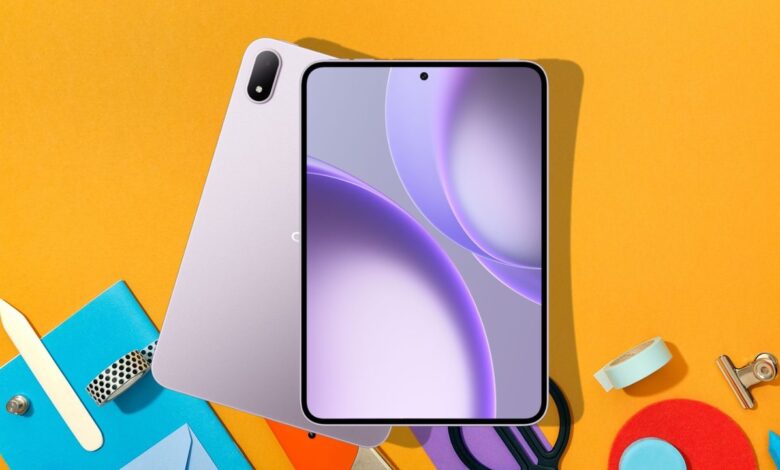
Oppo Pad Mini is shaping up as a serious challenge to the iPad Mini, and the biggest pressure point is easy to see. Its OLED display gives it an immediate advantage in contrast, perceived sharpness, and everyday brightness.
That advantage matters most when the tablet is used for HDR content and APL testing, where the gap becomes especially noticeable. Apple’s iPad Mini 7 reached 525 cd/m² in testing, but that result still falls well behind Oppo Pad Mini.
Display hardware gives Oppo the clearer edge
Beyond the OLED panel, Oppo Pad Mini also offers a 144 Hz refresh rate. That should make scrolling and interface navigation feel more responsive than on a device limited to a 60 Hz panel.
The iPad Mini still relies on an IPS display at 60 Hz, a combination that keeps the long-discussed “jelly scrolling” issue in the conversation. For a compact tablet, screen behavior is one of the most visible factors in everyday use.
Why the difference is easy to notice in daily use
Higher brightness gives Oppo Pad Mini a practical advantage across more lighting conditions, while OLED contrast helps content look richer and more vivid. Those are the kinds of differences that users notice quickly once the tablet is out of the box.
Apple still has a strong audience for iPad Mini, but in display quality the gap is hard to ignore. Even with a solid test result of 525 cd/m², the Apple tablet does not close the distance in the areas that matter most to visual comfort.
HDR playback is another place where Oppo Pad Mini stretches the lead further. In that kind of usage, the difference is not only visible on paper but also much more obvious in real-world viewing.
| Feature | Oppo Pad Mini | iPad Mini 7 |
|---|---|---|
| Display type | OLED | IPS |
| Refresh rate | 144 Hz | 60 Hz |
| Brightness result mentioned | Higher than iPad Mini in use | 525 cd/m² |
| Key advantage | Better contrast and brightness | Compact form factor |
Not just a screen upgrade
Oppo Pad Mini is described as carrying a very large set of features, which makes the device feel unusually well equipped for a compact tablet. That broad feature set adds to its appeal for buyers who want a small form factor without giving up much capability.
There is, however, one important limitation for some markets. A formal launch in Europe appears unlikely, which may restrict access for many potential buyers.
Even so, the comparison leaves Apple in an uncomfortable position. For users who rank display quality first, Oppo Pad Mini looks like the more convincing option, and the battery difference mentioned in the broader comparison makes the pressure even stronger.
In the small-tablet segment, size alone is no longer enough to protect iPad Mini’s position. When a rival brings OLED, a higher refresh rate, stronger brightness, and better battery performance into the same compact class, the competitive gap becomes much harder to defend.