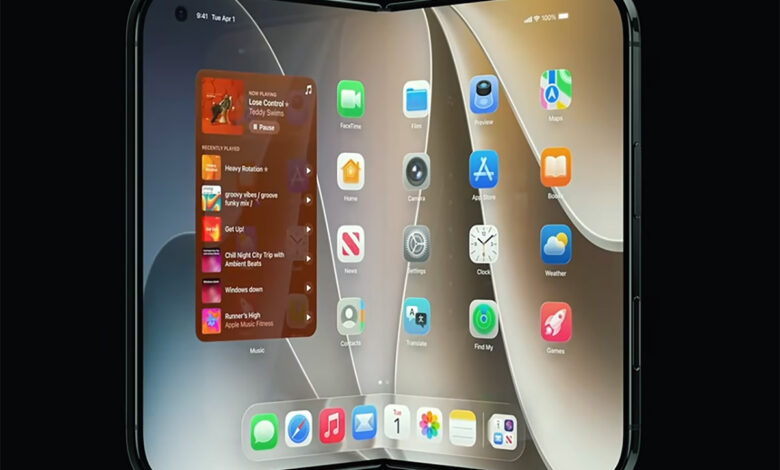
Apple appears to be preparing two very different premium iPhone paths at once. One is built around refinement, while the other moves into a new foldable format that could redefine the company’s highest-end lineup.
Both devices are reported to be scheduled for September 2026, giving Apple a dual launch strategy that serves users who want a familiar flagship and those ready for a more experimental form factor. The contrast is clear: the iPhone 18 Pro focuses on polish, while the iPhone Ultra is positioned as a book-style foldable.
The iPhone 18 Pro stays close to the classic formula
The iPhone 18 Pro is described as an evolution rather than a redesign. Its main changes target the display, camera system, and performance, while keeping the overall identity of Apple’s Pro lineup intact.
One of the most visible updates is a smaller Dynamic Island. In the details circulating around the device, the cutout is said to be 35 percent narrower, which would make the front of the phone look cleaner without removing Face ID support.
| iPhone 18 Pro Series Highlights | Details |
|---|---|
| Display sizes | 6.3 inches and 6.9 inches |
| Panel | LTPO Plus Super Retina XDR OLED |
| Refresh rate | 1-120Hz |
| Peak brightness | 3,000 nits |
| Main chip | A20 Pro on TSMC 2nm |
| Modem | C2 5G modem |
Apple is also said to be preparing LTPO Plus panels for the Pro and Pro Max models. Those displays measure 6.3 inches and 6.9 inches, with a 1-120Hz refresh rate on Super Retina XDR OLED technology.
The display upgrade is not only about smoother animation. LTPO Plus is also expected to improve power efficiency, brightness, and responsiveness, which matters for gaming, streaming, and multitasking.
Camera and silicon get a serious upgrade
The camera system is another major focus. The main camera on the iPhone 18 Pro is reported to be 48 MP, and one of the standout additions is variable aperture for better control over light and depth of field.
The telephoto lens is also said to have a wider aperture, which should help produce sharper and more detailed zoom shots in low light. In the leaked specification breakdown, the Pro model uses a 48 MP periscope telephoto camera with 5x optical zoom.
| Camera and Performance Details | iPhone 18 Pro / Pro Max |
|---|---|
| Main camera | 48 MP with variable aperture |
| Ultra-wide camera | 48 MP, F2.2 |
| Front camera | 24 MP Center Stage |
| Telephoto | 48 MP periscope, 5x optical zoom on Pro |
| Telephoto zoom on Pro Max | 5x or 8x optical zoom |
| RAM | 12GB GDDR7 |
The Pro Max may go even further, with the same 5x or an 8x optical zoom option depending on the final configuration. The ultra-wide camera on both Pro models is said to be 48 MP with an F2.2 aperture, while the front camera is a 24 MP Center Stage unit.
Under the hood, the iPhone 18 Pro is expected to run on the A20 Pro chip built with TSMC’s 2nm process. Apple is also reported to use its second-generation in-house C2 5G modem, replacing Qualcomm hardware and aiming for faster, more reliable connectivity.
New colors and premium materials complete the package
The memory specification reportedly rises to 12GB GDDR7 RAM, supported by a body that still uses premium materials. The combination mentioned is Grade 5 Titanium and aluminum, keeping the Pro series aligned with Apple’s high-end positioning.
Color choices are also part of the refresh. The expected lineup includes black, silver, light blue, and dark cherry, with orange said to be removed from the previous generation’s palette.
The iPhone Ultra takes Apple into foldables
While the iPhone 18 Pro is about refinement, the iPhone Ultra is framed as Apple’s entry into a new category. It is described as a book-style foldable that turns from a phone into a compact tablet-like device for multitasking, work, and media use.
The external screen is said to measure around 5.3 to 5.5 inches, while the inner display reaches 7.7 to 7.8 inches and reportedly resembles the shape of an iPad mini. The body is also described as extremely thin, measuring about 4.5 mm when opened and around 9.5 mm when folded.
| iPhone Ultra Foldable Details | Reported Specs |
|---|---|
| Design | Book-style foldable |
| Outer display | 5.3 to 5.5 inches |
| Inner display | 7.7 to 7.8 inches |
| Thickness | About 4.5 mm open, 9.5 mm folded |
| Material | Titanium alloy casing with stainless steel hinge |
The materials are equally premium, with a titanium alloy casing and a stainless steel hinge. That design choice suggests Apple is aiming to balance luxury with the structural demands of a foldable device.
Performance is also expected to remain flagship-level. The device is reported to use the A20 series chip and Apple’s C2 5G modem, although one part of the leaked information refers to A20 Pro while another lists an Apple A20 2nm TSMC chip.
Biometrics, cameras, and pricing mark the difference
The iPhone Ultra takes a different approach to biometrics and cameras. Instead of Face ID, it is said to use Touch ID built into the side power button, and its rear system is reportedly limited to a 48 MP main sensor and an ultra-wide camera.
There is no dedicated telephoto lens, which appears to be a space trade-off caused by the ultra-thin foldable body. On the front, the device is said to include two 18 MP cameras, one on the internal screen and one on the cover display.
| iPhone Ultra Core Features | Details |
|---|---|
| Biometrics | Touch ID in the side power button |
| Rear cameras | 48 MP main and ultra-wide, no telephoto |
| Front cameras | Two 18 MP cameras |
| Reported price | $2,500, with another estimate at $1,999 to $2,399 |
Pricing places the Ultra at the very top of Apple’s lineup. One description puts the starting price at $2,500, while another estimate suggests a range of $1,999 to $2,399, indicating that commercial details may still be in flux.
Even with that uncertainty, the direction is obvious. Apple appears ready to keep the iPhone 18 Pro as a polished flagship option while using the iPhone Ultra to enter foldables at a price point that signals how ambitious the move is.