Zoox is moving closer to a commercial launch with a redesigned robotaxi that keeps its unusual shape but adds practical changes for public use. The Amazon-backed company is preparing to open paid service in the United States after years of offering free rides in select cities.
The new model is part of a broader shift from demonstration to deployment. Zoox says the updated vehicle was designed to improve comfort and usability as it prepares for mass production of its commercial fleet.
A paid service is now the main target
Zoox currently offers free rides in several U.S. cities, including Las Vegas, San Francisco, Miami, and Austin. The next step is a paid service that could arrive before the end of this year, pending regulatory approval.
The company has petitioned the National Highway Traffic Safety Administration for permission to operate up to 2,500 driverless vehicles on public roads for commercial use. That request remains under review after the public comment period closed in early April.
Approval matters because Zoox’s robotaxi was built without a steering wheel or pedals, placing it outside the standard federal setup required for most vehicles in the United States.
| Key Zoox Robotaxi Milestones | Status | Details |
|---|---|---|
| Free rides | Active | Available in Las Vegas, San Francisco, Miami, and Austin |
| Paid service | Planned | Could launch before the end of this year |
| Commercial fleet request | Under review | Up to 2,500 driverless vehicles |
| Manufacturing target | Planned | Plant capacity could reach 10,000 vehicles per year |
The shape stays familiar, but the details change
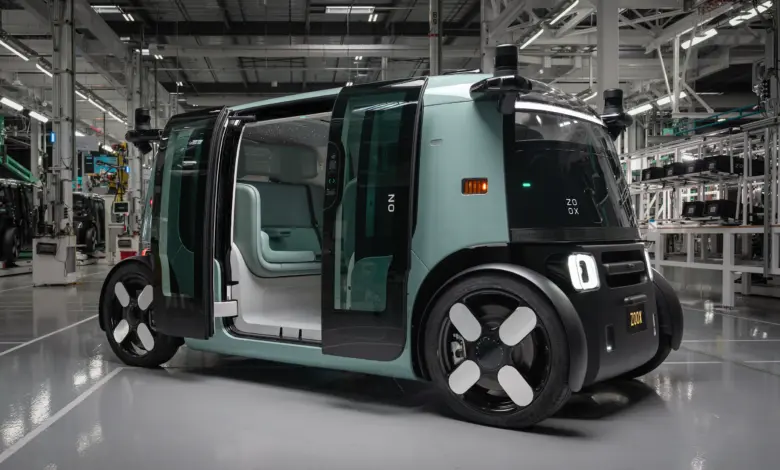
From the outside, the robotaxi still looks like a carriage with nearly identical front and rear ends when viewed from the side. Its elongated boxy body has long drawn comparisons to a toaster, and that design remains intact.
The vehicle can drive in both directions and reach speeds of up to 75 mph, or about 120 km per hour. That two-way driving concept remains one of Zoox’s clearest differences from conventional cars.
Zoox has now made several visible changes to help the vehicle work better on public roads. The company enlarged and repositioned dual-direction reflectors so passengers, police officers, and emergency responders can more easily identify the front and rear of the vehicle.
It also added speakers, microphones, and two-way audio capability at the door interface. Those updates point to a stronger focus on passenger interaction and day-to-day operational use.
Existing features remain in place, including the moonroof, the starry interior lighting theme, and the camera, radar, lidar, and infrared sensor suite used to monitor surroundings.
Inside, Zoox is putting comfort first
The cabin still uses a minimalist layout with four seats arranged face to face. Because the vehicle is fully autonomous, there is no steering wheel and no pedal set inside.
The latest version adds an updated touchscreen and improved seat and headrest comfort with extra padding. Zoox also moved to a brighter interior palette, using aloe green seats and stone-gray trim.
Other changes are practical as well. Cup holders are now larger, and the charging pad has grooves to keep a phone from sliding around during a ride.
Zoox says the interior updates also make it easier for riders to spot items left behind, such as keys and phones. That kind of design detail matters more as the company prepares the vehicle for broader public use.
Production plans are expanding alongside demand
Zoox says it has carried more than 500,000 passengers since launching service in Las Vegas in September. The figure suggests growing interest in the company’s robotaxi program even before a full paid rollout.
The company also partnered with Uber in March to bring its robotaxi to the platform in Las Vegas. That agreement could become an important distribution channel once commercial service expands.
To support that expansion, Zoox plans to begin mass production at its manufacturing facility in Hayward, California. The plant opened in June and could eventually produce 10,000 vehicles per year.
Initial output is expected to rise to 100 vehicles per week, depending on regulatory approval. That scale-up shows Zoox is shifting from testing technology to building an industrial base for commercial operations.
Waymo still sets the pace
Zoox remains behind Waymo, Google’s self-driving unit, in the robotaxi race. Waymo recently said it has exceeded 500,000 paid rides per week across 10 U.S. cities.
Waymo also plans to expand commercial service to new cities this year, including London and Tokyo. That competitive pressure makes Zoox’s move toward paid rides and large-scale production even more important.
As autonomous vehicles become more visible on public roads, Zoox’s redesigned robotaxi shows that the contest is no longer only about sensors and software. Passenger comfort, production readiness, and regulatory approval are now central to who moves fastest in the market.