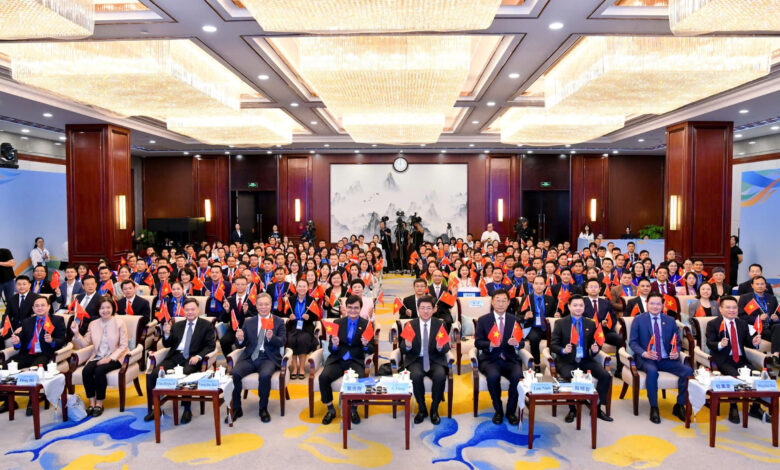
Guangxi’s pitch to ASEAN youth was not a speech about the future, but a demonstration of it. During a three-day visit to Nanning and Qinzhou, delegates from several ASEAN twin cities saw robots, smart devices, logistics infrastructure, and vocational training sites that showed how artificial intelligence is already embedded in daily life and industry.
The visit, held from June 23 to 25 at the invitation of Guangxi’s foreign affairs authorities, brought together more than 20 young representatives from seven twin cities in Cambodia, Indonesia, Malaysia, Myanmar, and the Philippines. The program quickly turned from observation into a discussion of practical cooperation in education, industry, and regional connectivity.
AI tools that caught the delegates’ attention
At the Guangxi-ASEAN Physical AI Innovation Center, the delegation watched robots handle tasks in banking, retail, and cultural settings. A robot barista and interactive demonstrations drew particular interest, underscoring how AI is moving beyond lab settings into public-facing services.
The group also visited the China-ASEAN Artificial Intelligence Innovation Cooperation Center, where they were introduced to a range of AI-based products. These included traditional Chinese medicine diagnostic devices, translator glasses, and a biomimetic robotic fish.
La Ode Muhammad Faisal Wikra Kusuma Wardana, a cultural affairs official from West Java Province, said the visit gave him a deeper understanding of the importance of learning from China’s fast-moving technological progress. He said the scale of innovation made clear that AI will play an increasingly important role in improving people’s lives.
| Site Visited | Main Focus | Notable Examples |
|---|---|---|
| Guangxi-ASEAN Physical AI Innovation Center | Applied AI demonstrations | Robot barista, banking, retail, and cultural tasks |
| China-ASEAN Artificial Intelligence Innovation Cooperation Center | AI product showcase | Traditional Chinese medicine diagnostic devices, translator glasses, biomimetic robotic fish |
Interest in AI was not limited to industrial applications. Delegates from Myanmar said the health-related demonstrations were especially memorable, after seeing an AI-based health assessment device that analyzed facial features and tongue images to evaluate a person’s condition.
Htet Htet Yi Nway Oo said AI has broad prospects in healthcare and could also be used for eldercare robots. Her comments reflected a wider impression among the visitors that the technology could become useful in sectors where demand is rising quickly.
Industry links and logistics in focus
The delegation’s itinerary also highlighted how China and ASEAN are already connected through industry. One stop was Guangxi Jingui Pulp & Paper Co., Ltd., a subsidiary of Asia Pulp & Paper under Indonesia’s Sinar Mas Group, where production lines were reported to be running at full capacity.
The company’s premium carton products are exported to ASEAN markets and used for pharmaceutical, cosmetic, consumer goods, and electronics packaging. For the visitors, that made the cooperation story more tangible: the relationship is not only built in forums, but also in supply chains, exports, and shared production bases.
| Company | Connection | Products and Use |
|---|---|---|
| Guangxi Jingui Pulp & Paper Co., Ltd. | Subsidiary of Asia Pulp & Paper under Sinar Mas Group Indonesia | Premium carton products for pharmaceutical, cosmetic, consumer goods, and electronics packaging |
Wardana said Guangxi’s proximity to ASEAN gives the region an advantage in cooperation, especially through ports and transport networks. He also pointed to the Pinglu Canal, saying the project is expected to improve logistics connectivity and create new opportunities for trade and industrial collaboration.
Alongside AI sites and industrial facilities, the delegation visited a smart port and major infrastructure projects. Those stops helped frame Guangxi as a regional link that can support both technological exchange and economic integration with ASEAN.
Vocational education becomes a concrete outcome
The visit also produced results in vocational education. On June 25, four institutions joined the Guangxi International Twin-City Vocational Education Alliance during an exchange event, bringing the alliance’s membership to 77.
The new members were Yangon University of Economics in Myanmar, Mariano Marcos State University in the Philippines, Guangxi Vocational and Technical College of Mechanical and Electrical Engineering, and Nanning No. 3 Vocational Secondary School. Guangxi authorities said cooperation with ASEAN partners is expanding through joint training programs, practical training bases, and skills competitions in emerging fields such as AI and the digital economy.
That focus suggests the relationship is being shaped around workforce preparation as much as symbolism. The aim is to build skilled talent for regional development, with practical training positioned as a bridge between classroom learning and future industrial needs.
Wardana described vocational education as an important bridge for shared development. After returning to West Java, he plans to share the lessons from the visit with provincial departments and hopes the two sides can expand cooperation in AI, vocational education, culture, and tourism.
For the young delegates, Guangxi offered more than a showcase of innovation. It presented a working model of how AI, industry, infrastructure, and education can be tied together in a way that makes ASEAN-China cooperation feel immediate and concrete.