


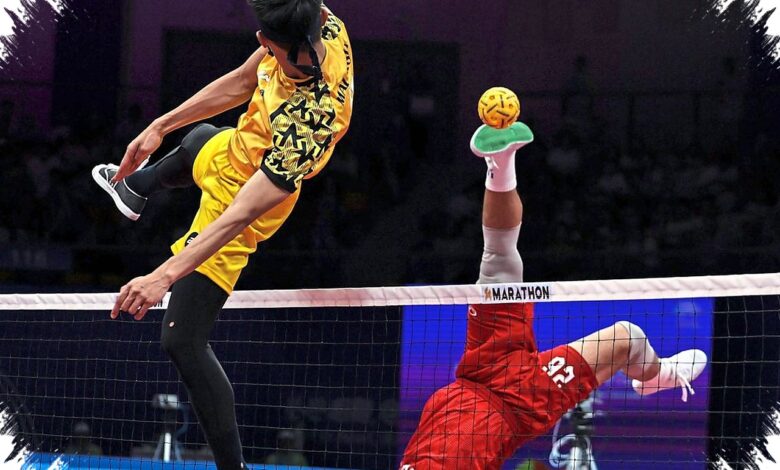
Takraw photos can now be turned into cinematic sports images without erasing the player’s identity. With carefully written Gemini AI prompts, the results can emphasize motion, lighting, and match atmosphere while still looking realistic.
The appeal is straightforward: takraw moves fast, and the sport is built on agility, body balance, and tight coordination. That makes it ideal for dramatic photo edits, especially when a single frame needs to capture a leap, a kick, or a save that cannot be repeated in real time.
Why takraw works well for AI-driven editing
Sports photography often carries strong emotional value because it can freeze tension, effort, and expression in one frame. AI tools then add another layer, helping sharpen lighting, enrich detail, and keep facial identity intact when the prompt is written with enough precision.
Cinematic styling remains the most popular direction for these edits. Low-angle compositions, warm late-afternoon light, shallow depth of field, and a visible crowd can make a takraw scene feel like a professional action photograph rather than a casual snapshot.
Small visual details matter just as much. Flying dust, subtle motion on the ball, realistic shadows, and a clear court layout help build a stronger sense of match intensity.
1. Backflip kick in an open court
One prompt places the subject in a backflip kick scene on an outdoor court during the golden hour. It asks Gemini AI to preserve facial features, skin tone, hair texture, and body proportions while adding spectators in the background and a light dust trail from movement.
The ball is also described with soft motion effects, but the body should remain sharp. The intended result is a realistic, cinematic sports photo that looks like it was captured by a professional photographer.
2. Receiving the ball while balancing on one leg
Another prompt focuses on a takraw moment where the player receives the ball with one leg raised high. The expression is meant to look confident and energetic, with sharp eyes and a busy outdoor court full of spectators.
Natural side lighting is used to define the face and body in clearer dimension. Realistic shadows, crisp textures on clothing, skin, and hair, and a low camera angle help reinforce the professional sports look.
| Scene | Main Focus | Visual Effect |
|---|---|---|
| Backflip kick | Identity, motion, crowd | Golden hour, dust, cinematic realism |
| Ball receive | Balance, expression, court action | Side lighting, sharp textures, low angle |
| High jump play | Official match intensity | Stadium depth, controlled natural light |
| Block and celebration | Defense, victory mood | Soft sunlight, blurred spectators, natural emotion |
| Chasing the ball | Speed, outdoor setting | Realistic shadows, subtle motion, traditional court feel |
3. High jump in an official match
A third prompt turns the photo into a high leap to chase the ball in an official match. A small stadium with full stands, balanced natural light, and depth of field are used so the subject remains the main focus.
The takraw ball is placed close to the foot, then dust and motion are added to make the scene feel more dynamic. The final result is intended to resemble a highly realistic professional match document.
4. Block near the net and point celebration
For a defensive moment, one prompt shows the subject blocking near the net while an opponent stands on the other side. The eyes are directed at the ball, the afternoon sunlight is kept soft, and the spectators are blurred so attention stays on the player.
Another prompt changes the frame into a scene after a successful point. A natural victory smile appears, teammates are added in the background, and cheering spectators with a realistic court atmosphere complete the celebration mood.
5. Running to chase the ball
The final option shows a player sprinting after the ball on an open court. Facial features, distinctive traits, and expression are kept intact, while late-day light, realistic shadows, a traditional court with trees, and subtle motion effects make the scene feel alive.
A low angle is used again to heighten the professional sports impression. With clothing, skin, and hair kept clearly defined, the image is designed to look dramatic, cinematic, and still natural when shared on social media.
Takraw images also carry cultural value because the sport is part of the identity of communities across several Southeast Asian regions and remains recognized internationally. Realistic photos can help make that heritage feel more accessible to younger audiences while keeping the competitive spirit visible in a single frame.