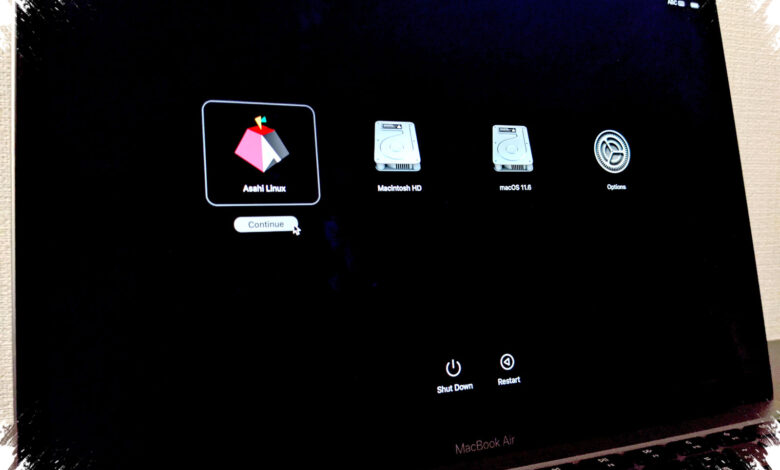
Linux on Apple Silicon MacBooks is moving past the stage of bare-metal boot success and into something far more practical. On the MacBook M3, new driver work is finally bringing life to the built-in keyboard, one of the biggest obstacles to daily use.
This matters because a laptop that only boots Linux is still far from comfortable to operate. Without working internal input devices, the machine remains more of a technical demonstration than a usable workstation.
Why the keyboard breakthrough matters
According to Phoronix, a series of 10 patches is now focused on internal keyboard support for Apple Silicon MacBook models, including M2 and M3 devices. The goal is to make the built-in keyboard usable under Linux, not just to confirm that the system can start.
The challenge comes from the way Apple handles internal input hardware. Rather than exposing it like a typical laptop controller, Apple routes management through a dedicated coprocessor running RTKit-based software.
That coprocessor communicates with the main processor over a low-latency byte FIFO interface called DockChannel. Linux therefore needs a driver path that understands this channel before the internal keyboard can function properly.
| Patch Component | Role | Purpose |
|---|---|---|
| apple-dockchannel mailbox driver | Communication layer | Handles the DockChannel mailbox path |
| DockChannel HID transport driver | Device enablement | Wakes the coprocessor and wraps the HID protocol for Linux |
| apple-rtkit and hid-apple updates | Driver adjustments | Aligns existing drivers with the new input path |
| Devicetree bindings and DTS updates | Hardware description | Refines MacBook M2 and M3 node definitions |
To make that possible, the patch set introduces the apple-dockchannel mailbox driver and a DockChannel HID transport driver. The same work also adjusts apple-rtkit and hid-apple, while updating Devicetree bindings and DTS files for MacBook M2 and M3 nodes.
From bootable to practical
Linux had already reached an important milestone on the MacBook M3 by booting through kernel Linux 7.2. Even so, the lack of built-in input support kept the experience firmly in experimental territory.
That limitation is what makes the new keyboard progress stand out. A system that can power on and reach the desktop is useful only in theory if the user still cannot rely on the laptop’s own keyboard.
For anyone following Apple Silicon support, this changes the conversation. The focus is no longer only on whether Linux can start, but on whether it can begin to function as a realistic daily operating system on Apple hardware.
Trackpad support is still missing
Even with the keyboard breakthrough, the job is not finished. Internal trackpad support remains absent, so Linux on the MacBook M3 still lacks a complete built-in input solution.
That means the laptop is not yet at the point where it can be called fully comfortable for everyday use. The keyboard milestone is important, but the trackpad remains the next major hurdle.
Still, the direction of development is clear. Once the DockChannel and RTKit paths are understood well enough for the keyboard, the same foundation can help guide future work on other internal devices.
A broader community effort
The progress also reflects how Linux support for closed hardware usually advances. Developers do not solve everything at once; they uncover each hardware layer, then build support piece by piece until core functions become reliable.
If the apple-dockchannel work makes its way fully into the kernel mainline, it will become part of the long-term support base rather than a separate experiment. That would make it easier for distributions to inherit the work and keep it maintained over time.
For MacBook M3 owners hoping for a more usable Linux setup, this is not the final answer yet. It is, however, the clearest sign so far that the internal keyboard is no longer the missing piece it once was.