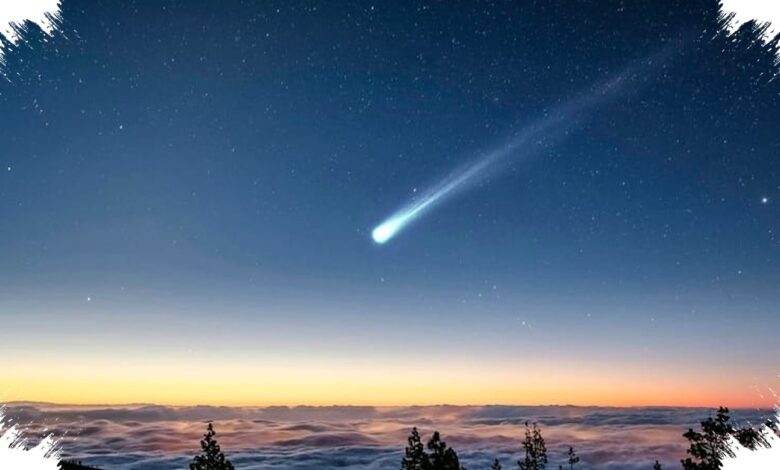
Astronomers are revisiting a surprising idea: some objects that were once thrown out of the Solar System may not be gone for good. Under the Sun’s gravity, a small number can drift back into the inner system as so-called quasi-interstellar objects.
These bodies are not true visitors from another star system. They were born in the Solar System, were pushed far into space, and later returned while remaining only weakly bound to the Sun’s pull.
Not Truly Lost in Space
The finding changes the way scientists think about comets and asteroids that escape the region near the planets. Some do not fully break free, even after traveling enormous distances into interstellar space.
The key lies in the dynamics of the Oort Cloud, the distant reservoir where many comets originate. According to the statistical model discussed by researchers, about 95 percent of original Solar System comets and asteroids have already been ejected into interstellar space since the system formed, equal to roughly 10,000 trillion giant rocks.
| Key Fact | Explanation | Figure |
|---|---|---|
| Quasi-interstellar objects | Solar System bodies that were ejected and later pulled back by the Sun | Not specified |
| Objects already ejected | Original Solar System comets and asteroids now drifting far outside the system | 95 percent |
| Estimated rock count | Scale of material expelled into interstellar space | 10,000 trillion |
Even at those distances, some of these rocks are still affected by the Sun’s gravity. That lingering influence is enough to bring a fraction of them back into the region where they can be tracked again as part of Solar System dynamics.
How They Differ From True Interstellar Visitors
Researchers stress that these returning objects are very different from genuine interstellar bodies. In their preprint, they wrote that quasi-interstellar objects differ dramatically from true interstellar objects in almost every respect.
One of the clearest differences is speed. Boomerang-like comets are expected to move much more slowly when passing near our planetary region than outsiders such as ‘Oumuamua or Comet Borisov.
Detection is also far more difficult. Their numbers are tiny, with fewer than one object per year estimated inside Jupiter’s orbit, making observation a rare event.
The similarity to long-period comets from the Oort Cloud adds another layer of confusion. Objects may be seen, but they are not easily recognized as quasi-interstellar at first glance.
A Hard Target for Future Telescopes
Even advanced projects such as the Legacy Survey of Space and Time, or LSST, at the Vera Rubin Observatory are expected to struggle to identify these objects with certainty. That difficulty reflects how subtle and uncommon their signatures are.
Still, the study offers a broader view of how small bodies move through the Solar System, how they migrate, and how some can return after being flung far away. In that sense, the Sun does more than hold the system together; it can also reclaim what once seemed permanently lost.
The research leaves open a striking possibility for future observations: the interstellar road may not always be one-way, and some of the Solar System’s own debris can come back on a long, faint, and difficult-to-trace path.