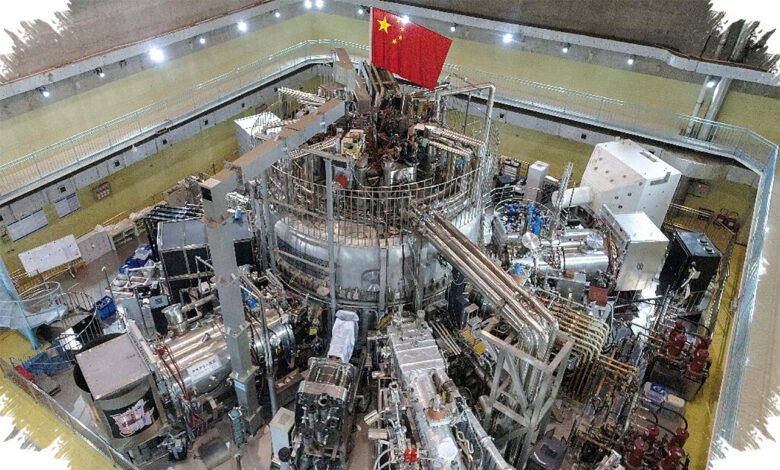
China’s fusion program is moving beyond laboratory proof and into the harder question of practical electricity generation. With the core technologies for the EAST reactor now localized, the country is aiming for its first fusion-based power around 2030.
That shift matters because the project is no longer framed only around controlling plasma. The focus is now on whether a fusion reactor can operate stably enough to produce electricity in a real power system.
Superconducting magnets become the key milestone
The latest progress centers on two main superconducting magnets that have completed technical testing and full-load testing. These components are part of the next-generation fusion reactor being developed by the Chinese Academy of Sciences.
Qin Jinggang, deputy director of the Institute of Plasma Physics at ASIPP, said the magnet program began about six years ago. The team was asked to improve performance while also lowering production costs.
| Component | Main Detail | Impact |
|---|---|---|
| Main superconducting magnets | Passed technical and full-load tests | Critical for the next generation of fusion reactor |
| Core technology localization | Reached 100% | The full supply chain is now produced in China |
| Superconducting material cost | Down from about 400 yuan to about 100 yuan per meter | Significantly reduces production cost |
China announced at the end of June that development of the two main superconducting components had been completed. The country also said the entire supply chain is now manufactured domestically.
Cost reduction is another major step forward. Superconducting material that once cost about 400 yuan per meter is now said to be about 100 yuan per meter, a significant change for a project that depends on precision engineering and expensive materials.
Built for extreme conditions inside the reactor
The magnets are shaped like a D and measure 21 meters long, 12 meters wide, and 3.3 meters high. Each coil weighs about 580 tons, up from about 350 tons in the earlier design.
Their energy storage capacity has also been increased to support a fusion reactor with higher energy levels. In the final reactor setup, 16 similar magnets will be assembled into a complete toroidal magnetic field with a center strength of 6.5 tesla.
ASIPP researcher Wu Yu explained that the magnet’s role is to keep plasma confined inside the vacuum chamber so it does not strike the reactor wall. Without that containment, the plasma would spread out and the fusion reaction could not continue.
Without fusion, the extreme heat needed to generate electricity would not be produced either. That is why the superconducting magnet has become one of the biggest technical hurdles now being overcome.
Testing is not the same as deployment
Qin said the work is still not finished even after the laboratory tests. In his view, the project has completed only about 80% of the journey.
The next step is to install the magnets inside the fusion reactor and prove that they can remain stable over long periods under extremely harsh operating conditions. Qin said nuclear fusion remains one of the most difficult technologies to master.
The compact experimental fusion reactor using the magnets is scheduled to be completed no earlier than the end of 2027. If testing proceeds as planned, that facility will serve as the basis for China’s first demonstration of fusion power generation around 2030.
If the target is met, China would be among the first countries in the world to demonstrate electricity generation from nuclear fusion. The technology is often described as the holy grail of clean energy because it could deliver enormous power without carbon emissions and without the long-term radioactive waste associated with conventional nuclear plants.
China also recorded another milestone in 2025, when EAST sustained plasma at about 100 million degrees Celsius for 1,066 seconds, or about 17.7 minutes. That achievement strengthens the sense that the path toward fusion electricity is becoming more realistic, even if the toughest engineering work is still ahead.