


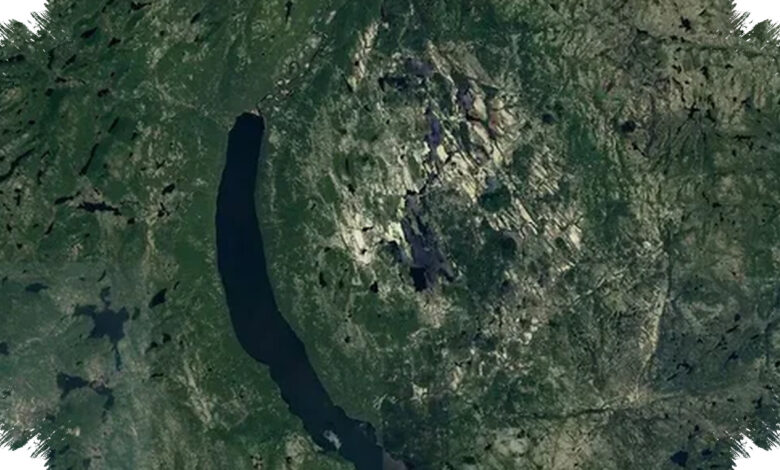
A search for a camping location on Google Maps has led to the confirmation of a previously unrecorded meteor impact crater in Quebec, Canada. The structure, named Uhackatik, is estimated to be about 390 million years old and measures 25 kilometres across.
The discovery began with an unusual circular depression visible in satellite imagery, but it required a demanding field expedition to establish its origin. Researchers found distinctive rocks that confirm the landform was created by a major celestial impact rather than ordinary geological processes.
| Feature | Details |
|---|---|
| Crater name | Uhackatik |
| Estimated age | 390 million years |
| Diameter | 25 kilometres |
| Location | Côte-Nord, Quebec, Canada |
Rocks Provide the Decisive Evidence
The planetary geology team found impact melt rocks, material formed under the exceptional heat and pressure produced by an impact event. It also identified shatter cones, a distinctive rock structure strongly associated with high-energy impacts.
Shatter cones are known to occur only at meteor impact sites or nuclear bomb test locations. Together with the impact melt rocks, they provided strong evidence that the Quebec depression is a genuine impact crater.
With a diameter of 25 kilometres, Uhackatik is a substantial addition to the global record of confirmed impact structures. The crater now belongs to a group of roughly 200 confirmed impact craters worldwide.
A Five-Day Route to the Crater
The site’s remoteness was a major obstacle to the research team during its 2025 expedition. A seaplane could only land offshore, requiring the researchers to cross water while transporting heavy equipment.
The group then spent five days travelling through forest and rugged terrain to reach the sampling area. Professor Gordon Osinski of Western University described it as one of the most difficult expeditions he had undertaken across six continents.
The difficult access helps explain why a structure of this size had not previously been scientifically identified. Satellite images could reveal its circular outline, but the crater required field samples to determine its true nature.
An Amateur Observer Spotted the Clue
Joël Lapointe, an amateur stargazer, noticed the unusual formation in 2024 while examining satellite imagery for a camping trip. The feature lies about 100 kilometres north of the village of Magpie in Quebec’s Côte-Nord region.
Lapointe suspected that the circular pattern could be linked to an impact by an object from space and contacted Osinski’s planetary geology team. That observation prompted the field investigation that later confirmed the crater.
According to CNBC Indonesia, geologist Jérôme Gattacceca, a member of the research team, said the discovery shows that Earth still holds remarkable surprises. The team is scheduled to present further details of the Uhackatik Crater finding at the Annual Meeting of the Meteoritical Society in Germany next month.
Lapointe said the experience demonstrates the value of following up on observations that may initially seem ordinary. “Never ignore your intuition or observations, even if it is not your field of expertise,” he said.