


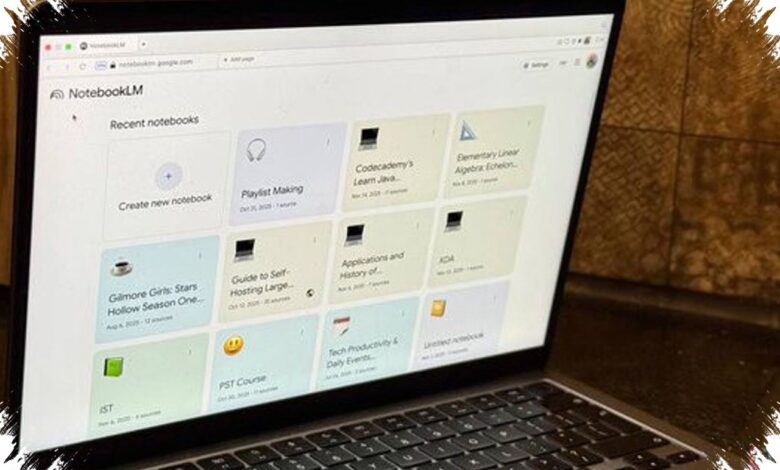
Google has renamed NotebookLM as Gemini Notebook and added a cloud-based capability that can write and run code within the service. The change expands the document-focused research tool beyond summarisation and question answering.
With the new capability, users can analyse spreadsheet data, generate charts, and run statistical calculations without relying on their own device. The work remains grounded in the files and sources that users add to a notebook.
A Research Tool That Can Process Data
Gemini Notebook is designed to work with research materials that include figures, tables, and datasets. Users can ask the service to prepare code for an analysis and execute it directly through cloud computing.
Google said the feature can automatically process datasets and turn spreadsheet information into charts. It can also be used for statistical calculations based on the data contained in a user’s notebook.
The service supports a range of user-provided materials, including PDFs, articles, notes, audio recordings, presentations, and spreadsheet data. This source-based approach keeps its analysis tied to the context supplied by the user.
The new function changes Gemini Notebook’s role from a tool that primarily reads and condenses documents into one that can also process the data inside them. It does not remove the service’s original emphasis on organising references and understanding reading materials.
Availability Depends on the Google Plan
Gemini Notebook is already available to Google AI Ultra subscribers and Google Workspace customers. Support for Google AI Pro customers on the web will roll out gradually over the coming weeks.
| Service | Gemini Notebook Access | Details |
|---|---|---|
| Google AI Ultra | Available | Service can already be used |
| Google Workspace | Available | Service can already be used |
| Google AI Pro on the web | Gradual rollout | Support is due over the coming weeks |
Google has not provided a complete timetable for wider availability. The company also has not detailed the full schedule for the planned expansion of integrations.
From Google Labs Experiment to Gemini Product
NotebookLM was first introduced in 2023 as a research assistant built to understand and summarise multiple documents. In its early phase, it was an experimental project under Google Labs.
Google said in its official blog that the service has now been used by more than 30 million people. It also said that more than 600,000 organisations worldwide use Gemini Notebook.
The rebrand clarifies the product’s place within Google’s Gemini family of AI services. Despite the new name, Gemini Notebook remains available as a standalone application for the time being.
Broader Integration Is Planned
Google is preparing broader Gemini Notebook integration with the Gemini app and Google Search. The intended result is to let users continue research work without repeatedly moving between separate applications.
That plan positions the service as a potential hub for reference management and AI-based analysis across Google’s products. Google has not yet announced when the broader integration will be fully available.
For users handling source-heavy research, the addition of cloud code execution is the most consequential change. It allows document-based research and data processing to take place in the same workspace.