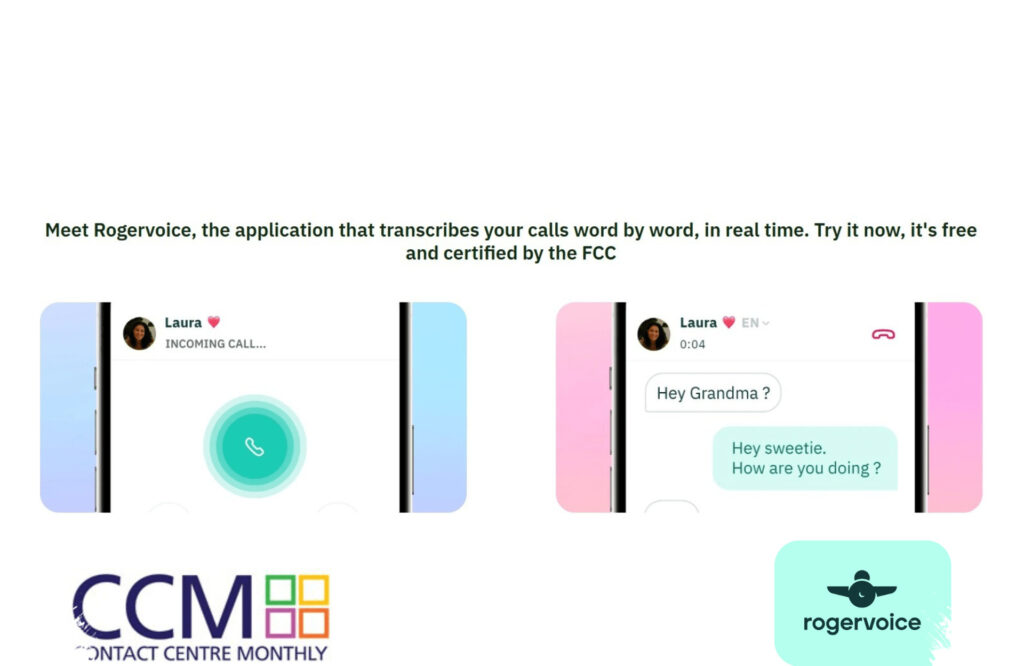
Rogervoice’s expansion into the United States marks a major shift for people who rely on real-time call transcription. After securing Federal Communications Commission certification, the company’s captioned calling service can now be used free of charge by users in the U.S., while also meeting federal accessibility requirements.
The service combines live speech-to-text captions with text-to-speech, allowing a user to type a reply when speaking is difficult or not preferred. That response is then read aloud during the call, creating a two-way communication flow that goes beyond a simple caption overlay.
What FCC certification changes
Rogervoice operates as an Internet Protocol Captioned Telephone Service, or IP CTS. In practice, that means it uses fast speech-to-text technology to turn phone conversations into word-for-word captions in real time.
With FCC certification in place, users in the U.S. do not need to pay subscription fees or per-minute charges to access the service. The certification also signals that the platform meets the accessibility standards required in the American market.
Why the service stands out
Many phones and apps now include caption features, but Rogervoice is positioned differently because it builds both transcription and spoken-out replies into one system. That combination makes it more flexible for people who need an alternative to standard voice-only calling.
The company points to this two-way model as one of its key advantages over built-in options such as Live Caption on Android or Call Captions in the Samsung Phone app. Rather than only showing text on the screen, Rogervoice also lets users answer through typed messages that are spoken during the call.
Built for users who need another way to communicate
The service is especially relevant for deaf and hard-of-hearing users, as well as for people who struggle to speak during phone calls. It allows them to follow the conversation through live captions while still taking part without depending entirely on audio.
That role is central to Rogervoice’s accessibility mission. In this setup, a phone call becomes less limited by hearing or speech barriers, which is the core reason the service has drawn attention in the first place.
A personal origin behind the platform
Rogervoice founder Olivier Jeannel said the product grew out of his own experience. Jeannel, who has been deaf since the age of two, described phone calls as deeply isolating when audio was the only option available.
“Growing up, I experienced firsthand how isolating phone calls could be when audio was the only option,” Jeannel said. He also framed the U.S. launch as an important step toward greater independence and more equal access to communication.
Scale, usage, and reach
The move into the U.S. comes alongside another milestone for the company: Rogervoice says it has surpassed 10 million captioned calls. It also now operates locally in America, a shift that can help it manage regulatory and privacy compliance in the market.
Beyond the U.S., Rogervoice supports more than 100 languages across more than 50 countries. That broad reach suggests captioned calling is not limited to one type of user or one region, but addresses a wider communication need.
Evidence of everyday use
The company’s usage data suggests the service is part of daily routines for many people. Nearly 55 percent of users make at least one to two calls per day, while 24 percent are said to make more than five calls daily.
Rogervoice also says it has collected more than 2,000 five-star reviews. One user described the difference the service made in strongly personal terms, saying, “Phone calls are a disaster for me… I have now come back to life,” after being able to enjoy conversations again.
As captioned calling gains visibility on mobile devices, Rogervoice’s FCC-backed availability in the U.S. gives it a distinct place in the accessibility market. For users who need real-time captions and the ability to answer by typing, the service now arrives with broader access and no added cost in the U.S.
Source: www.androidpolice.com