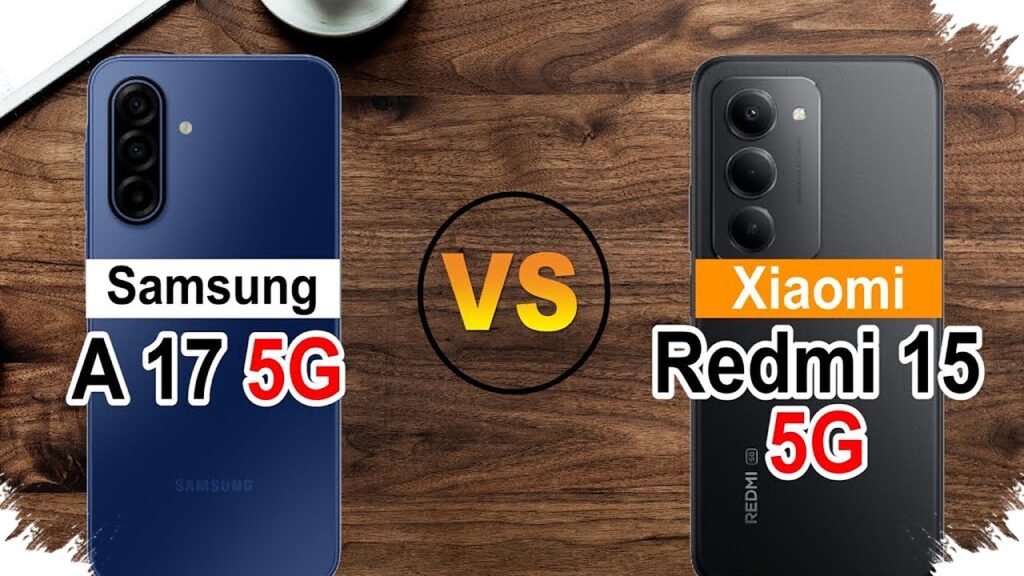
At the Rp3.2 million range, Redmi Note 15 5G enters the conversation as a mid-range phone that does not rely on brand name alone to stand out. Its presence also makes the Samsung Galaxy A17 5G harder to choose automatically, because both phones target buyers who care about display quality, day-to-day performance, and long battery life.
That overlap matters because the Redmi Note 15 5G brings a fairly dense set of specifications for its class. It combines an AMOLED display, a large battery, a high-resolution main camera, and a relatively slim body, while still leaving a few trade-offs that need attention before a purchase decision is made.
A slim body with practical durability
Redmi Note 15 5G comes with a 7.4 mm profile and weighs around 178 grams. Those numbers help it feel compact in hand and more comfortable for extended use than many bulkier phones in the same segment.
Durability also receives attention through IP66 protection, which offers resistance against dust and splashes of water. The device further carries MIL-STD-810H certification, adding to the impression that it is built to handle a wider range of everyday conditions.
The display is the clearest selling point
Among all its features, the screen is one of the strongest reasons the Redmi Note 15 5G draws attention. It uses a 6.77-inch AMOLED panel with Full HD+ resolution, a combination that should deliver sharper and more vivid visuals for everyday use.
A 120Hz refresh rate adds smoother movement when browsing social media, switching apps, or playing games. The claimed brightness level of up to 3200 nits also helps keep the display readable outdoors, which is a useful advantage for users who spend a lot of time outside.
Performance aimed at stable daily use
Under the hood, the phone is powered by Snapdragon 6 Gen 3. This chipset is positioned to handle common tasks such as messaging, browsing, streaming, and light multitasking without much trouble.
For popular games like Mobile Legends, performance is described as stable on medium to high settings. The Adreno 710 GPU supports that experience by helping maintain smoother graphics when the workload becomes heavier.
Memory options offer room, but with one limitation
Redmi Note 15 5G is available with RAM options ranging from 6GB to 12GB. Storage also scales generously, going up to 512GB, which gives users flexibility for apps, photos, and videos.
There is still a practical limitation to consider, since the phone uses a hybrid slot. That means users must choose between dual SIM use or microSD expansion, so the setup is not as flexible as devices with a separate card slot.
Camera setup centers on the 108MP main sensor
The imaging department is led by a 108MP main camera with OIS. That combination gives the phone a stronger chance of producing detailed shots, especially in well-lit conditions.
It is paired with an 8MP ultrawide camera for broader scenes, while the 20MP front camera handles selfies and social media content. The specification sheet makes it clear that the main sensor is the headline feature here, especially for users who want a higher-resolution camera in this price bracket.
Battery life and charging stay competitive
Battery capacity is another area where the Redmi Note 15 5G looks strong. It carries a 5520 mAh battery, which is presented as sufficient for a full day of use.
Charging support reaches 45W fast charging, helping shorten the time needed to top up the battery. Wireless charging is not included, so that remains one of the features missing from the package when compared with some rivals.
Why it becomes a real rival to Samsung Galaxy A17 5G
With pricing that starts at Rp3,2 jutaan for the 6GB/128GB variant, Redmi Note 15 5G sits directly in a competitive range. The top 12GB/512GB version is listed at around Rp4,5 jutaan, which broadens its appeal for buyers looking for more memory and storage.
In the same price class as Samsung Galaxy A17 5G, the Redmi Note 15 5G appears especially strong in display technology, battery capacity, and main camera resolution. At the same time, the hybrid slot and the mentioned limitations in video stabilization remain points that buyers may want to weigh carefully before deciding.