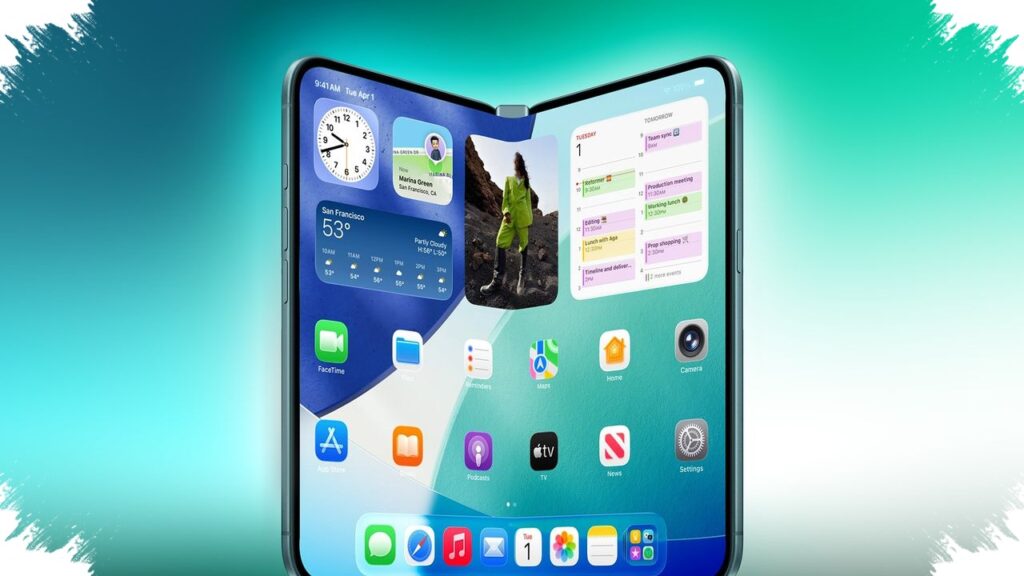
The latest dummy-unit leak is giving the clearest look yet at Apple’s first foldable iPhone, referred to in the report as iPhone Ultra/Fold. Rather than simply copying familiar foldable-phone layouts, Apple appears to be shaping the device around a wider use case that becomes more important when the screen is fully opened.
That direction also explains why two details stand out immediately: the return of Touch ID and an unusual placement for the volume buttons. If the leak is accurate, the foldable iPhone may be built to feel less like a standard handset and more like a compact iPhone-and-tablet hybrid.
A layout that favors the open mode
Notebookcheck, citing a leak from Majin Bu, says the iPhone Ultra/Fold uses a wide and short body format. In practice, that shape makes the device closer to an “iPad mini” feeling when unfolded, which seems to be the design priority Apple is pursuing.
The physical controls reflect that thinking. Unlike many foldables that place volume buttons on the side, the report says Apple has moved them to the top edge of the device. That choice makes more sense when the phone is opened and used in landscape orientation, since the controls become easier to reach in a tablet-like posture.
At the same time, that same placement may be less convenient when the device is closed. Using the foldable like a regular phone could require one-handed users to reach higher than usual just to adjust volume, which may make everyday handling feel less natural in compact mode.
Touch ID may return through the power button
Another notable leak points to the comeback of Touch ID. The power button on the right side is reportedly expected to double as the fingerprint sensor, according to the Notebookcheck report.
That would mark a meaningful shift for a modern iPhone, which is now more closely associated with Face ID. On a foldable device, however, the move could make practical sense because Apple needs a biometric solution that works smoothly across both folded and unfolded use.
Placing fingerprint authentication in the power button also suggests a more functional approach to the foldable form factor. Instead of forcing a familiar iPhone pattern onto a very different device, Apple appears to be adapting core features to match the hardware rather than the other way around.
Convenience concerns remain
Even with the logic behind the design, the leak raises an obvious question about day-to-day comfort. Notebookcheck describes the idea as solving one problem while creating another, which fits the tension between open-mode usability and closed-mode ergonomics.
The top-mounted volume buttons may be ideal for the wider, tablet-like experience, but they are harder to justify for quick one-handed use. That is why the reported layout is already drawing attention: it looks intentional, but it may not be universally convenient.
The same report also mentions the possibility of a software-based solution that could help with volume control, although no further confirmation is available. That leaves open the idea that Apple may try to soften the ergonomic tradeoff with interface behavior rather than physical design alone.
There is also a flat-looking element on the right side that is thought to resemble a 5G antenna. Its exact role is still unclear, but the report notes that its shape suggests antenna function more than anything else.
The regular Pro model looks unchanged
While attention is centered on the foldable, the dummy unit also suggests that iPhone 18 Pro may not be getting a major redesign. The leak reportedly shows a body that looks almost identical to iPhone 17 Pro, which makes the foldable the more visually striking device in the lineup.
That contrast is important because it shows where Apple’s bolder design work appears to be happening. The standard Pro model seems stable, while iPhone Ultra/Fold is the one experimenting with layout, control placement, and biometric hardware.
One more detail from the dummy unit is the absence of a visible MagSafe ring. The report does not say whether MagSafe is truly missing or simply not shown on that version of the dummy, so that part remains unresolved.
For now, the strongest impression from the leak is that Apple is treating its first foldable as more than a new screen format. If the dummy really reflects the final design, iPhone Ultra/Fold will stand apart through its wide body, top-positioned volume buttons, and Touch ID built into the power button.