


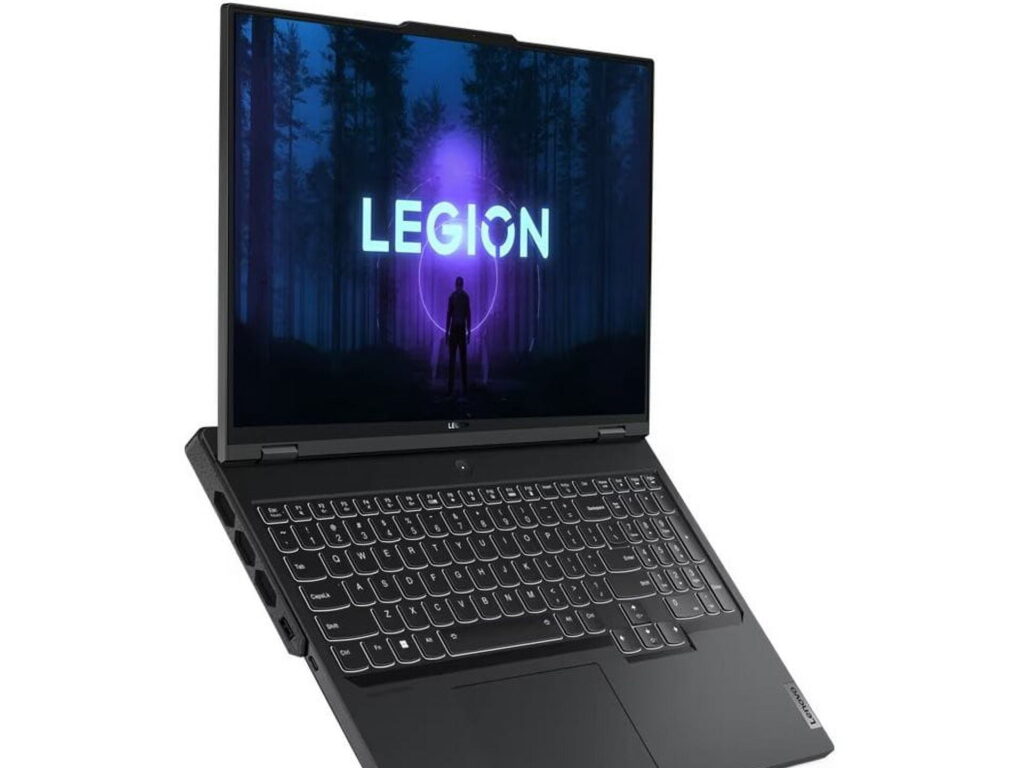
Lenovo’s Legion 7a 16 Gen 11 makes a clear trade-off: it is easier to carry, but it gives up some performance headroom and future upgrade flexibility in the process. For buyers who want a premium 16-inch gaming laptop that feels less burdensome in daily travel, that shift may matter more than raw speed.
Notebookcheck’s assessment points to a machine that still looks and feels high-end, yet no longer follows the same formula as the previous generation. The result is a more mobile Legion 7a 16, but also one that lands below its predecessor in both CPU and GPU output.
A lighter chassis without losing the premium feel
One of the most noticeable changes is weight. Lenovo has trimmed around 200 grams compared with the former AMD-based version, bringing the total weight to below 1.8 kg.
That reduction is meaningful for a 16-inch gaming notebook, a segment that often comes with heavier builds. Even so, Lenovo keeps aluminum on the main chassis, and Notebookcheck says the body still feels very solid.
The lighter design does not appear to have weakened the laptop’s structural quality. Notebookcheck also describes the chassis stability as very good, which suggests Lenovo managed to reduce mass without making the device feel flimsy in everyday use.
Typing and navigation also remain well judged. The keyboard and touchpad are still regarded as comfortable, which matters because thinner gaming laptops often sacrifice input quality as they chase portability.
The display remains the standout feature
While the weight reduction is important, the screen is still one of the strongest reasons to pay attention to the Legion 7a 16 Gen 11. Lenovo uses a 240 Hz OLED panel that Notebookcheck rates very highly for this class.
The display also supports VRR and G-Sync, helping games look smoother when frame rates fluctuate. That combination makes the laptop feel more responsive in gameplay, especially in titles where consistency matters.
HDR performance is another highlight. The panel can reach a peak brightness of up to 1100 nits, and Notebookcheck goes as far as saying it is difficult to find a gaming laptop with a better display right now.
Performance drops behind the previous Legion 7
The more surprising side of the update is that the new model is not faster than the one it replaces. Legion 7a 16 Gen 11 uses the AMD Ryzen AI 9 HX470, while the previous Legion 7 16 G10 ran on the Intel Core Ultra 7 255HX, which Notebookcheck considers the stronger chip.
That difference shows up in overall CPU performance, which falls behind the earlier generation. The graphics side sees a similar pattern, even though Lenovo still uses the Nvidia GeForce RTX 5060 mobile GPU.
The key change is in power delivery. In Performance mode, the GPU’s maximum TGP has been reduced from 115 watts to 95 watts. Lenovo does provide a manual mode that can raise the TGP back to 115 watts, but that requires changing settings in software and is not as convenient for routine use.
Because of that limitation, Notebookcheck concludes that CPU, GPU, and gaming performance are all lower than on the Legion 7 16 G10. For users focused mainly on speed, the older model keeps an advantage.
RAM upgrade flexibility is also reduced
The compromises do not stop at performance. Expansion options have also been tightened, and that may matter just as much to some buyers.
Where the previous generation still allowed RAM upgrades, the Legion 7a 16 Gen 11 comes with 32 GB of soldered memory. That design choice removes the option to expand memory later, which reduces long-term flexibility.
For gaming users and heavy productivity workloads, upgradeability can be an important factor in extending a system’s useful life. In this case, the slimmer and lighter chassis likely leaves less room for internal expansion, and the trade-off is a machine that is easier to carry but harder to modify.
Pricing shapes the appeal
Notebookcheck lists the review unit at $2279, a price that becomes more noticeable once the performance and upgrade limits are taken into account. The article also notes that the faster Legion 7 16 G10 can be found for under $1800 on Amazon.
That positions the Legion 7a 16 Gen 11 in a narrower lane. It is best suited to buyers who value a light premium build, a strong OLED display, and a more travel-friendly gaming laptop, while those who want the strongest performance and more room for future upgrades may still prefer the older generation.
Source: www.notebookcheck.net