


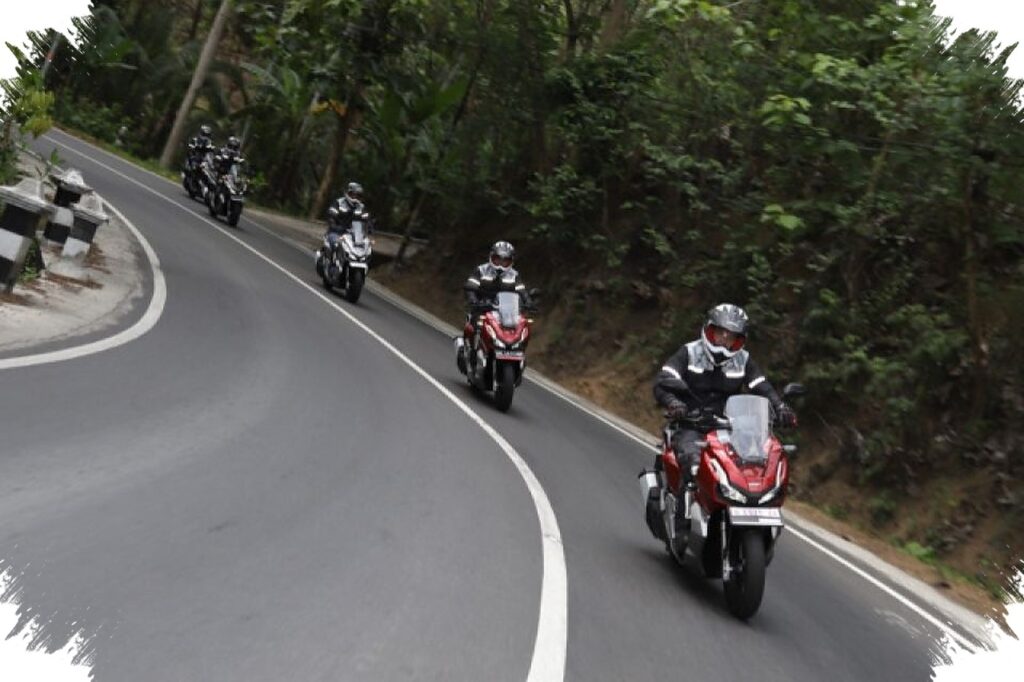
Mountain routes expose the real character of a scooter. Steep climbs, tight bends, uneven pavement, and long descents demand more than a comfortable seat and a stylish body.
That is why scooters with stronger engines, stable handling, and basic safety features are often preferred for this kind of riding. The most suitable models are usually in the 150cc class or above, with solid torque, ABS, traction control, and suspension that can handle longer trips without making the ride tiring.
What matters most on uphill and downhill roads
A mountain route places different demands on a scooter than a city street does. Strong torque helps the motor keep moving on long inclines, while controlled braking becomes crucial on extended descents.
Safety technology also matters more in this setting. ABS and traction control can help maintain control when the pavement is slippery or when braking must be done with more precision.
Honda ADV 160, built for mixed terrain
Among the scooters commonly seen as ready for mountain use, the Honda ADV 160 stands out for its versatility. Its 160cc engine provides enough power and torque to handle long climbs without feeling strained.
Its high ground clearance is another advantage, especially on damaged or rocky roads often found in hilly areas. The model also comes with ABS and traction control, both of which support control on wet descents or less predictable surfaces.
Comfort is part of its appeal as well. The softer suspension helps absorb bumps, which becomes important on uneven mountain routes that can take longer to finish.
Yamaha NMAX 155 focuses on balance
The Yamaha NMAX 155 earns attention for its responsive 155cc engine with VVA technology. That setup helps keep acceleration usable across different engine speeds, which is useful when road conditions change quickly in the hills.
Its balanced weight also contributes to stability. On long downhill stretches and layered curves, the motor feels calmer and easier to manage.
Some variants are equipped with dual-channel ABS. That feature gives riders extra confidence when braking on winding descents where control matters more than speed.
Honda PCX 160 leans toward comfort
For riders who want smoothness without giving up practical climbing ability, the Honda PCX 160 is a strong option. Its 160cc eSP+ engine is considered capable of handling mountain routes with good composure.
The engine character is described as smooth, which makes the ride feel less aggressive. That can be useful for longer trips where comfort matters as much as power.
ABS also adds value on descending roads. When the road slopes down for a long distance, controlled braking helps keep traction more manageable.
Yamaha Aerox 155 is the agile choice
The Yamaha Aerox 155 appeals to riders who prefer a sportier-feeling scooter. Its lighter weight compared with several rivals makes it easier to move through tight corners and quick direction changes.
Its 155cc engine has a more aggressive character, which helps on climbs with moderate slope. In mountain areas filled with frequent bends, that agility can be a major advantage.
This model is especially relevant where the road demands quick handling rather than relaxed cruising. The combination of lighter feel and lively response gives it a different strength from the more comfort-focused scooters on this list.
Yamaha XMAX 250 offers the strongest reserve of power
At the other end of the group, the Yamaha XMAX 250 brings a 250cc engine that gives it the most power for heavy-duty mountain riding. That larger displacement helps it face steep climbs with less effort.
Safety support is also strong, with ABS and traction control helping maintain stability. These features matter on long descents or when speed increases and the road surface becomes less predictable.
Its larger body adds a planted feeling on the road. That stability is valuable when a route combines curves, gradients, and changing pavement conditions in one trip.
Riding technique still decides the outcome
Even a capable scooter still depends on the rider’s approach. On climbs, the body should lean slightly forward to help maintain rear-wheel traction.
On descents, the brakes should not be held continuously. Using the front and rear brakes in a balanced way helps reduce the risk of brake fade from overheating.
Routine maintenance also remains essential, especially for the CVT, brakes, and engine oil. When those components stay in good condition, a scooter can perform more reliably on mountain roads that place greater stress on both acceleration and braking.