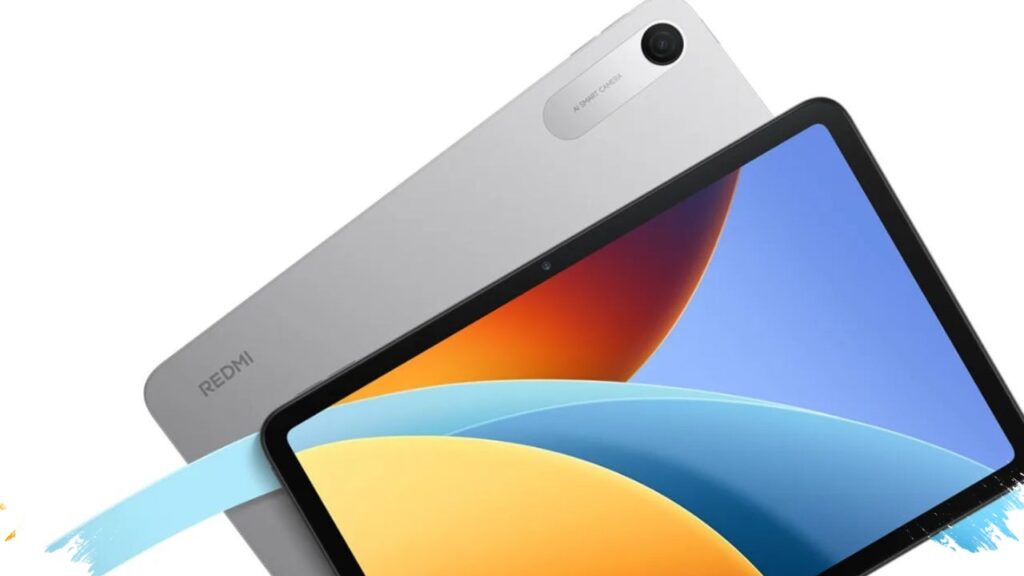
Xiaomi has introduced the Redmi Pad 2 9.7 quietly across several Asian markets, including Malaysia and Singapore. The compact tablet stands out not because it grows larger, but because it brings a 120 Hz display to a smaller body.
That choice makes the device feel more focused on everyday use. It is aimed at people who want a tablet that is easy to carry while still offering a smoother screen experience for reading, studying, watching videos, and moving between tasks.
A smaller screen with a faster panel
As the name suggests, the Redmi Pad 2 9.7 uses a 9.7-inch panel. That makes it smaller than the regular Redmi Pad 2, which comes with an 11-inch display.
Despite the reduced size, Xiaomi has raised the refresh rate to 120 Hz. The previous model only supported 90 Hz, so the new version pushes smoother motion as one of its main selling points.
The screen itself remains an LCD panel with a 2,048 x 1,280-pixel resolution. Xiaomi also gives it a touch sampling rate of up to 240 Hz, which should make input feel more responsive.
Brightness reaches 600 nits at peak. That level is meant to keep the display usable both indoors and outdoors, where screen visibility often matters as much as size.
Built for portable daily use
The compact form factor gives the Redmi Pad 2 9.7 a different position in the tablet market. It is better suited to users who need something lighter and easier to bring along than a larger slate.
That includes online classes, video meetings, document reading, and entertainment during travel. In that context, the 9.7-inch size becomes a practical middle ground between comfort and portability.
Xiaomi is also taking a different route from the trend of larger tablets that prioritize maximum screen area. Here, the company seems to be offering a smaller alternative without dropping the display features that matter most for day-to-day use.
Hardware tuned for routine tasks
Performance changes alongside the design shift. The Redmi Pad 2 9.7 uses the Snapdragon 6s Gen 2 4G, replacing the MediaTek Helio G100 Ultra found in the 2025 Redmi Pad 2.
Both chips are built on a 6 nm process, but their performance characteristics differ. On paper, the Helio G100 Ultra still holds a slight advantage because it uses newer Cortex A76 cores for stronger performance bursts.
The Snapdragon 6s Gen 2 relies on Cortex A73 and Cortex A53 CPU cores instead. That setup points to a tablet that is oriented more toward stable daily operation than peak performance.
Memory is limited to 4 GB of RAM. Storage comes in 64 GB and 128 GB variants, giving buyers two simple options for basic tablet use.
Battery, cameras, and software
Xiaomi also scales the battery down to match the smaller body. The Redmi Pad 2 9.7 carries a 7,600 mAh battery, which is smaller than the 9,000 mAh unit used in the previous generation.
Even with the smaller capacity, the tablet still supports 18W fast charging. The included adapter in the box is rated at 15W.
For cameras, the device keeps things straightforward. There is an 8 MP rear camera for basic photography, while the front side uses a 5 MP camera for video calls.
The tablet runs HyperOS 3, giving it Xiaomi’s latest software layer. Together with the compact body and 120 Hz display, the Redmi Pad 2 9.7 is positioned as a practical option for users who value portability, smooth scrolling, and everyday functionality over larger dimensions.