


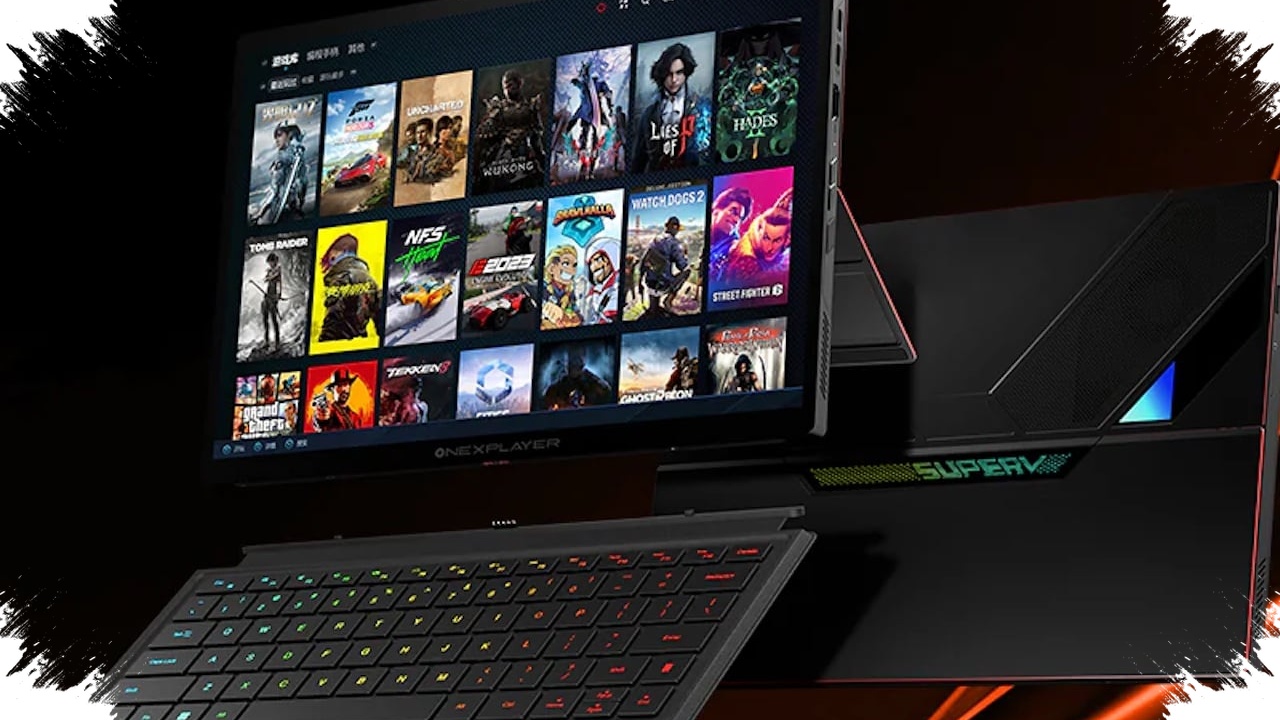
OneXPlayer Super V is drawing attention for a reason that matters in the premium handheld and tablet gaming space: it is being positioned as a device without a discrete GPU that can still handle AAA gaming at 1800p. The standout claim comes from testing linked to ETA Prime, where the tablet was shown running demanding games smoothly with Intel Panther Lake hardware.
That performance is tied to the Intel Core Ultra X7 358H, which powers the device instead of relying on a separate graphics card. For a product in this category, the appeal is obvious, since many gaming devices still depend heavily on dGPU hardware to reach similar results.
A high-end tablet built around integrated graphics
The key point behind OneXPlayer Super V is not just raw speed, but the approach it takes to get there. The tablet is described as delivering smooth AAA gameplay at 1800p while staying within a no-dGPU design, which makes it unusual in the current portable gaming landscape.
ETA Prime’s testing also included Forza Horizon 5, adding another data point beyond a single game. That detail suggests the performance discussion is not limited to one isolated title, even if broader real-world consistency still matters.
Premium pricing places it in a narrow market
The hardware story comes with a price tag that puts the device firmly in premium territory. The Core Ultra X7 358H version, paired with 48 GB of RAM and 1 TB of storage, is listed at $1,899.99.
That pricing also reflects wider conditions around Intel Panther Lake, which is described as expensive because of low yield and limited supply. Those factors help explain why devices built on this platform, including OneXPlayer Super V, are landing at the upper end of the market.
Direct competition is also expensive
OneXPlayer Super V is not entering this segment alone. Asus ROG Flow Z13 is positioned as a direct rival at the same $1,899.99 price point on Amazon.
The two tablets differ in platform and memory configuration, though, with Flow Z13 using AMD Ryzen AI Max 390 Strix Halo APU and 32 GB of RAM. That makes the comparison more about competing hardware strategies than identical specifications.
What the early testing suggests
The early results point to an important shift in what a gaming tablet can aim to do. A portable device without discrete graphics is now being tested at a level that once seemed far more dependent on dedicated GPU hardware.
At the same time, the asking price keeps OneXPlayer Super V in a highly selective category. The device stands out not only because of its performance claims, but because it tries to prove that a premium tablet can chase AAA gaming at 1800p without following the usual graphics-card formula.