


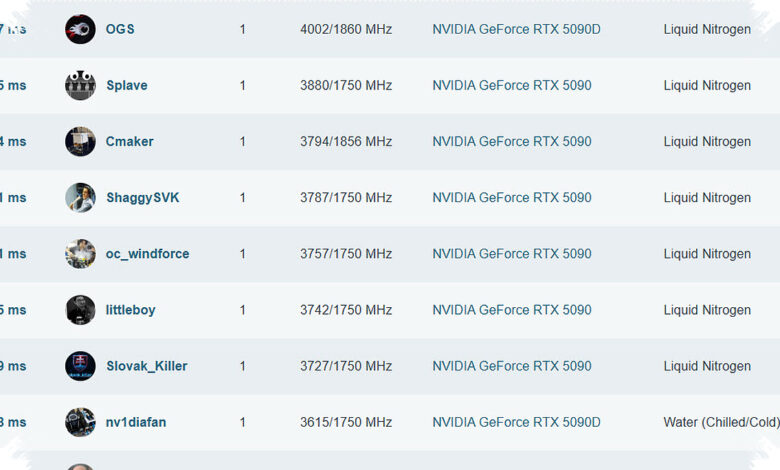
Team OGS has pushed a special Galax RTX 5090D past 4GHz, marking the first time a Blackwell GPU has been seen at that frequency. The result stands out not only because of the number itself, but because it was validated through HWBOT and completed on GPUPI in 35 seconds and 377 milliseconds.
The run also improved on Splave’s previous attempt by more than one second and more than 120MHz. That gap matters in extreme overclocking, where small gains often separate a headline result from an also-ran effort.
A card built for extreme tuning
The hardware behind the record was not an ordinary RTX 5090D. Team OGS used the Galax RTX 5090D HOF OC Lab Plus-X, a model equipped with a 36-phase VRM, 21,760 CUDA cores, and a 384-bit memory bus.
Although it carries the same core count as the standard model, this version is designed to leave much more room for extreme tuning. Its specialized power delivery helped make the 4GHz milestone possible under conditions far outside normal use.
| Item | Details |
|---|---|
| GPU | Galax RTX 5090D HOF OC Lab Plus-X |
| VRM | 36-phase |
| CUDA cores | 21,760 |
| Memory bus | 384-bit |
Liquid nitrogen and an external clock board
To reach the milestone, Team OGS relied on liquid nitrogen cooling and an external clock board. The setup also pushed power demand to an extreme level, with the card reportedly drawing more than 1,000W.
The rest of the test bench matched that ambition. Intel’s Core i9-14900KF ran at 6GHz, the system used 32GB of DDR5 memory at 4,200MT/s, and Corsair’s WS3000 3,000W power supply handled the load.
This was not an overclock intended for everyday gaming or normal workloads. The achievement is best understood as a proof of concept, showing what the Blackwell architecture can briefly reach under highly specialized cooling and power conditions.
A useful marker for Blackwell’s ceiling
The result also places Blackwell in a new position within the RTX 50-series. It is the first time a GPU from the lineup has produced a benchmark result at such a frequency, even if the number is far beyond stable daily operation.
That context makes the record more significant than a simple frequency chase. With no new GPU generation from Nvidia or AMD expected before 2027 at the earliest, results like this may continue to define how far current architectures can be pushed by elite overclockers.
There is one more detail that adds perspective to the achievement. The RTX 5090D itself has 24GB of memory, smaller than the standard RTX 5090, yet the special Galax edition used here compensates with advanced VRM hardware built for experimentation.
As a result, the 4GHz milestone is less about practical gaming performance and more about what can be extracted from Blackwell when cost, power, and cooling limits are ignored. For the overclocking community, that makes Team OGS’s run a new reference point for the limits of Nvidia’s latest architecture.