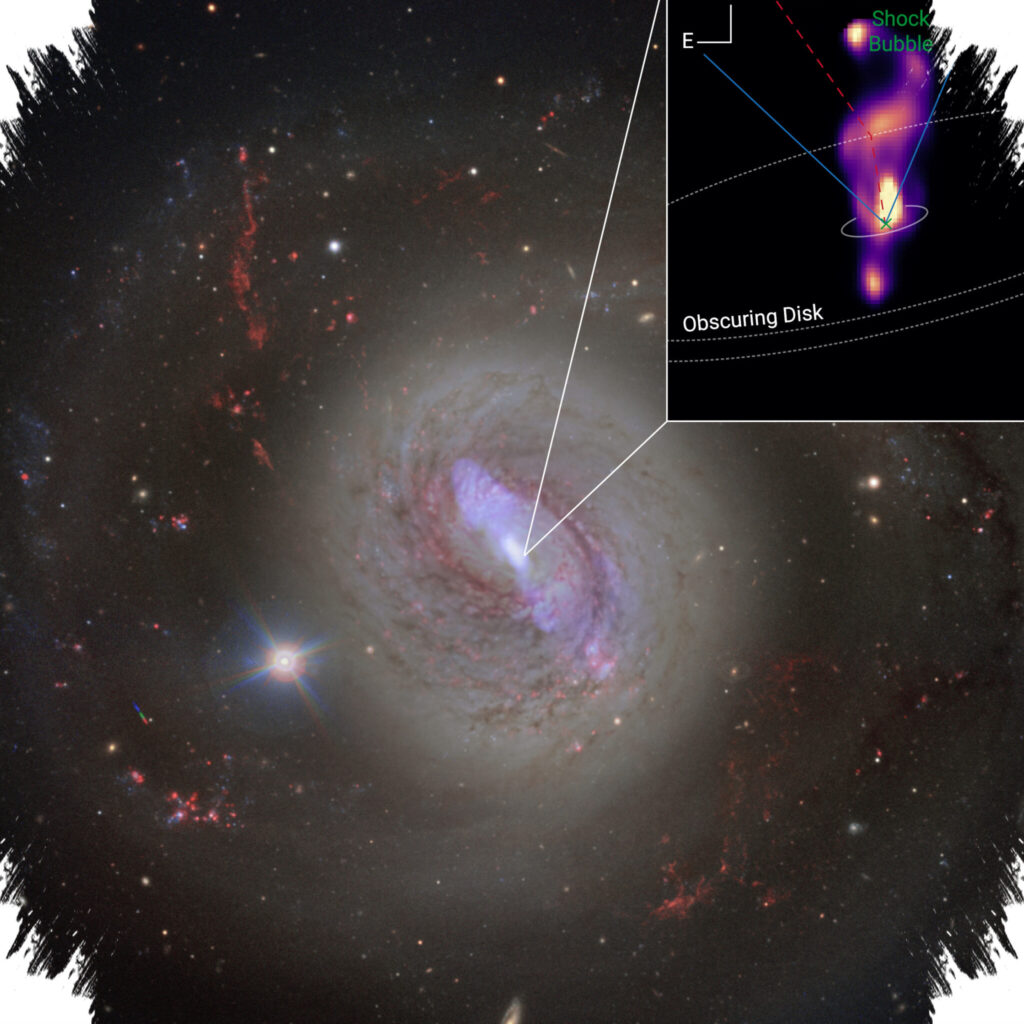
The James Webb Space Telescope has delivered another sharp look at a galaxy whose bright center hides intense activity behind layers of dust. In the case of M77, the new view highlights a blazing nucleus while pointing to the supermassive black hole driving the chaos deep inside.
M77, also known as NGC 1068, sits about 45 million light-years from Earth. It has long drawn attention because it is large, rich in material, and powered by a highly active core.
A Core Powered by Extreme Motion
The brightest region in the Webb image comes from material near the galaxy’s center that is heated to very high temperatures. At the heart of M77 lies a supermassive black hole with a mass of about eight million times the Sun.
Gas around that black hole is moving at speeds close to the speed of light. That makes the nucleus one of the most dynamic regions in a galaxy of this kind, and it gives astronomers a rare chance to study how matter behaves in the environment around a supermassive black hole.
More Than Just a Bright Center
Webb did not only reveal the intense core. It also brought out the structure of the galaxy itself with unusual clarity, including spiral arms made of hydrogen.
Those arms are part of a galaxy that spans roughly 90,000 light-years across. With a size like that, M77 shows why high-resolution observations are needed to understand how much material it contains and how that material is arranged.
The galaxy is also home to more than 300 billion stars, along with a very large amount of dust. That dust makes detailed observation difficult in ordinary light, but Webb’s infrared capability can penetrate the cosmic veil and expose features that were previously hidden.
Why the Image Matters to Astronomy
The image is more than a striking visual of a distant galaxy. It offers scientific detail that can help researchers better understand the structure and motion of M77.
From the luminous center to the hydrogen-rich arms, each part adds information about how the galaxy formed and how it continues to evolve. Webb’s instrument design makes that kind of work possible by capturing fine detail that was difficult to see before.
The bright streaks seen in the image also deserve attention, even though they are not part of the galaxy itself. Those lines are diffraction spikes created by light interacting with the James Webb Telescope’s mirror.
Even with that visual effect, the observation remains scientifically valuable. It provides a clearer view of a massive, dust-filled galaxy whose active center and fast-moving gas reveal how extreme galactic nuclei can be.