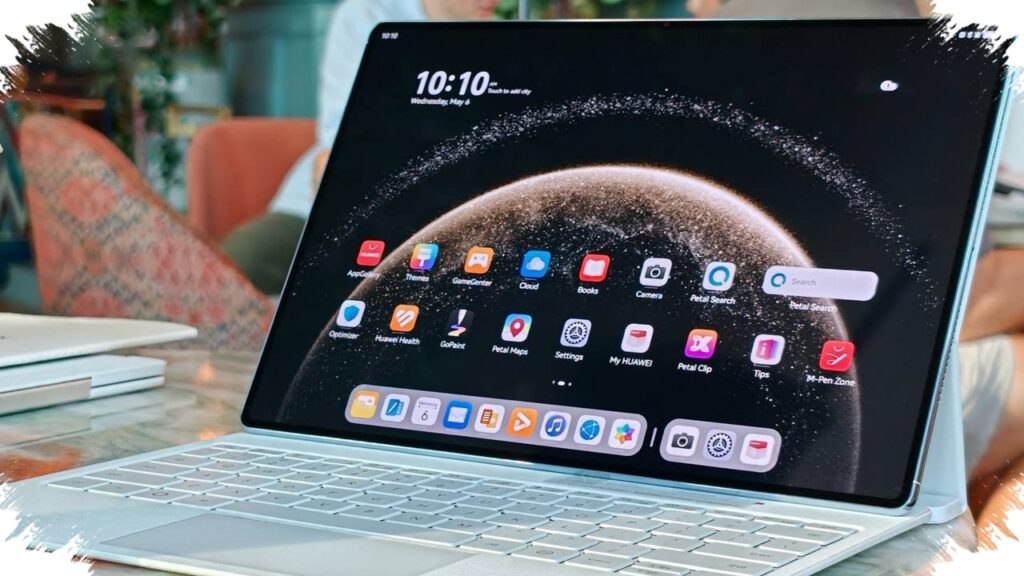
Huawei’s latest tablet draws attention for a simple reason: it tries to do what ultra-thin devices often struggle to achieve. At just 4.7 mm thick, the MatePad Pro Max is presented as a slim premium tablet that still aims to deliver strong battery life, serious productivity features, and even satellite messaging.
That combination makes the device stand out in a category where thinness usually comes with trade-offs. Huawei is positioning the MatePad Pro Max not only as a stylish mobile device, but also as a tablet built for demanding work and wider everyday use.
A thin body without a fragile feel
A 4.7 mm profile places the MatePad Pro Max among the thinnest tablet contenders in 2026. To address the usual concerns around such an extreme design, Huawei uses aerospace-grade carbon fiber to strengthen the chassis.
The company appears to be emphasizing that a slim device does not have to feel weak. The tablet is also described as nearly weightless in use, while still retaining a solid structure.
The screen design follows the same approach. Huawei keeps the bezels extremely narrow, helping the display achieve a claimed 94 percent screen-to-body ratio.
Internal layout built for efficiency
Packing important components into such a limited space is another major part of the story. Huawei has compressed the cooling system, processor, and battery inside the body without turning the tablet into a compromised device.
The MatePad Pro Max is powered by the latest Kirin chipset, which has been optimized for high-level power management. That setup is intended to keep performance balanced with energy efficiency during heavier workloads.
This puts the tablet in a different category from many thin devices that rely mainly on appearance. Huawei is clearly trying to make the MatePad Pro Max capable of handling intensive productivity rather than serving only as a design showcase.
Large battery, fast charging
One of the most notable features is its Dual-Cell Battery Technology. That solution allows Huawei to include a large battery capacity despite the restricted internal space.
Charging is handled through 100W fast charging. For users with busy schedules and constant mobility, the combination of a large battery and rapid recharging is one of the strongest selling points.
Huawei’s approach signals that battery endurance remains a priority even in an ultra-thin tablet. The company is not treating slimness as a reason to reduce practicality.
Satellite messaging adds an unusual layer
The MatePad Pro Max also includes Beidou Satellite Messaging. This function allows users to send emergency messages through satellite when cellular service is unavailable.
That feature is still uncommon in a tablet and expands the device’s role beyond standard work and entertainment tasks. It gives the MatePad Pro Max an additional communication option for situations where normal networks cannot be reached.
Alongside that hardware, the tablet runs HarmonyOS 5.0. The operating system is designed to integrate smoothly with other Huawei devices and supports advanced multitasking that is meant to resemble a PC-like experience.
Built with productivity in mind
Huawei pairs the tablet with the StarLight Keyboard, which is said to keep a comfortable travel distance despite its compact design. Together with the large display and multitasking support, the accessory helps push the device toward professional use.
The target audience appears to include designers, video editors, and business professionals who need something light but still capable. In that context, the 4.7 mm thickness becomes more than a design talking point.
It supports portability while preserving a premium feel and enough capability for serious work. Huawei is framing the MatePad Pro Max as a tablet that blends luxury, strength, and modern utility in one ultra-thin body.