


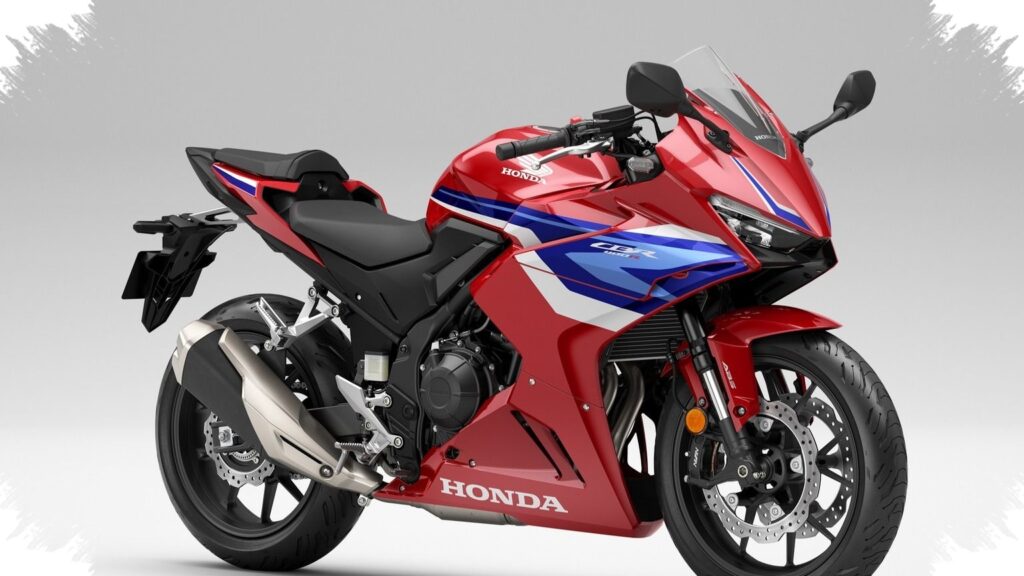
Honda’s CBR400R Four returns with a clear purpose: to make the middleweight sport category feel more exciting without giving up everyday usability. In a market crowded by 250 cc models and twin-cylinder middleweights, its four-cylinder layout immediately sets it apart.
That difference is more than a technical detail. Honda is aiming at riders who want the character of a high-revving four-cylinder engine, but still need a machine that works well for city commuting and occasional track days.
A four-cylinder engine that changes the formula
The main attraction is the 399 cc DOHC inline-four, liquid-cooled engine. It stands out sharply from the twin-cylinder version in the same family and gives the CBR400R Four a more emotional riding character.
Honda says output is in the range of 55 to 59 PS. That places it among the stronger bikes in the 400 cc class and puts it directly in the conversation with the Kawasaki Ninja ZX-4RR.
What matters for many enthusiasts is not only the number. A middleweight four-cylinder still carries a strong appeal because it delivers a different feel from the more common quarter-liter sport bikes.
Built to stay friendly in daily use
Honda did not stop at the engine. The CBR400R Four also brings Honda E-Clutch, a system that allows gear changes without pulling the clutch lever.
The feature supports both upshifts and downshifts while keeping the manual-riding experience intact. In dense traffic, especially in stop-and-go conditions, it should reduce fatigue because the rider does not need to work the clutch constantly.
That approach shows Honda is trying to balance two demands at once. The bike still aims for a sporty riding feel, but it is not meant to be troublesome in routine use.
Aggressive styling with Fireblade influence
Visually, the CBR400R Four takes clear inspiration from the CBR1000RR-R Fireblade. Its front end and fairing have a sharp, aggressive look that gives the bike a stronger racing presence.
One of the more notable details is the integrated winglet on the fairing side. Honda says it helps create downforce at speed, which improves front-end stability when the bike is moving quickly.
The design is not only about drama. It also reflects an aerodynamic purpose aimed at supporting control during more serious riding.
Electronics and safety support the package
Honda pairs the performance hardware with HSTC, or Honda Selectable Torque Control. The system is there to help reduce rear-wheel slip during acceleration, especially when traction is poor.
The bike also uses dual-channel ABS. That adds another layer of control during braking and matters on a machine with this level of performance.
At the front, Honda uses Showa Separate Function Front Fork Big Piston, or SFF-BP. The suspension is designed to provide stable damping, particularly under hard braking.
Modern cockpit and connectivity
Inside the cockpit, Honda fits a 5-inch full-color TFT display. The panel is intended to be bright and easy to read, giving the rider clearer information at a glance.
Honda RoadSync is also part of the package. It allows smartphone connection for turn-by-turn navigation, music control, and phone calls through voice commands when used with a helmet intercom.
That makes the CBR400R Four more than just a performance-focused sport bike. It also matches the expectations of riders who want modern connectivity in a machine that still feels mechanical and engaging.
With its 399 cc four-cylinder engine, E-Clutch, Fireblade-inspired styling, and a full set of electronic aids, the CBR400R Four brings a different identity to the middleweight sport segment. It is aimed at riders who want something more emotional than a typical 250 cc bike, yet still practical enough for everyday use.