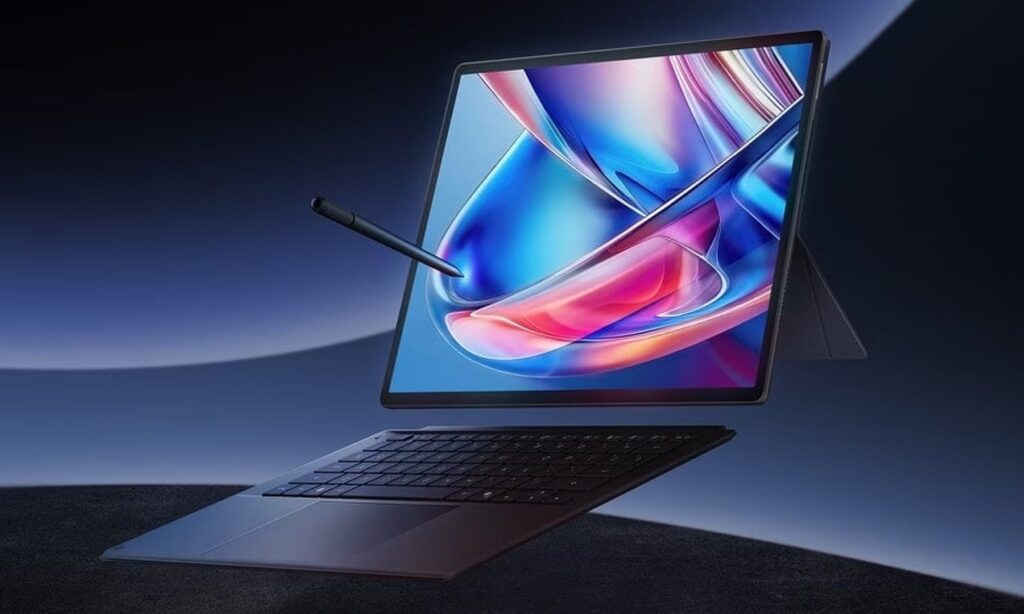
ASUS has taken a bold route with the ProArt PZ14, turning a premium tablet into a portable Windows 11 ARM workstation aimed squarely at professional creators. Rather than positioning it as a device for casual entertainment, ASUS has built it for users who need a flexible tool for serious work on the move.
That positioning matters because the ProArt PZ14 tries to combine tablet mobility, laptop-like convenience, and professional-grade output in one thin body. Designers, video editors, and photographers are the clear targets, and the hardware choices show that ASUS wants this device to fit demanding creative workflows.
Built for work, not just portability
The ProArt PZ14 uses a detachable design that has been refined for practical use. Its included keyboard now supports Bluetooth connectivity, so typing remains possible even when the keyboard is removed from the tablet.
ASUS also gives the device military-grade durability certification and an IP52 rating. Together, those protections make it more prepared for dust and light water splashes, while the magnetic stand on the back helps the tablet stay stable in both landscape and portrait modes.
A display aimed at creative precision
One of the strongest parts of the ProArt PZ14 is its screen. ASUS uses a Lumina Pro OLED touchscreen with 10-bit color depth, 3K resolution, and a 144Hz refresh rate.
For visual creators, that combination is especially relevant because color accuracy and smooth motion both play an important role in editing and review work. The panel is designed to provide more room for detailed illustration, content editing, and careful visual checks.
Input tools and file access that suit creators
ASUS pairs the tablet with the ASUS Pen 3.0, which supports Microsoft Pen Protocol 2.6. The stylus also includes advanced haptic feedback and a small speaker inside its body.
When used, the pen can produce friction-like sounds that imitate the feel of a pencil, marker, or felt-tip pen depending on the virtual tool selected. Charging is also handled conveniently, since the stylus can attach magnetically to the back of the tablet.
For photographers and videographers, the ProArt PZ14 includes a Full-Size SD Card slot with transfer speeds of up to 985 MB/s. ASUS hides the slot behind a dedicated cover, allowing camera memory cards to move directly into the tablet without a dongle.
Connectivity and performance for heavier workloads
The device also offers two USB 4 Type-C ports with 40 Gbps bandwidth. Both support 100W fast charging, which helps keep the tablet practical for users who need quick transfers and frequent movement between work locations.
Inside, ASUS equips the ProArt PZ14 with the highest version of Snapdragon X Elite and RAM running at 9500 MHz. That hardware pushes the tablet into a performance range that is uncommon for this form factor.
Cinebench R24 multi-core testing reflects that ambition. The ProArt PZ14 recorded 755 points in Whisper Mode, 1,030 points in Standard Mode, 1,159 points in Performance Mode, and 1,183 points in Manual Mode.
That top score is said to surpass the AMD Ryzen 5800X and also edge past the Apple MacBook Pro powered by the M5 chip, which posted 1,153 points. The iPad Pro M5 is also mentioned in the same comparison, placing the ASUS tablet in unusually competitive territory for a detachable Windows device.
Extra software support and a few trade-offs
ASUS includes GlideX, letting the ProArt PZ14 work as a wireless secondary display for either a PC or a Mac. That gives users extra workspace without carrying an external monitor.
The package also comes with three months of Adobe Creative Cloud, six months of GoPro Premium Plus, and three months of GoodNotes Essential. Even so, there is one small ergonomic note: the volume rocker sits on the bottom edge when the tablet is used in portrait mode, which means it can sometimes press against a desk surface.
With its 3K OLED panel, haptic stylus, full-size SD support, and aggressive Snapdragon X Elite performance, the ProArt PZ14 is clearly aimed at professionals who want more than a standard tablet. ASUS has placed it in a segment where creative demands are high and the competition includes both MacBook and iPad Pro class devices.