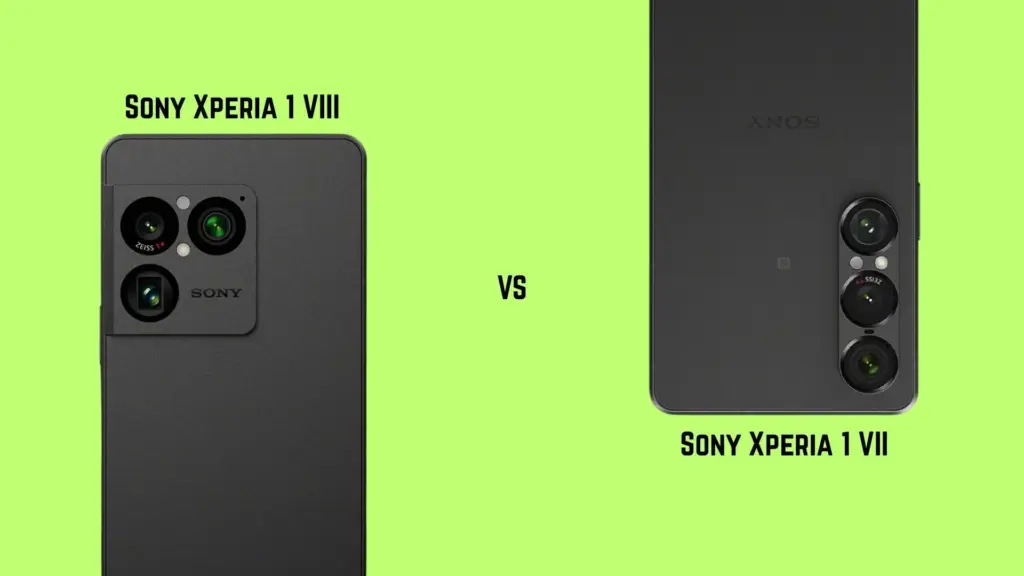
Sony’s Xperia 1 lineup has taken a notable step forward with the Xperia 1 VIII, but the upgrade story is not as straightforward as it first looks. For Xperia 1 VII owners, the new model feels more like a targeted refinement than a total reinvention.
The most meaningful changes are concentrated in the camera system and sustained performance. That makes the Xperia 1 VIII especially interesting for users who care about zoom quality, low-light shooting, and heavier gaming sessions, while leaving many everyday Xperia 1 VII owners with little urgent reason to switch.
A bigger leap in telephoto capability
Sony moved in a different direction for the Xperia 1 VIII’s rear camera setup. Instead of the variable telephoto design used on the Xperia 1 VII, the new phone uses a 48 MP periscope telephoto camera with a much larger 1/1.56-inch sensor.
That change matters because the Xperia 1 VII’s telephoto lens was one of its most unusual features. It offered a physical continuous optical zoom range from 3.5x to 7.1x, or 85 mm to 170 mm, which gave enthusiasts more manual control.
The trade-off was the smaller 1/3.5-inch telephoto sensor. Sony’s newer approach prioritizes cleaner and more stable zoom shots, especially in lower light, and it is designed to be easier for general users to handle.
Sony also pairs the Xperia 1 VIII’s camera system with RAW multi-frame processing and an AI Camera Assistant. Those additions can suggest the right lens, tone, and depth effect based on the scene.
Performance improves, but the older phone remains fast enough
Under the hood, the Xperia 1 VIII runs on the Snapdragon 8 Elite Gen 5 with Adreno 840 graphics. The Xperia 1 VII uses the Snapdragon 8 Elite with Adreno 830, so the newer model has the edge on paper.
Memory options also widen on the Xperia 1 VIII, which comes with 12 GB or 16 GB of RAM and storage choices of 256 GB, 512 GB, or 1 TB. Nanoreview figures cited for the device place its AnTuTu score at about 3,842,882, around 14 percent ahead of the Xperia 1 VII’s 2,994,112.
Geekbench results for the Xperia 1 VIII are also stronger, at around 3,522 in single-core and 9,923 in multi-core testing. In practice, the advantage is most useful in demanding games and longer workloads.
Sony says the newer model is also better at holding frame rates, helped by an improved vapor chamber and a GPU architecture designed to reduce throttling. Even so, the Xperia 1 VII still has enough speed for multitasking, streaming, and normal day-to-day use.
The display stays familiar
The screen story is mostly one of continuity. Both phones use a 6.5-inch LTPO AMOLED panel with a 120Hz refresh rate and a 1080 x 2340 resolution.
Sony’s familiar emphasis on color accuracy remains in place, which keeps both devices relevant for media viewing and creator-focused use. The Xperia 1 VIII does reach a slightly higher peak brightness of 1,510 nits in automatic mode, compared with 1,475 nits on the Xperia 1 VII.
Small changes to the body, bigger gains in protection
The Xperia 1 VII is slightly lighter and thinner, at 197 grams and 8.2 mm. The Xperia 1 VIII comes in at 200 grams and 8.3 mm, largely because of its upgraded internal camera module.
Both phones still use premium materials, including Gorilla Glass Victus 2 on the front, textured glass on the back, and an aluminum frame with a tactile finish. Sony also keeps the design language consistent across the two generations.
Protection is one area where the newer model stands out. The Xperia 1 VIII carries IP68 and IP69 certification, while the Xperia 1 VII is rated IP65 and IP68.
Battery life is more about efficiency than capacity
Both phones have a 5,000 mAh battery, and both support 30W wired charging, 15W wireless charging, and reverse wireless charging. That means charging speed and battery size are unchanged between generations.
The difference comes from efficiency. Sony says the Xperia 1 VIII should deliver better endurance thanks to a more efficient chipset, a more optimized LTPO panel, and improved cooling structure.
The result is not just better stability under load, but also better thermal control during charging and intensive use. Both devices now run Android 16, so the upgrade case is centered on hardware advantages rather than a software version gap.
For Xperia 1 VII owners, the decision depends on what matters most in daily use. The Xperia 1 VIII is the stronger choice for zoom photography, steadier gaming, and AI-assisted shooting, but the older phone still holds up well for people who mainly use their device for media, casual photography, and routine tasks.