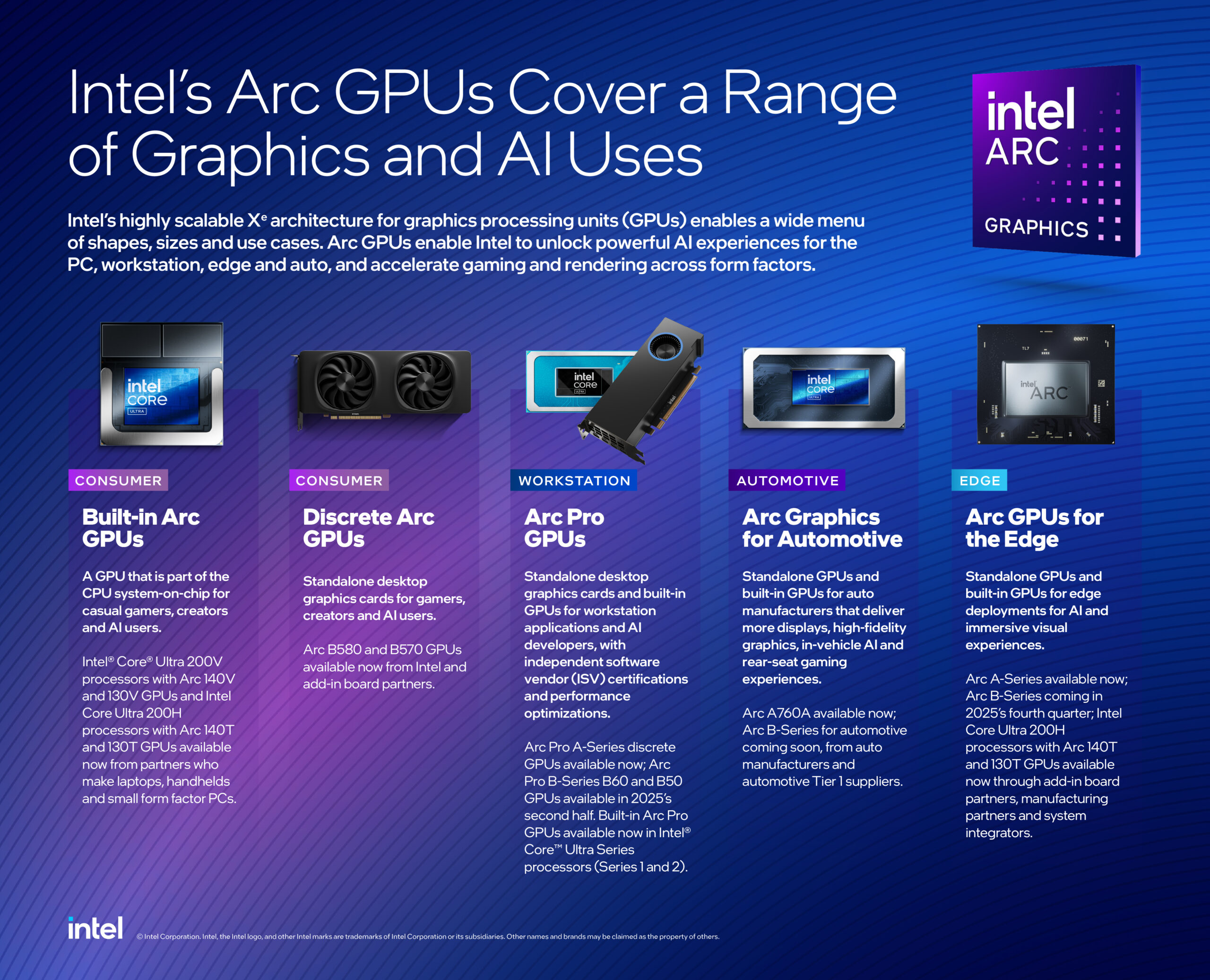
Intel is still making a point of keeping Arc in its PC strategy, but the company has not offered a clear answer about the future of a discrete desktop GPU lineup. That gap is now shaping the discussion around Intel’s graphics roadmap, especially as the company says more about integrated graphics than about a new standalone desktop card.
Alex Katouzian, Intel’s Executive Vice President and General Manager of Client Computing, described GPU as a very important part of the company’s PC portfolio. In a Q&A with Tweakers.net in Taiwan, he also said that gaming on both mobile and PC generates substantial revenue, and that Intel wants to play a significant role in that market.
Katouzian added that Intel’s core GPU traction is currently very strong. He said game developers and game engine creators are already working with Intel, and that what the company has shown so far is only the beginning of what comes next.
That message matters because it reinforces that Arc is not being treated as a side project. For Intel, the brand still has a role in both mobile and desktop computing as part of the broader PC business.
The silence is on desktop dGPU plans
Even with that emphasis, Intel has not directly confirmed a new desktop discrete graphics card based on Arc. That is the main reason the market remains uncertain, since the company has been more outspoken about the value of Arc in general than about the next standalone desktop product.
Intel’s most recent discrete Arc GPU releases for PCs were the Arc B570 and B580, both based on the Battlemage architecture. Since then, there has been no new desktop launch, including the higher-end model that has long been rumored.
Names such as B770 and B780 have surfaced more than once in rumors and sightings, but neither product has officially arrived. The absence of a follow-up has led some observers to wonder whether Intel may be scaling back its ambitions in the discrete desktop GPU segment.
At the same time, Katouzian did not say Intel was ending Arc on desktop. He simply stressed how important Arc is within Intel’s PC portfolio and left the question of a future desktop dGPU unresolved.
Where Arc appears more concrete
Intel’s clearest Arc momentum is showing up in integrated graphics. The company recently announced two new processors for gaming handhelds, each carrying strong built-in graphics: Arc G3 and Arc G3 Extreme.
Both are designed to deliver better gaming performance than what AMD currently offers in the same segment. That move suggests Intel sees Arc as a key tool for improving gaming on compact, power-efficient devices.
The direction also fits a wider PC trend toward stronger integrated graphics. If iGPU performance gets close to what mainstream gamers need, it becomes more important for thin laptops, handheld systems, and compact PCs.
Arc is also already part of Intel’s client CPU roadmap. Panther Lake is set to include Arc-based Xe3 integrated graphics, which shows the brand will continue into the next generation of processors.
Reports about Nova Lake point to an even more advanced Arc-based Xe3P iGPU in the future. If that happens, Arc could become even more central to Intel’s CPU lineup.
Still, that does not answer the larger question around separate desktop graphics cards. The open issue is whether Intel will also bring Xe3P or even Xe4-based desktop GPUs to PC builders and desktop gamers.
Software support remains a key piece
Katouzian also said Intel is working with many game engine developers to optimize games for Arc GPUs. That matters because software support often decides whether a new GPU family succeeds, not just hardware specifications.
Better developer support can improve compatibility, performance, and user confidence. That is relevant across the Arc line, whether the graphics are integrated into processors or delivered through a discrete product if Intel continues that path.
For now, Intel is clearly signaling that Arc still has a place in its plans. What remains missing is a firm statement on the next generation of desktop discrete graphics, leaving the market to wait for a clearer sign of whether Arc will reassert itself on desktop or continue to lean more heavily on integrated graphics.
Source: tech.sportskeeda.com-

-
-

-