Intel is sharpening its data center strategy for the AI era by treating compute, acceleration, and networking as a single system rather than separate parts. That approach is now reflected in Xeon 6+, Crescent Island, and a refreshed Ethernet lineup aimed at workloads that depend on orchestration as much as raw speed.
The company’s message is clear: agentic AI is creating pressure that goes beyond faster processing. Intel is positioning its latest products around concurrency, large-scale data movement, and control across the stack, with the CPU still placed at the center of that operation.
Xeon 6+ becomes Intel’s main CPU statement
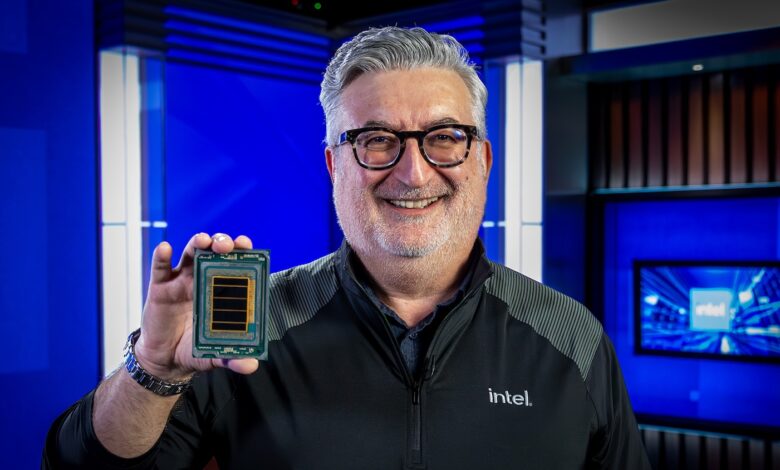
The most prominent part of the announcement is Xeon 6+, which Intel describes as the first data center CPU built on Intel 18A process technology. It is aimed at cloud-native and agentic AI workloads that need dense compute capacity.
In its highest configuration, Xeon 6+ can deliver up to 288 Efficient-cores, or E-cores. Intel says the processor offers up to 2.5 times the performance of the previous generation and 45% better per-thread-per-watt efficiency than a peer-class competitor.
Intel is also highlighting a 9:1 server consolidation ratio for Xeon 6+. That claim matters because it suggests data centers may be able to reduce footprint and operating costs as AI demand keeps rising.
CPU control still matters in Intel’s AI view
Intel is not presenting the CPU as just another component in an AI system. Kevork Kechichan, Executive Vice President and General Manager of Intel Data Center Group, said AI infrastructure needs an integrated system, with the CPU acting as the control plane.
That framing shows where Intel wants to compete in data center AI. As more AI agents and parallel workflows enter the picture, the company is emphasizing coordination and efficiency across the full infrastructure rather than relying on isolated hardware gains.
Crescent Island targets heavier AI acceleration
Alongside the CPU push, Intel also introduced its next data center GPU development, called Crescent Island. The GPU is based on the Xe 3P architecture and comes with up to 480 GB of LPDDR5x memory.
That memory capacity is intended for large-scale AI workloads with heavy token requirements. Intel also says Crescent Island uses a 350W PCIe configuration and can still be cooled with conventional air-cooling systems.
The combination of high memory capacity and manageable power draw is a key part of the appeal. It suggests Intel wants to expand its AI acceleration presence without making deployment too complex for data center operators.
Networking gets the same priority as compute
Intel also placed networking in the spotlight, which fits its broader view of AI infrastructure. The company launched the Ethernet 800 Series E835 controller and adapter, supporting throughput of up to 200 GbE with multiple configuration options.
Intel says the E835 delivers a 1.9 times better performance-per-watt ratio than Nvidia ConnectX-6 DX and 1.4 times better than Broadcom BCM957508-P2100G. Those comparisons reinforce Intel’s claim that data movement is now as important as processing power in modern AI systems.
Entry-level Xeon also gets an upgrade
The announcement was not limited to the high end of the data center market. Intel also updated its entry-level and small-business lineup with a 12-core option in the Intel Xeon 6300 family.
This move raises the ceiling beyond the previous 8-core limit in that segment. Intel says the new option is directly compatible with existing server motherboard designs, which makes upgrades easier because users do not need to rebuild the underlying system.
For small and medium-sized businesses, that kind of drop-in upgrade can lower disruption and reduce infrastructure costs. It also gives those users a path to more server performance as their needs grow.
Taken together, the new products show a more integrated Intel data center strategy. In the company’s view, AI infrastructure now depends on CPU, GPU, and networking working as one system, especially as agentic AI puts more pressure on control, concurrency, and data movement.
Source: inet.detik.com